Mexican Peso strengthens ahead of Friday’s NFP data, with US-Mexico relations in focus
- Mexican Peso rises to its highest level since last October against the US Dollar on weakening US labour data.
- Mexico is expected to file its official request for an exemption on Friday in response to increased tariffs on steel and aluminium.
- USD/MXN remains in a broader downtrend with prices vulnerable to Friday’s NFP employment data.

The Mexican Peso (MXN) is on track to extend its winning streak for a second consecutive session against the US Dollar (USD) on Thursday.
At the time of writing, USD/MXN is trading near the new yearly lows, around 19.15, as market participants shift their focus to the upcoming US Nonfarm Payrolls (NFP) report, due Friday, which could provide fresh direction for the pair.
USD/MXN continues to weaken with the US labour market in focus ahead of Friday’s NFP data
During the European session, risk appetite remained fragile, but confirmation of a productive phone call between US President Donald Trump and Chinese President Xi Jinping helped ease some market jitters, lifting overall sentiment.
For the United States, attention now turns to Friday’s release of the US Nonfarm Payrolls report, a key labor market indicator that could influence the Federal Reserve’s policy outlook. Analysts expect the US economy to have added 130,000 jobs in May, marking a slowdown from the 177,000 gain in April. The Unemployment Rate is expected to hold steady at 4.2%. Mexican Peso daily digest: USD/MXN monitors US-Mexican relations, US labour market conditions
- Weekly Initial Jobless Claims on Thursday rose to 247,000, above the expected 235,000. The report followed Wednesday’s weak ADP employment data, which showed that just 37K jobs were added to the US private sector in May.
- On Wednesday, tariffs on steel and aluminum imports to the US increased from 25% to 50%.
- Mexican President Claudia Sheinbaum labeled the tariff increase as "unjust," "unsustainable," and lacking a legal basis, asserting that it violates the United States-Mexico-Canada Agreement (USMCA)
- Mexican Economy Minister Marcelo Ebrard argued that imposing tariffs on a product where the US has a trade surplus with Mexico lacks justification.
- With Mexico expected to file for an official exemption from the higher tariffs on Friday, in a pivotal meeting with US officials, both Ebrard and President Sheinbaum have stated that Mexico will announce countermeasures against the US if no agreement is reached this week.
USD/MXN bears remain in control below 19.20
Price action on the USD/MXN daily chart continued to reinforce the broader bearish structure, as the pair posted another red candlestick, closing near the critical support zone between 19.15 and 19.20.
This decline keeps the price firmly below both the 10-day Simple Moving Average (SMA) at 19.28 and the 20-day SMA at 19.34. The 78.6% Fibonacci retracement level at 19.57, derived from the broader October–February rally, now acts as a key resistance level, further capping any recovery attempts.
The Relative Strength Index (RSI) near 38 signals bearish momentum, although the indicator has yet to reach oversold conditions, suggesting potential for further downside.
USD/MXN daily chart
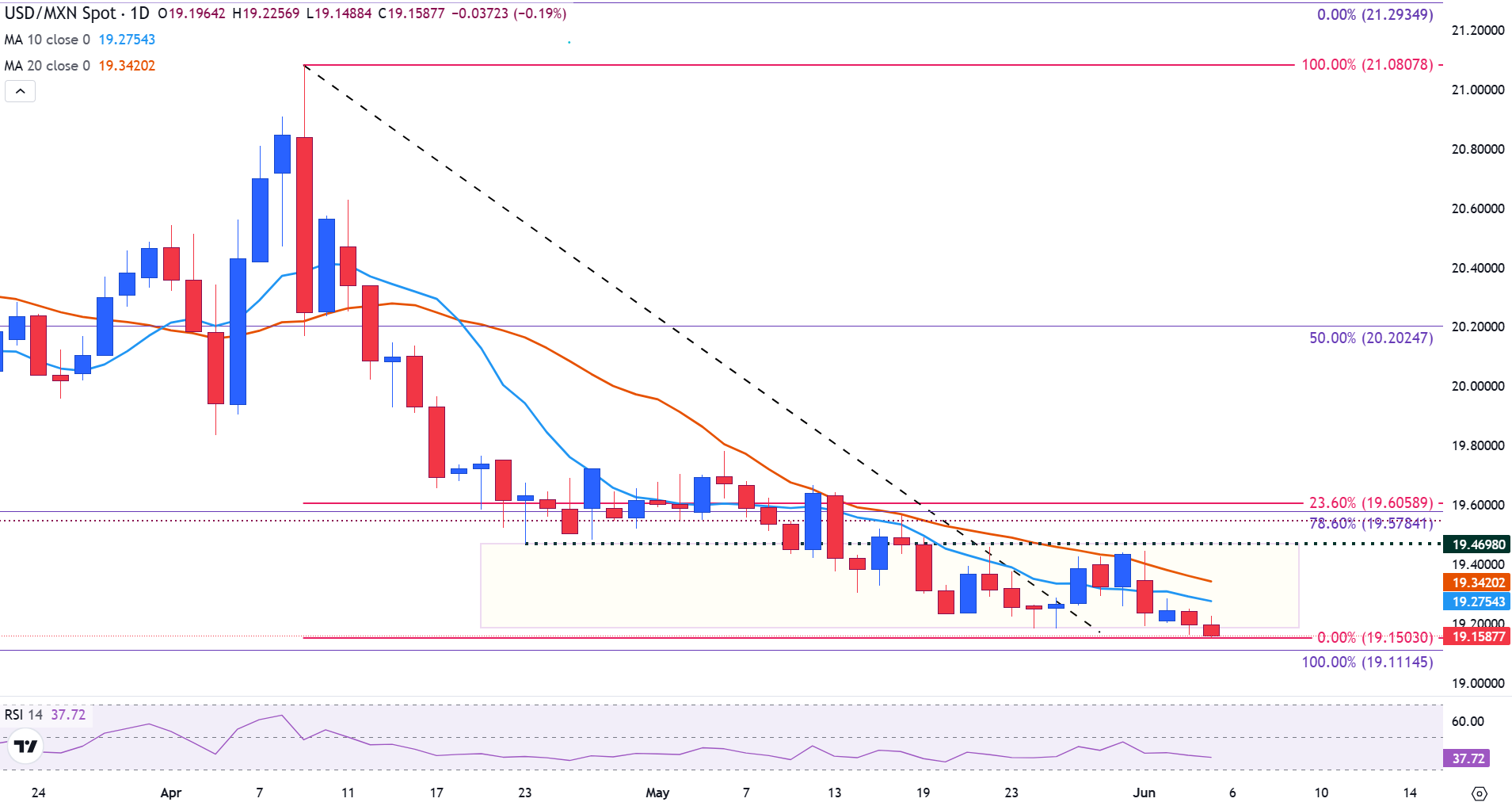
From here, the bearish scenario would involve a decisive break below the 19.15 support, potentially exposing the next downside target at the October low of 19.11. A failure to hold above this level could accelerate selling pressure. On the other hand, the bullish scenario would require a sustained recovery above 19.28 (10-day SMA) and 19.34 (20-day SMA), followed by a breakout above the 19.60 resistance, which aligns with the 23.6% retracement of the same October–February move.
Mexican Peso FAQs
The Mexican Peso (MXN) is the most traded currency among its Latin American peers. Its value is broadly determined by the performance of the Mexican economy, the country’s central bank’s policy, the amount of foreign investment in the country and even the levels of remittances sent by Mexicans who live abroad, particularly in the United States. Geopolitical trends can also move MXN: for example, the process of nearshoring – or the decision by some firms to relocate manufacturing capacity and supply chains closer to their home countries – is also seen as a catalyst for the Mexican currency as the country is considered a key manufacturing hub in the American continent. Another catalyst for MXN is Oil prices as Mexico is a key exporter of the commodity.
The main objective of Mexico’s central bank, also known as Banxico, is to maintain inflation at low and stable levels (at or close to its target of 3%, the midpoint in a tolerance band of between 2% and 4%). To this end, the bank sets an appropriate level of interest rates. When inflation is too high, Banxico will attempt to tame it by raising interest rates, making it more expensive for households and businesses to borrow money, thus cooling demand and the overall economy. Higher interest rates are generally positive for the Mexican Peso (MXN) as they lead to higher yields, making the country a more attractive place for investors. On the contrary, lower interest rates tend to weaken MXN.
Macroeconomic data releases are key to assess the state of the economy and can have an impact on the Mexican Peso (MXN) valuation. A strong Mexican economy, based on high economic growth, low unemployment and high confidence is good for MXN. Not only does it attract more foreign investment but it may encourage the Bank of Mexico (Banxico) to increase interest rates, particularly if this strength comes together with elevated inflation. However, if economic data is weak, MXN is likely to depreciate.
As an emerging-market currency, the Mexican Peso (MXN) tends to strive during risk-on periods, or when investors perceive that broader market risks are low and thus are eager to engage with investments that carry a higher risk. Conversely, MXN tends to weaken at times of market turbulence or economic uncertainty as investors tend to sell higher-risk assets and flee to the more-stable safe havens.
Author

Tammy Da Costa, CFTe®
FXStreet
Tammy is an economist and market analyst with a deep passion for financial markets, particularly commodities and geopolitics.