Mexican Peso slides as US Dollar jumps on Fed Minutes
- The Mexican Peso slides with the FOMC Minutes reiterating the Fed’s hawkish stance.
- Banxico prepares to release its May Minutes on Thursday.
- USD/MXN breaks prior psychological resistance at 19.40.

The Mexican Peso (MXN) has fallen against the US Dollar (USD) on Wednesday, following a steady climb as investors digest the latest Federal Open Market Committee (FOMC) meeting minutes.
In Wednesday’s report, the group acknowledged that policy decisions are becoming increasingly complex, with some warning of heightened recession risks.
Rather than leaning toward a rate hike or a cut, most officials felt it was best to hold rates where they are and let upcoming economic data guide the next move.
The comments largely aligned with market expectations, as officials maintained a cautious tone, emphasizing the need to assess the full impact of ongoing trade measures before making any changes to interest rates.
Attention now turns to Thursday’s high-impact data releases, including the second estimate of Q1 Preliminary Gross Domestic Product (GDP) and weekly Initial Jobless Claims. These figures will be closely watched, as they directly inform the Fed’s broader assessment of economic conditions and could impact the trajectory of future policy decisions.
Mexican Peso daily digest: USD/MXN hinges on the Greenback
- According to the CME FedWatch Tool, market participants are currently pricing in a 48.3% chance of a rate cut in September. For June and July meetings, the expectation is that the Fed will maintain its benchmark rate at the current range of 4.25%-4.50%.
- Mexico’s central Bank, Banxico, is set to release the minutes from its latest policy meeting on Thursday, following its seventh consecutive rate cut on May 15.
- Markets will closely examine the commentary for signs of a potential pause in the easing cycle, particularly as policymakers weigh external risks such as US tariff threats.
- The core PCE figures for April – the Fed's preferred inflation measure –and the final University of Michigan Consumer Sentiment figures are both scheduled for release on Friday.
- With the Fed reiterating its 'data-dependent' stance, these data points are crucial for understanding inflation and consumer sentiment, as they gauge the feelings of US citizens about the current economic situation.
- On Tuesday, the US Dollar received some support after the publication of Consumer Confidence data from The Conference Board, which showed that households’ moods improved significantly after declining for five consecutive months. The rebound was partly attributed to the US-China trade deal.
Mexican Peso technical analysis: USD/MXN clears first major technical hurdle
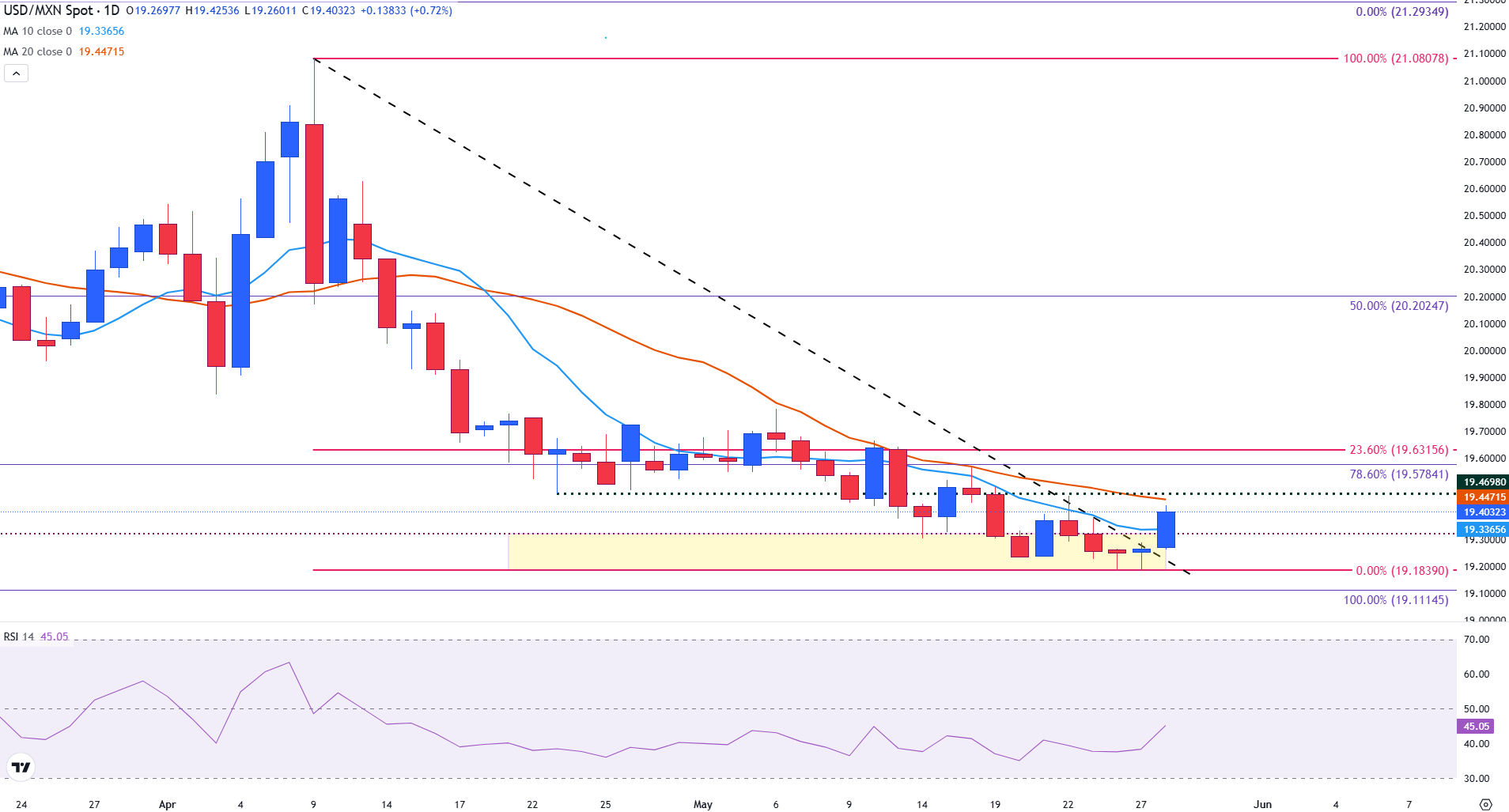
USD/MXN has broken above prior technical resistance that has been limiting the pair's upside potential over recent days.
In anticipation of Wednesday’s FOMC Minutes, the US Dollar strengthened against the Peso, allowing it to clear prior trendline resistance at 19.29 and the 10-day Simple Moving Average (SMA) near 19.34.
With these levels now coming into play as support, bulls are gearing up for a retest of the 20-day SMA at 19.45. A break of this level and of the April 19.47 low could open the door for the 78.60% Fibonacci retracement (Fib) level of the October-February move around 19.58.
USD/MXN daily chart
US Dollar FAQs
The US Dollar (USD) is the official currency of the United States of America, and the ‘de facto’ currency of a significant number of other countries where it is found in circulation alongside local notes. It is the most heavily traded currency in the world, accounting for over 88% of all global foreign exchange turnover, or an average of $6.6 trillion in transactions per day, according to data from 2022. Following the second world war, the USD took over from the British Pound as the world’s reserve currency. For most of its history, the US Dollar was backed by Gold, until the Bretton Woods Agreement in 1971 when the Gold Standard went away.
The most important single factor impacting on the value of the US Dollar is monetary policy, which is shaped by the Federal Reserve (Fed). The Fed has two mandates: to achieve price stability (control inflation) and foster full employment. Its primary tool to achieve these two goals is by adjusting interest rates. When prices are rising too quickly and inflation is above the Fed’s 2% target, the Fed will raise rates, which helps the USD value. When inflation falls below 2% or the Unemployment Rate is too high, the Fed may lower interest rates, which weighs on the Greenback.
In extreme situations, the Federal Reserve can also print more Dollars and enact quantitative easing (QE). QE is the process by which the Fed substantially increases the flow of credit in a stuck financial system. It is a non-standard policy measure used when credit has dried up because banks will not lend to each other (out of the fear of counterparty default). It is a last resort when simply lowering interest rates is unlikely to achieve the necessary result. It was the Fed’s weapon of choice to combat the credit crunch that occurred during the Great Financial Crisis in 2008. It involves the Fed printing more Dollars and using them to buy US government bonds predominantly from financial institutions. QE usually leads to a weaker US Dollar.
Quantitative tightening (QT) is the reverse process whereby the Federal Reserve stops buying bonds from financial institutions and does not reinvest the principal from the bonds it holds maturing in new purchases. It is usually positive for the US Dollar.
Author

Tammy Da Costa, CFTe®
FXStreet
Tammy is an economist and market analyst with a deep passion for financial markets, particularly commodities and geopolitics.