Mexican Peso surges as Trump spares Mexico from tariffs
- Trump exempts Mexico and Canada from sweeping new tariffs; China, EU, and others hit with duties up to 46%.
- Sheinbaum avoids retaliatory measures, while Mexico’s fiscal plan eyes narrower deficit and optimistic growth targets.
- Strong US labor data supports USD, but focus shifts to ISM Services PMI, NFP, and Powell’s remarks later this week.

The Mexican Peso (MXN) staged a comeback on Wednesday, finishing the session on a strong note with gains of 0.86%, as Mexico and Canada were exempted from US President Trump’s reciprocal tariffs. As Thursday’s Asian session begins, the USD/MXN is exchanging hands at 20.24 up some 0.33%.
Recently, the US President Donald Trump announced that the US will impose 10% tariffs on all imports and 25% duties on automobiles. These duties become effective on April 3.
Reciprocal tariffs are being applied to some countries. China’s being hit with 34% duties, the European Union with 20%, 46% to Vietnam, 24% to Japan, and 10% to the United Kingdom,
In the meantime, Mexico’s President Claudia Sheinbaum said she would not impose tit-for-tat tariffs, sparking a dip in the USD/MXN pair, which buyers bought, keeping the exotic pair within familiar levels.
Mexico’s Finance Ministry announced that it would narrow the fiscal deficit in 2026. According to Bloomberg, “Sheinbaum’s administration said it will target a budget gap of 3.2% to 3.5% of gross domestic product next year, smaller than this year’s ambitious estimate of 3.9% to 4%.”
The ministry revised its 2025 growth forecast downward to around 1.5%-2.3%, a very optimistic scenario compared to Banco de Mexico’s (Banxico) 0.6% estimate. The Organization for Economic Co-operation and Development (OECD) predicts Mexico’s GDP will contract by 1.3%.
Data in the US revealed a strong labor market, with companies hiring more people than expected by economists, surpassing the February reading. At the same time, Factory Orders expanded above forecasts but dipped compared to January’s figures.
Ahead this week, Mexico’s economic agenda will feature Gross Fixed Investment figures and Consumer Confidence data. In the US, traders are focusing on the ISM Services PMI for March, Nonfarm Payroll figures, and Fed Chair Jerome Powell's speech.
Daily digest market movers: Mexican Peso falls on uncertainty about tariffs
- Mexico’s Business Confidence deteriorated sharply in February, according to INEGI. Meanwhile, S&P Global reported that manufacturing activity contracted for the fifth consecutive month.
- Banxico’s Governor, Victoria Rodríguez Ceja, stated that the central bank will remain attentive to US trade policies and their impact on the country, with a primary focus on inflation, as she noted in an interview with El Financiero.
- In March, the ADP National Employment Report revealed that businesses added 155,000 people to the workforce, exceeding the forecast of more than 105,000 jobs and up from the 84,000 jobs created in February.
- Other data showed that Factory Orders in February exceeded estimates of 0.5% and expanded 0.6% MoM, down from 1.8% in January.
- At 20:00 GMT, Donald Trump is expected to announce the imposition of reciprocal tariffs on trading partners in the White House Rose Garden.
- JP Morgan supports an additional 50 bps cut in Mexico due to the risks of an imminent recession, according to analyst Steven Palacio. Palacio added that Mexico would be tapped into a recession spread by tariffs and “uncertainty surrounding their implementation.”
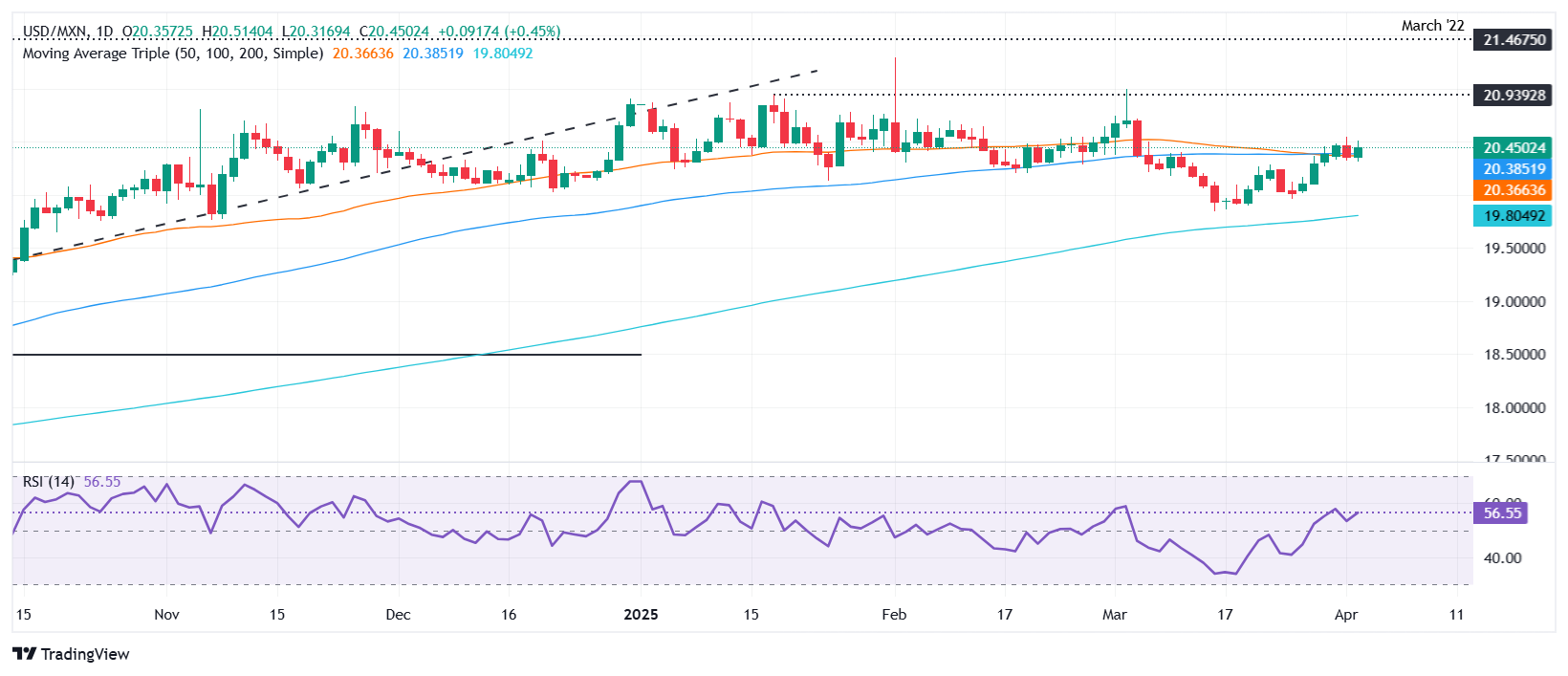
USD/MXN technical outlook: Mexican Peso treads water as USD/MXN climbs above 20.40
USD/MXN remains upwardly biased, trading near its weekly high of 20.54, yet is contained due to uncertainty about the outcome of the tariff. If duties are applied with no exemptions, the Peso could depreciate sharply. In that outcome, the pair could challenge the March 4 high at 20.99, followed by the February 3 peak of 21.28.
On the other hand, if Mexico is exempt from tariffs due to the US adhering to the USMCA free trade rules, USD/MXN could dip below the first support level, seen at the confluence of the 50- and 100-day Simple Moving Averages (SMAs) around 20.35/36, followed by the 20.00 mark. A breach of the latter will expose the 200-day SMA at 19.76.
Banxico FAQs
The Bank of Mexico, also known as Banxico, is the country’s central bank. Its mission is to preserve the value of Mexico’s currency, the Mexican Peso (MXN), and to set the monetary policy. To this end, its main objective is to maintain low and stable inflation within target levels – at or close to its target of 3%, the midpoint in a tolerance band of between 2% and 4%.
The main tool of the Banxico to guide monetary policy is by setting interest rates. When inflation is above target, the bank will attempt to tame it by raising rates, making it more expensive for households and businesses to borrow money and thus cooling the economy. Higher interest rates are generally positive for the Mexican Peso (MXN) as they lead to higher yields, making the country a more attractive place for investors. On the contrary, lower interest rates tend to weaken MXN. The rate differential with the USD, or how the Banxico is expected to set interest rates compared with the US Federal Reserve (Fed), is a key factor.
Banxico meets eight times a year, and its monetary policy is greatly influenced by decisions of the US Federal Reserve (Fed). Therefore, the central bank’s decision-making committee usually gathers a week after the Fed. In doing so, Banxico reacts and sometimes anticipates monetary policy measures set by the Federal Reserve. For example, after the Covid-19 pandemic, before the Fed raised rates, Banxico did it first in an attempt to diminish the chances of a substantial depreciation of the Mexican Peso (MXN) and to prevent capital outflows that could destabilize the country.
Author

Christian Borjon Valencia
FXStreet
Markets analyst, news editor, and trading instructor with over 14 years of experience across FX, commodities, US equity indices, and global macro markets.