Mexican Peso rises against counterparts hit by weak data
- The Mexican Peso rises in its key pairs after USD and GBP are pressured by weak inflation prints.
- Banxico will probably cut interest rates gradually, according to Capital Economics.

The Mexican Peso (MXN) is trading between a third and half of a percent higher in its key trading pairs on Wednesday, as firmer risk appetite supports emerging market FX.
Investor spirits lifted after lower US factory-gate inflation led to a rally in US stocks on Tuesday. Across the pond in the UK, inflation data on Wednesday morning revealed that prices grew less than expected. This is weighing on the Pound Sterling (GBP), with GBP/MXN down 0.50% at the time of publication.
One US Dollar (USD) buys 18.92 Mexican Pesos, EUR/MXN trades at 20.86, and GBP/MXN at 24.31.
Mexican Peso trades higher as key counterparts fall on data
The Mexican Peso trades higher in its most traded pairs on Wednesday, supported by an overall risk-on mood in financial markets. Tuesday’s US Producer Price Index (PPI) data showed factory-gate prices easing overall, solidifying expectations of the Federal Reserve (Fed) entering a new era of rate-cutting in September. With US borrowing costs expected to fall, US stock indices rallied, helping risk-sensitive emerging market FX like the Peso.
The Mexican Peso is performing particularly well against the Pound on Wednesday as GBP weakens following the release of mostly lower-than-expected UK inflation data. The data increases the probability of the Bank of England (BoE) cutting interest rates, which is negative for GBP since that will likely lower foreign capital inflows. The UK Consumer Price Index (CPI) fell 0.2% in July on month after gaining 0.1% in June. It came out at 2.2% year-over-year, undershooting expectations of 2.3% but higher than the 2.0% registered in June.
UK PPI was mixed, and the Retail Price Index was lower month-over-month (0.1% versus 0.2% previously) but higher YoY at 3.6% versus the 2.9% previously.
EUR/MXN shrugged off Eurozone data which showed the second estimate of Gross Domestic Product (GDP) data for Q2 meeting expectations, Employment Change (Q2) likewise in line with forecasts and Industrial Production undershooting expectations in June.
During the US session the US Bureau of Labor Statistics will release US CPI for July, which could impact USD/MXN and other key Peso pairs.
Banxico to adopt gradual approach to cutting interest rates – Capital Economics
The Banxico has cut its main policy interest rate twice in 2024, once by 0.25% in March and by 0.25% in August, bringing the Banxico policy rate down to 10.75%.
The August cut came as a surprise as headline inflation remained elevated at 5.57%, but according to the Banxico Governor, Victoria Rodriguez Ceja, the decision was based on the expectation that headline inflation would come down eventually. Core prices in Mexico are much lower at 4.05% in July, its eighteenth straight month of declines.
“We expect these effects of the shocks that we observe in non-core inflation to be transitory, so we are still expecting headline inflation to return to its target at the same time, at the end of 2025,” said Rodriguez Ceja in an interview with El Financiero.
Economists at Capital Economics, however, argue that inflation in Mexico will fall only gradually because of stubbornly high dwelling inflation. This is due to a combination of lack of housing stock supply and continued rising household income.
“Housing inflation has become an increasingly important driver of core services inflation in Mexico – a key concern of the central bank, Banxico. And we think that robust household income growth and a lack of supply of dwellings will keep housing and, by extension, headline inflation higher than most expect in the next couple of years. This supports our view that Banxico’s easing cycle will be very gradual and that interest rates will stay high by past standards,” says Kimberley Sperrfechter, Emerging Markets Economist at Capital Economics.
A more gradual approach to cutting interest rates would probably keep them higher in Mexico compared to counterparts. This would support the Mexican Peso, since it will favor foreign capital inflows into the currency, given it offers higher interest rate returns to investors.
Technical Analysis: USD/MXN unfolds weak correction higher
USD/MXN is broadly rising in a channel. Since the August 5 peak of 20.07 it has been unfolding a down wave within the rising channel. That down leg bottomed at 18.77 on August 9. Since then the pair has been correcting higher.
USD/MXN 4-hour Chart
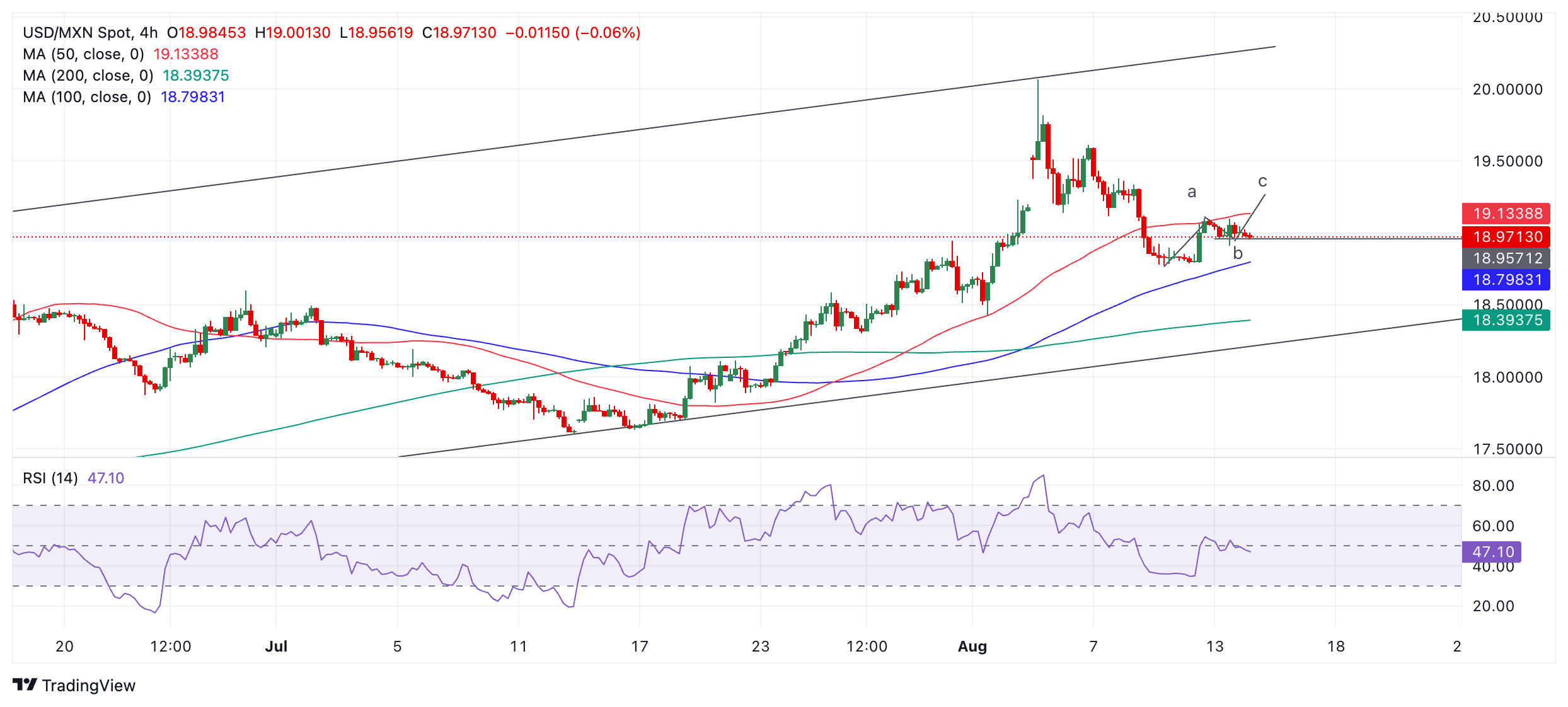
The pullback from the August 9 lows looks corrective in nature and therefore unlikely to endure. It has failed, so far, to stretch a final, third, “c” leg higher to complete an ABC correction that might have been forming. Further, the decline from the top of the channel looks unfinished.
In the event of a resumption of the down leg it will probably reach the lower channel line at around 18.30. A break back below 18.97 (lows of wave “b”) would provide added confirmation of such a resumption, as would a break below the 18.77, the swing low from August 9.
Such a break lower would probably first target 18.35 and the 200-period Simple Moving Average (SMA). In addition, the lower channel line will likely provide solid support at roughly 18.30.
Mexican Peso FAQs
The Mexican Peso (MXN) is the most traded currency among its Latin American peers. Its value is broadly determined by the performance of the Mexican economy, the country’s central bank’s policy, the amount of foreign investment in the country and even the levels of remittances sent by Mexicans who live abroad, particularly in the United States. Geopolitical trends can also move MXN: for example, the process of nearshoring – or the decision by some firms to relocate manufacturing capacity and supply chains closer to their home countries – is also seen as a catalyst for the Mexican currency as the country is considered a key manufacturing hub in the American continent. Another catalyst for MXN is Oil prices as Mexico is a key exporter of the commodity.
The main objective of Mexico’s central bank, also known as Banxico, is to maintain inflation at low and stable levels (at or close to its target of 3%, the midpoint in a tolerance band of between 2% and 4%). To this end, the bank sets an appropriate level of interest rates. When inflation is too high, Banxico will attempt to tame it by raising interest rates, making it more expensive for households and businesses to borrow money, thus cooling demand and the overall economy. Higher interest rates are generally positive for the Mexican Peso (MXN) as they lead to higher yields, making the country a more attractive place for investors. On the contrary, lower interest rates tend to weaken MXN.
Macroeconomic data releases are key to assess the state of the economy and can have an impact on the Mexican Peso (MXN) valuation. A strong Mexican economy, based on high economic growth, low unemployment and high confidence is good for MXN. Not only does it attract more foreign investment but it may encourage the Bank of Mexico (Banxico) to increase interest rates, particularly if this strength comes together with elevated inflation. However, if economic data is weak, MXN is likely to depreciate.
As an emerging-market currency, the Mexican Peso (MXN) tends to strive during risk-on periods, or when investors perceive that broader market risks are low and thus are eager to engage with investments that carry a higher risk. Conversely, MXN tends to weaken at times of market turbulence or economic uncertainty as investors tend to sell higher-risk assets and flee to the more-stable safe havens.
Author

Joaquin Monfort
FXStreet
Joaquin Monfort is a financial writer and analyst with over 10 years experience writing about financial markets and alt data. He holds a degree in Anthropology from London University and a Diploma in Technical analysis.