Mexican Peso remains sideways against US Dollar on positive mood ahead of crucial data
- Mexican Peso is stable against US Dollar as US jobs data improves, but housing paints mixed outlook.
- Drop in US unemployment claims indicates the economy remains resilient, strengthening US Dollar.
- USD/MXN traders await further Fed speakers, Mexico’s Retail Sales on Friday.

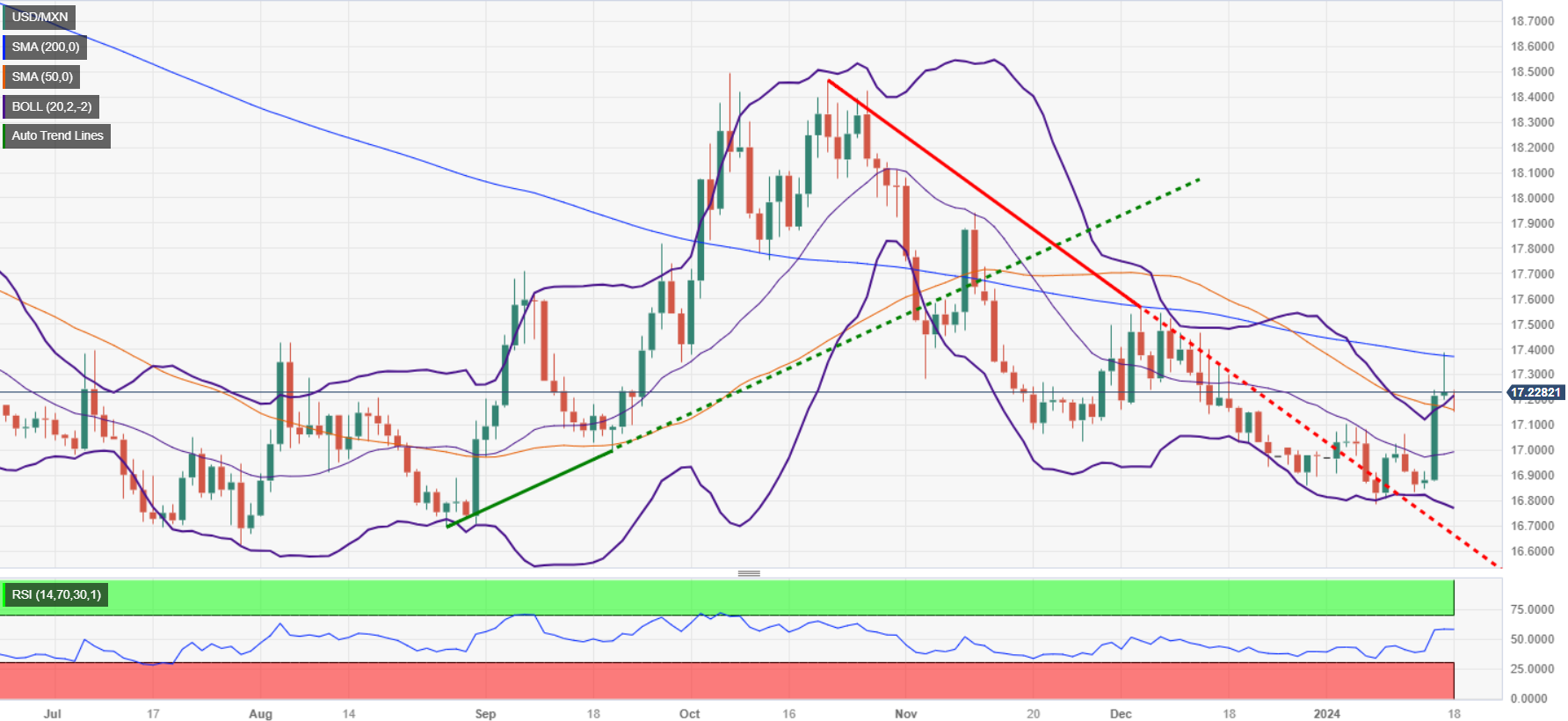
The Mexican Peso (MXN) posts minuscule gains against the US Dollar (USD) after a tranche of mixed economic data from the United States (US) and traders paring rate cut bets on the Federal Reserve (Fed), which is keeping the Greenback (USD) bid across the board. It should be said that the USD/MXN trades at 17.18 on the day after hitting a daily low of 17.15, down 0.06% and trapped within strong support and resistance levels, with the 50-day Simple Moving Average (SMA) on the bottom and the 200-day SMA on the top.
The US Bureau of Labor Statistics (BLS) revealed that unemployment claims for last week grew at a slower pace than the previous reading and expectations. The print portrays a tight labor market. Meanwhile, the US Department of Commerce (DoC) released Housing Starts and Building Permits data, which came in mixed, failing to keep the USD/MXN in positive territory. Ahead on Thursday, Atlanta Fed President Raphael Bostic’s comments will cross the newswires.
Daily digest market movers: Mexican Peso stays firm despite mixed US economic data
- The latest Initial Jobless Claims report for the week ending January 12 revealed a decrease to 187,000, lower than both the previous week's numbers and the anticipated consensus of 207,000. This suggests that the labor market remains tight.
- Regarding the labor market, the Federal Reserve's latest Beige Book, released on Wednesday, presented a more nuanced picture, reporting that “nearly all districts cited one or more signs of a cooling labor market,” indicating some emerging signs of a slowdown in employment growth across various regions.
- US housing data presented a mixed picture recently. Building Permits saw an increase of 1.9% and reached 1.495 million, compared to 1.467 million in November and surpassing the forecast of 1.48 million. On the other hand, Housing Starts experienced a decline, dropping from 1.525 million in November to 1.46 million in December, a contraction of -4.3%.
- The strongest catalyst in the week has been Federal Reserve Governor Christopher Waller’s speech: “no reason to move as quickly or cut as rapidly as in the past.” This kept investors in check despite supporting rate cuts if inflation indeed gets lowered.
- Besides that, December’s Retail Sales report and Industrial Production have fueled speculation that the US economy would likely grow by 2.4% in Q4 2023 as shown by the Atlanta GDPNow model. This spurred a reaction by fed funds rate (FFR) traders, who trimmed rate cut bets for 2024 from 175 basis points to just 150.
- The lack of data in Mexico keeps traders leaning on the latest inflation figures, which edged higher than expected in headline inflation, but core data suggests the Bank of Mexico (Banxico) has done a good job, curbing elevated prices after hiking rates toward 11.25%.
- Although December’s meeting minutes from Banxico (the Central Bank of Mexico) suggest that the central bank might contemplate easing its monetary policy, the inflation report for December could hinder any move toward policy relaxation.
- Analysts at Standard Chartered noted, “We expect the policy rate to be lowered to 9.25% by end-2024, although an official downward revision in the output gap could open the door for more aggressive rate cuts.”
- On January 5, a Reuters poll suggested the Mexican Peso could weaken 5.4% to 18.00 per US Dollar in the 12 months following December.
Technical analysis: Mexican Peso stays firm as USD/MXN meanders around 17.20
The USD/MXN daily chart remains neutral to upward biased, but failure to decisively break the 200-day SMA (Simple Moving Average) at 17.37 exacerbated a pullback below the 17.20 area. A breach of the 50-day SMA at 17.17 would pave the way to challenge the January 12 low of 16.82. Further downside is seen at the January 8 low of 16.78. Once those levels are hurdled, the next demand level would be the August 28 cycle low of 16.69, ahead of last year’s low of 16.62.
On the other hand, if buyers reclaim the 17.20 area, that could open the door to test the 200-day SMA at 17.37. Once surpassed, the next resistance emerges at the 100-day SMA at 17.41, ahead of the December 5 high at 17.56, before testing the May 23 high of 17.99.
USD/MXN Price Action – Daily Chart
Risk sentiment FAQs
What do the terms"risk-on" and "risk-off" mean when referring to sentiment in financial markets?
In the world of financial jargon the two widely used terms “risk-on” and “risk off'' refer to the level of risk that investors are willing to stomach during the period referenced. In a “risk-on” market, investors are optimistic about the future and more willing to buy risky assets. In a “risk-off” market investors start to ‘play it safe’ because they are worried about the future, and therefore buy less risky assets that are more certain of bringing a return, even if it is relatively modest.
What are the key assets to track to understand risk sentiment dynamics?
Typically, during periods of “risk-on”, stock markets will rise, most commodities – except Gold – will also gain in value, since they benefit from a positive growth outlook. The currencies of nations that are heavy commodity exporters strengthen because of increased demand, and Cryptocurrencies rise. In a “risk-off” market, Bonds go up – especially major government Bonds – Gold shines, and safe-haven currencies such as the Japanese Yen, Swiss Franc and US Dollar all benefit.
Which currencies strengthen when sentiment is "risk-on"?
The Australian Dollar (AUD), the Canadian Dollar (CAD), the New Zealand Dollar (NZD) and minor FX like the Ruble (RUB) and the South African Rand (ZAR), all tend to rise in markets that are “risk-on”. This is because the economies of these currencies are heavily reliant on commodity exports for growth, and commodities tend to rise in price during risk-on periods. This is because investors foresee greater demand for raw materials in the future due to heightened economic activity.
Which currencies strengthen when sentiment is "risk-off"?
The major currencies that tend to rise during periods of “risk-off” are the US Dollar (USD), the Japanese Yen (JPY) and the Swiss Franc (CHF). The US Dollar, because it is the world’s reserve currency, and because in times of crisis investors buy US government debt, which is seen as safe because the largest economy in the world is unlikely to default. The Yen, from increased demand for Japanese government bonds, because a high proportion are held by domestic investors who are unlikely to dump them – even in a crisis. The Swiss Franc, because strict Swiss banking laws offer investors enhanced capital protection.
Author

Christian Borjon Valencia
FXStreet
Markets analyst, news editor, and trading instructor with over 14 years of experience across FX, commodities, US equity indices, and global macro markets.