Mexican Peso recovers vs. USD before “coin toss” US election
- The Mexican Peso pushes higher against the US Dollar on Monday as predictions of a Trump victory in the presidential election give way to doubt.
- Where could the Peso end up after the election? Four scenarios for the Mexican currency.
- USD/MXN peaked at a new year-to-date high of 20.29 on Friday and then opened a gap down on Monday.

The Mexican Peso (MXN) trades higher in its key pairs on Monday. The Peso is rising against the US Dollar (USD) as the “Trump trade” – which has proven positive for the Greenback – fades due to increased doubts about the outcome of the US presidential election.
The USD is further under pressure as concerns mount that post-election market volatility might encourage the Federal Reserve (Fed) to slash interest rates by another 50 basis points (bps) (0.50%) at its November meeting on Thursday to act as a “tranquilizer”.
Against the Euro (EUR) MXN is edging higher as the shared currency gains mild support from recent solid Eurozone Unemployment and IFO survey data. Versus the Pound Sterling (GBP), the Peso seesaws between tepid gains and losses as Sterling attempts to reboot after the dust settles after the Autumn government’s budget sell-off.
Mexican Peso rises against USD as election remains a “coin toss”
The Mexican Peso trades higher against the US Dollar as the US presidential election proves too close to call, and traders unwind bets from a few days ago when the odds favored former President Donald Trump winning the race.
According to election guru Nate Silver, the election outcome is going to be “a pure coin toss-up,” and his website FiveThirtyEight gives Trump a 53% probability of winning, Vice President Kamala Harris a 46% chance, and a 1% probability of no outright winner.
Four US presidential election scenarios for the Peso
The number of Mexican Pesos that can be bought with one US Dollar could fluctuate between a low of 18.30 and a high of 22.26 depending on the outcome of the US presidential election, according to Mexican financial daily El Financiero.
The financial news site posits four possible US presidential election scenarios for the USD/MXN pair (graphic below).
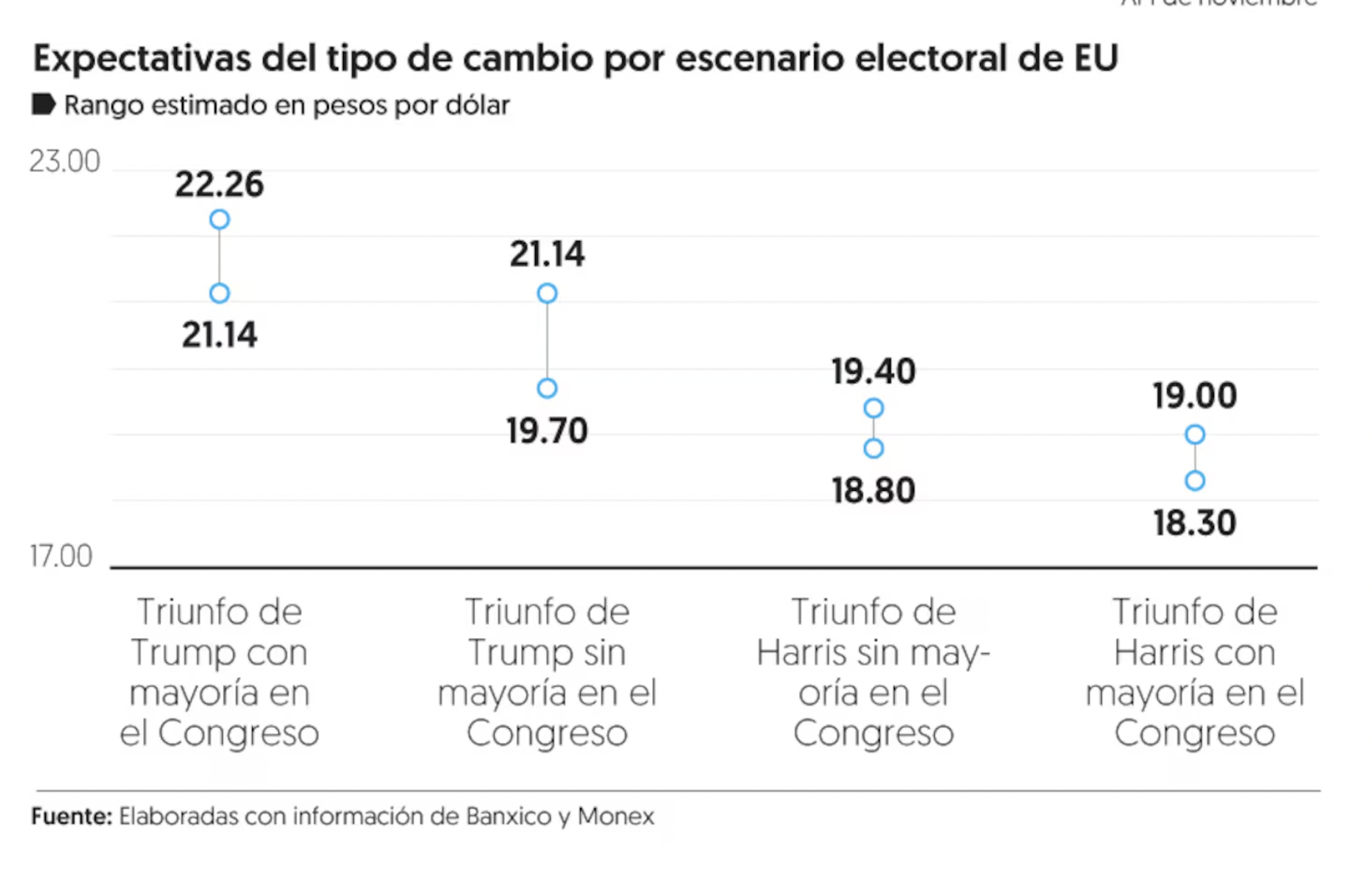
In the case of Harris winning the presidency and the Democrats securing a majority in Congress, the Peso is likely to strengthen to between 18.30 and 19.00 against the USD.
In the worst-case scenario of a Trump victory and a Republican majority in Congress, the Peso is likely to fall to between 21.14 and 22.26 to the US Dollar.
If Kamala Harris wins the presidency without a Democrat majority in Congress, USD/MXN is likely to fluctuate between 19.40 and 18.80.
A win for Trump without a Republican majority in Congress, however, could see the pair in a range between 21.14 and 19.70.
Mexican data upbeat
The Mexican Peso is underpinned by relatively positive recent macroeconomic data.
Mexican Business Confidence improved to 52.3 in October, and the S&P Global Mexican Manufacturing PMI rose to 48.4 in October from 47.3 in the previous month, albeit remaining in contraction territory below 50. The survey showed orders remained low due to fierce competition from China, although it highlighted lower cost pressures, which might feed through into lower inflation.
The Mexican Unemployment rate stood at a relatively low 2.9% in September, unchanged from the corresponding period in the previous year.
As measured by the Gross Domestic Product (GDP) growth rate, the third-quarter economic growth for Mexico came out at 1.0% quarter-on-quarter, accelerating from 0.2% in Q2, and annualized GDP growth rose by 1.5%.
Banxico expected to cut by 0.25%
Expectations are generally still high for the Banco de Mexico (Banxico) to cut interest rates by 25 bps (0.25%) to 10.25% at their meeting on November 14. This is likely to put pressure on the Mexican Peso as lower interest rates attract less foreign capital inflows.
According to Kimberley Sperrfechter, Emerging Markets Economist at Capital Economics, Mexico’s surprise GDP growth in Q3 does not “preclude another rate cut in November” by Banxico.
A rate cut will depend on the path of inflation, and core inflation is likely to remain low, according to Klaus Baader, Global Chief Economist, Societe Generale.
“In Mexico, the sluggish core disinflation continues amid a weakening economy, and despite significant Peso depreciation,” says Baader in a recent note.
A further driver of the Peso is remittances from Mexican migrants working abroad, sending money home. These fell by 4.6% in September to $5.36 billion compared to $5.62 billion recorded in the same month last year, according to Banxico.
Technical Analysis: USD/MXN gaps down at open after peaking on Friday
USD/MXN gaps down (orange shaded rectangle on the chart below) to trade in the 20.11s at the open on Monday, after peaking at 20.29 on Friday.
The pair appears to have completed a bullish Measured Move, or “abc” pattern (see chart), which began at the October 14 swing low.
USD/MXN 4-hour Chart
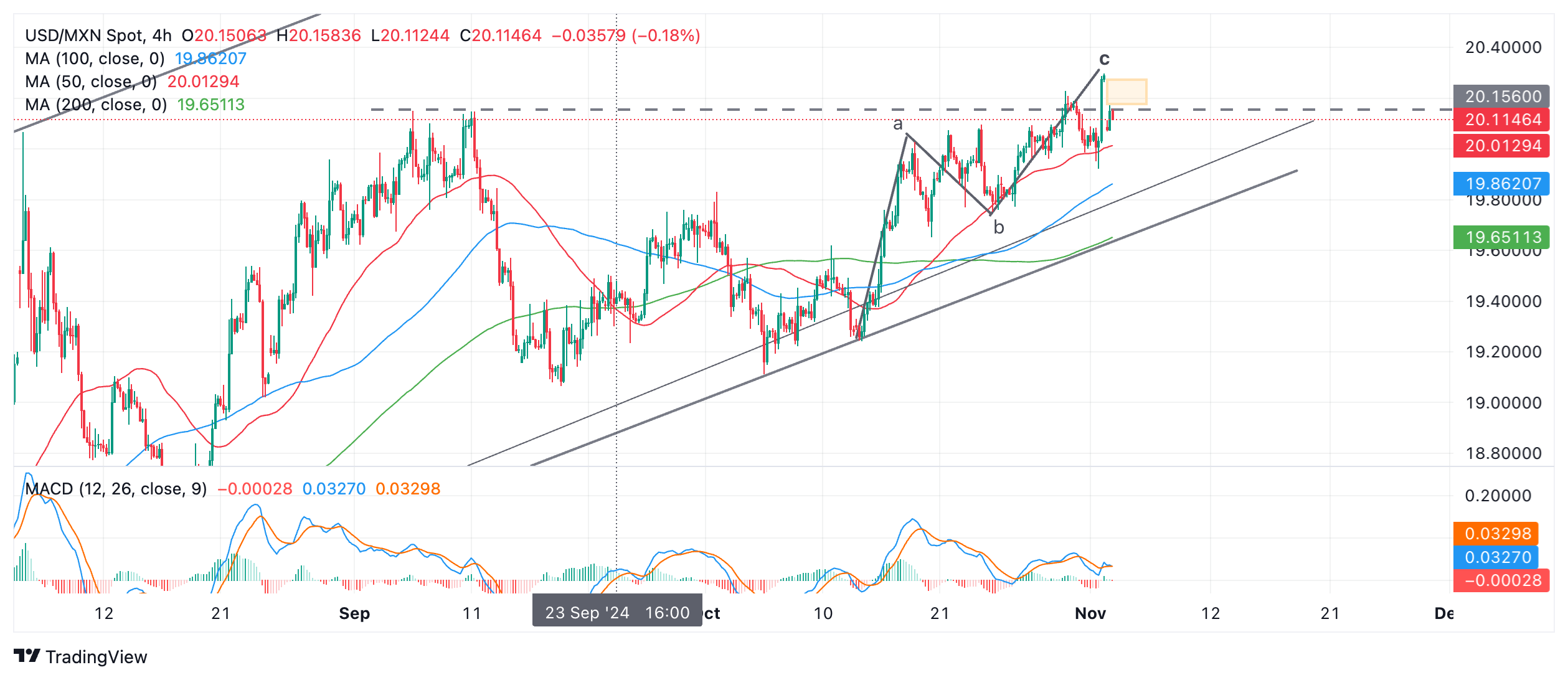
Despite the gap down, USD/MXN is still probably in an uptrend on a short, medium and long-term basis. Further, it is trading in a bullish rising channel. Given the technical dictum “the trend is your friend,” the odds favor a continuation higher.
In addition, according to technical analysis theory, gaps do not tend to remain open for long, suggesting the gap that opened on Monday could soon be filled by rising prices.
That said, momentum, as measured by the Moving Average Convergence Divergence (MACD), remains low by recent standards and indicates a lack of bullish enthusiasm underpinned Friday’s rally to new highs.
Banxico FAQs
The Bank of Mexico, also known as Banxico, is the country’s central bank. Its mission is to preserve the value of Mexico’s currency, the Mexican Peso (MXN), and to set the monetary policy. To this end, its main objective is to maintain low and stable inflation within target levels – at or close to its target of 3%, the midpoint in a tolerance band of between 2% and 4%.
The main tool of the Banxico to guide monetary policy is by setting interest rates. When inflation is above target, the bank will attempt to tame it by raising rates, making it more expensive for households and businesses to borrow money and thus cooling the economy. Higher interest rates are generally positive for the Mexican Peso (MXN) as they lead to higher yields, making the country a more attractive place for investors. On the contrary, lower interest rates tend to weaken MXN. The rate differential with the USD, or how the Banxico is expected to set interest rates compared with the US Federal Reserve (Fed), is a key factor.
Banxico meets eight times a year, and its monetary policy is greatly influenced by decisions of the US Federal Reserve (Fed). Therefore, the central bank’s decision-making committee usually gathers a week after the Fed. In doing so, Banxico reacts and sometimes anticipates monetary policy measures set by the Federal Reserve. For example, after the Covid-19 pandemic, before the Fed raised rates, Banxico did it first in an attempt to diminish the chances of a substantial depreciation of the Mexican Peso (MXN) and to prevent capital outflows that could destabilize the country.
Author

Joaquin Monfort
FXStreet
Joaquin Monfort is a financial writer and analyst with over 10 years experience writing about financial markets and alt data. He holds a degree in Anthropology from London University and a Diploma in Technical analysis.