Mexican Peso gains as analysts revise 2024 economic growth forecasts downward
- Mexican Peso peaks at 16.90 versus USD, closes slightly lower at 16.97.
- Banxico poll: 2024 inflation forecast up to 4.20% from 4.10%; minor future adjustments expected.
- Mexico's 2024 GDP growth projection cut to 2.25% from 2.40%.
- Fed holds rates steady amid disinflation; Powell stresses cautious, data-driven rate decisions.
- Peso strengthens despite lower business confidence, buoyed by expected ongoing Banxico support.

The Mexican Peso rose for the second straight day on Thursday against the US Dollar, yet despite hitting a new weekly high of 16.90, lost some ground towards the end of the trading session. Market participants had begun to price in a rate cut by the US Federal Reserve following its decision to keep rates unchanged. The USD/MXN trades at 16.97, down by 0.07%.
A poll revealed by the Bank of Mexico (Banxico) showed that private analysts estimate that headline inflation will end at 4.20% in 2024, up from the March estimate of 4.10%. For the next year, economists estimate inflation to edge from 3.70% to 3.71%. Underlying inflation is foreseen to drop from 4.15% to 4.10% toward the end of the year, while for 2025, it will remain unchanged at 3.72%.
Further projections estimate the economy would finish at 2.25%, down from March forecasts of 2.40%, while for the next year, economic growth is expected at 1.8%. In regard to the USD/MXN exchange rate, analysts downward revised the spot from 18.10 to 17.89, while most analysts expect Banxico’s main reference rates to end at 10.00% in the present year.
Mexico’s economic docket revealed that April’s Business Confidence deteriorated. However, the Mexican currency remained strong against the US Dollar, following the Fed’s decision to keep rates unchanged due to the “lack of progress” on the disinflation process.
Fed Chair Jerome Powell added that it wouldn’t be appropriate to ease policy until they gather confidence that inflation is trending toward the 2% goal. He added they – the Fed – would remain data dependent and that the upcoming monetary policy decision would be decided “meeting by meeting.”
Powell said the Fed’s belief that monetary policy is sufficiently restrictive to curb inflation and disregarded the potential of hiking rates when he asked.
Daily digest market movers: Mexican Peso shrugs off Fed’s decision, mixed US data
- Mexico’s Business Confidence deteriorated from 54.4 to 54.2. The report showed that businesses remain confident in the current economic conditions in Mexico. Further data in the report added that businesses' current economic conditions had worsened.
- Although most analysts estimate Banxico will keep rates unchanged at 11.00%, new data could prompt heated discussions among Banxico’s Governing Council members on May 9.
- Last week, Banxico Governor Victoria Rodriguez Ceja said the central bank would be data dependent. However, weak GDP data could lead to a “live meeting” on May 9.
- Citibanamex Survey showed that most analysts expect Banxico to hold rates unchanged at the May meeting. The median foresees a rate cut in June, while they estimate the main reference rate to end the year at 10.00%, up from 9.63% previously.
- The US Trade Balance showed the deficit narrowed by -0.1%, from $-69.5 billion to $-69.4 billion, missing estimates of $-69.1 billion. Imports dived -1.6% to $327 billion, while exports contracted -2.0% to $257.6 billion.
- The US Bureau of Labor Statistics (BLS) revealed that US Initial Jobless Claims for the week ending April 27 rose by 208K, unchanged from the previous reading and lower than the 212K projected by the consensus.
- On Wednesday, the Fed decided to keep the federal funds rate unchanged at 5.25%-5.50 %. They acknowledged that risks to achieving the Fed’s dual mandate on employment and inflation “moved toward better balance over the past year.” Although they said there’s progress on inflation, recent data showed that it has stalled.
- Fed policymakers added that they would begin reducing their balance sheet holdings of US Treasury securities from $60 billion to $25 billion starting in June.
- Data from the Chicago Board of Trade (CBOT) suggests that traders expect the fed funds rate to finish 2024 at 5.045%, down from 5.100% on Wednesday.
USD/MXN technical analysis: Mexican Peso regains control as USD/MXN sellers eye 100-day SMA
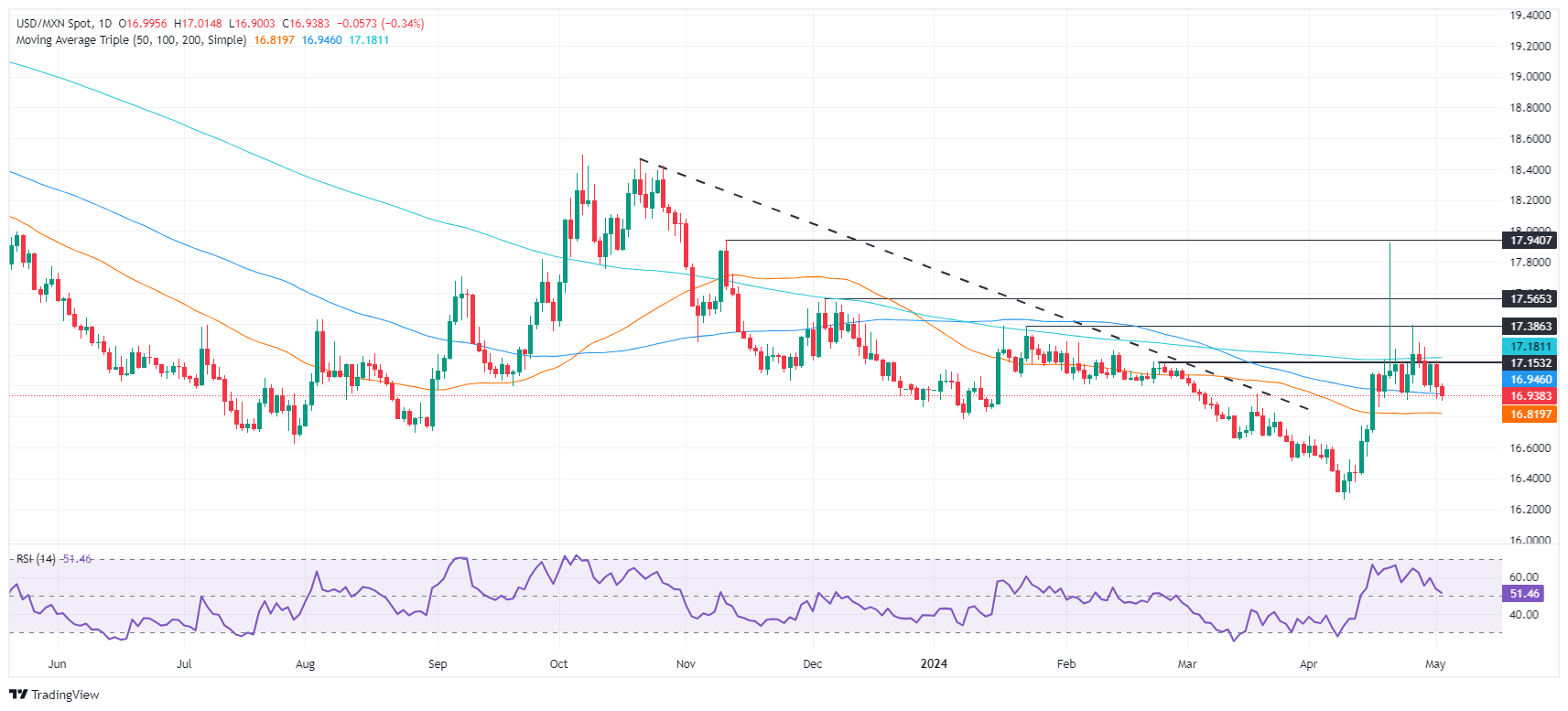
The Mexican Peso remains strong after the USD/MXN dipped beneath the crucial 17.00 psychological level, exacerbating the Peso’s appreciation toward 16.90. However, key support levels remain on their way, to challenge lower levels last seen in 2015. Additionally, the Relative Strength Index (RSI) suggests that bulls are looming with the indicator standing in bullish territory despite trending to its 50 neutral level.
For a bearish continuation, USD/MXN sellers must crack the 100-day Simple Moving Average (SMA) at 16.94, followed by the 50-day SMA at 16.81, before challenging last year’s low of 16.62. On the other hand, buyers need to reclaim the 17.00 figure before they can test the 200-day SMA, followed by the weekly high of 17.24. The next key resistance levels would be the January 23 swing high of 17.38 and the year-to-date (YTD) high of 17.92, ahead of 18.00.
Mexican Peso FAQs
The Mexican Peso (MXN) is the most traded currency among its Latin American peers. Its value is broadly determined by the performance of the Mexican economy, the country’s central bank’s policy, the amount of foreign investment in the country and even the levels of remittances sent by Mexicans who live abroad, particularly in the United States. Geopolitical trends can also move MXN: for example, the process of nearshoring – or the decision by some firms to relocate manufacturing capacity and supply chains closer to their home countries – is also seen as a catalyst for the Mexican currency as the country is considered a key manufacturing hub in the American continent. Another catalyst for MXN is Oil prices as Mexico is a key exporter of the commodity.
The main objective of Mexico’s central bank, also known as Banxico, is to maintain inflation at low and stable levels (at or close to its target of 3%, the midpoint in a tolerance band of between 2% and 4%). To this end, the bank sets an appropriate level of interest rates. When inflation is too high, Banxico will attempt to tame it by raising interest rates, making it more expensive for households and businesses to borrow money, thus cooling demand and the overall economy. Higher interest rates are generally positive for the Mexican Peso (MXN) as they lead to higher yields, making the country a more attractive place for investors. On the contrary, lower interest rates tend to weaken MXN.
Macroeconomic data releases are key to assess the state of the economy and can have an impact on the Mexican Peso (MXN) valuation. A strong Mexican economy, based on high economic growth, low unemployment and high confidence is good for MXN. Not only does it attract more foreign investment but it may encourage the Bank of Mexico (Banxico) to increase interest rates, particularly if this strength comes together with elevated inflation. However, if economic data is weak, MXN is likely to depreciate.
As an emerging-market currency, the Mexican Peso (MXN) tends to strive during risk-on periods, or when investors perceive that broader market risks are low and thus are eager to engage with investments that carry a higher risk. Conversely, MXN tends to weaken at times of market turbulence or economic uncertainty as investors tend to sell higher-risk assets and flee to the more-stable safe havens.
Author

Christian Borjon Valencia
FXStreet
Markets analyst, news editor, and trading instructor with over 14 years of experience across FX, commodities, US equity indices, and global macro markets.

















