Mexican Peso prints back-to-back positive weeks against US Dollar, stays below 17.00

Most recent article: Mexican Peso weakens against US Dollar on risk aversion despite Fed rate cut speculation
- Mexican Peso advances due to investors expecting substantial US rate cuts, a headwind for the US Dollar.
- Mexico's higher-than-expected inflation and industrial production slump puts Banxico at a crossroads.
- USD/MXN retreats below 16.85 with traders eyeing a new multi-year low below 16.62.
The Mexican Peso (MXN) wraps up Friday’s session with gains of 0.29% against the Greenback (USD) and posted back-to-back positive weeks so far in the year. Investors seem confident that the US Federal Reserve (Fed) would embark in an aggressive easing cycle, as reflected by data from the Chicago Board of Trade (CBOT), with investors expecting 175 basis points of rate cuts. Therefore, the US Dollar (USD) would continue to remain on the defensive, boosting the emerging market currency. The USD/MXN trades at 17.86, down 0.26%.
Mexico’s economic docket remains scarce, though the current week revealed that inflation was higher than expected in December, which could deter the Bank of Mexico (Banxico) from easing monetary policy in the first quarter. Nevertheless, higher interest rates are beginning to impact the country's industry as Industrial Production plunged, hurting growth prospects for 2024.
In regard to that, Mexican President Andres Manual Lopez Obrador entered the arena of economic projections, projecting that the economy would grow by 3.5%, exceeding the World Bank forecast of 2.6%.
Across the border, the US Department of Labor announced that prices paid by producers slipped in December, which triggered a repricing for additional rate cuts by the US central bank, consequently weakening the Greenback.
Daily digest market movers: Mexican Peso climbs on investor expectation of a dovish Fed
- The Producer Price Index (PPI) fell short of expectations, with the monthly PPI decreasing by -0.1%, which is below the forecasted 0.1%. In a YoY comparison, the PPI experienced a rise of 1%, which is also below the anticipated 1.9%. The core PPI remained unchanged at 0% compared to November's data, falling below estimates. Additionally, the YoY core PPI figures declined from the previous reading of 2% to 1.8%, also falling short of projections.
- Given the fact that Industrial Production plunged in Mexico, the scenario of the country is becoming uncertain, which could weigh on the Mexican Peso.
- On Wednesday, the World Bank revised its economic projections for Mexico in 2024. The updated forecast anticipates that Mexico's Gross Domestic Product (GDP) will grow by 2.6%, an increase from the bank’s initial prediction of 1.9%. Analysts at the bank attribute this expected growth to the rise in near-shoring activities, which they believe will positively impact the Mexican economy.
- Although the recent meeting minutes from Banxico (the Central Bank of Mexico) suggest that the central bank might contemplate easing its monetary policy, the inflation report for December could hinder any move toward policy relaxation.
- On Tuesday, Mexico's Consumer Price Index (CPI) recorded a YoY increase of 4.66% in December, surpassing the expected 4.55%. This is a significant jump from November's figure of 4.32%.
- Core inflation figures, which exclude volatile items like food and energy, showed a YoY increase of 5.09%, which was slightly lower than the consensus and the previous month's figures of 5.15% and 5.30%, respectively.
- On January 5, a Reuters poll suggested the Mexican Peso could weaken 5.4% to 18.00 per US Dollar in the 12 months following December.
- On Thursday, Fed policymakers reiterated that cutting rates in March is too soon, while adding that even though progress on inflation had been achieved, December’s data bucked the trend.
Technical analysis: Mexican Peso counterattacks as USD/MXN tumbles below 16.90
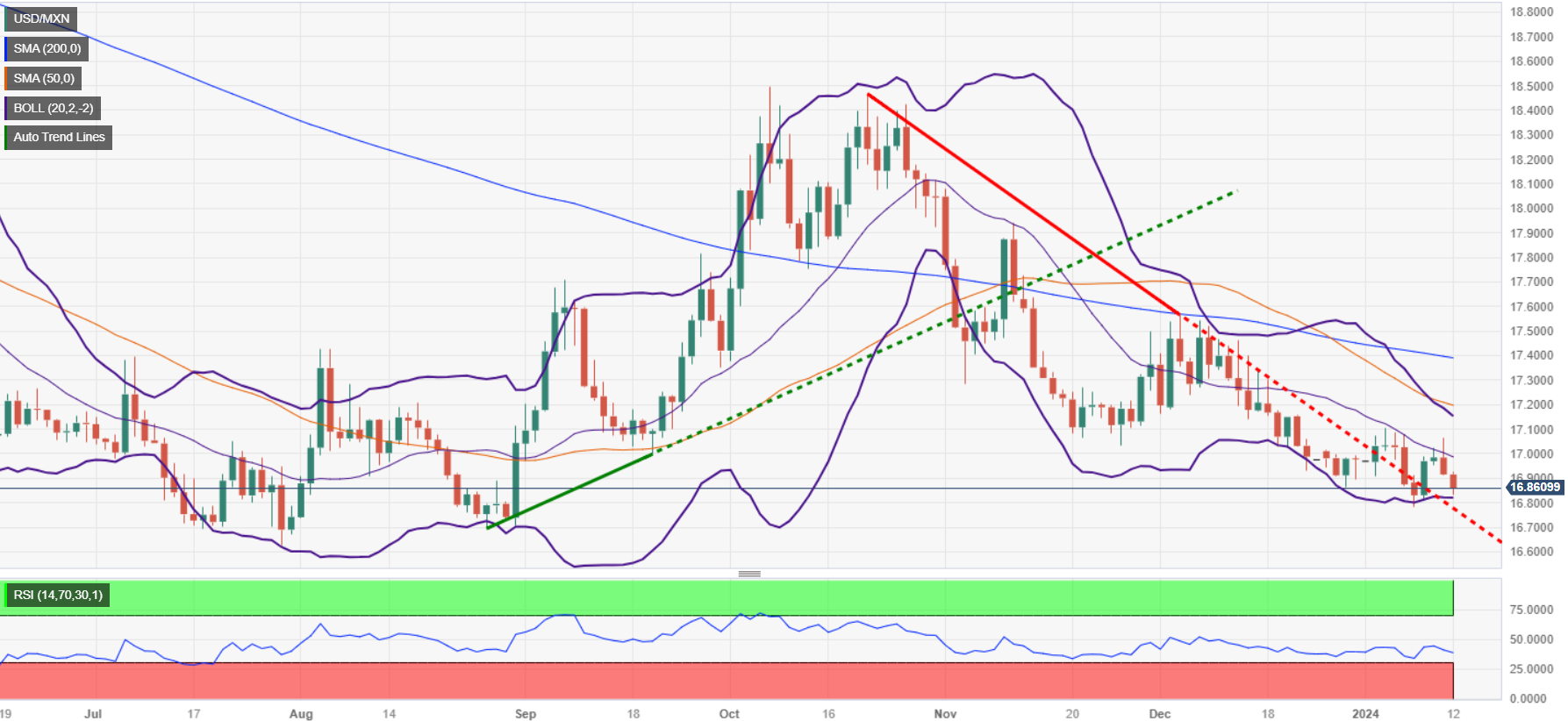
The USD/MXN pair resumed its uptrend after a bullish impulsive correction that lifted the spot price toward its weekly high of 17.07 before reversing course below the 17.00 figure. As the downtrend advances, the next key support levels to be tested would be August 28’s 16.69, followed by the 2023 low of 16.62.
Further upside will only be seen if buyers step in, pushing the USD/MXN exchange rate above 17.00. The first resistance would be 17.20, followed by the 50-day Simple Moving Average (SMA) at 17.20, ahead of challenging the confluence of the 100 and 200-day SMAs at around 17.39/40.
USD/MXN Price Action – Daily Chart
Mexican Peso FAQs
What key factors drive the Mexican Peso?
The Mexican Peso (MXN) is the most traded currency among its Latin American peers. Its value is broadly determined by the performance of the Mexican economy, the country’s central bank’s policy, the amount of foreign investment in the country and even the levels of remittances sent by Mexicans who live abroad, particularly in the United States. Geopolitical trends can also move MXN: for example, the process of nearshoring – or the decision by some firms to relocate manufacturing capacity and supply chains closer to their home countries – is also seen as a catalyst for the Mexican currency as the country is considered a key manufacturing hub in the American continent. Another catalyst for MXN is Oil prices as Mexico is a key exporter of the commodity.
How do decisions of the Banxico impact the Mexican Peso?
The main objective of Mexico’s central bank, also known as Banxico, is to maintain inflation at low and stable levels (at or close to its target of 3%, the midpoint in a tolerance band of between 2% and 4%). To this end, the bank sets an appropriate level of interest rates. When inflation is too high, Banxico will attempt to tame it by raising interest rates, making it more expensive for households and businesses to borrow money, thus cooling demand and the overall economy. Higher interest rates are generally positive for the Mexican Peso (MXN) as they lead to higher yields, making the country a more attractive place for investors. On the contrary, lower interest rates tend to weaken MXN.
How does economic data influence the value of the Mexican Peso?
Macroeconomic data releases are key to assess the state of the economy and can have an impact on the Mexican Peso (MXN) valuation. A strong Mexican economy, based on high economic growth, low unemployment and high confidence is good for MXN. Not only does it attract more foreign investment but it may encourage the Bank of Mexico (Banxico) to increase interest rates, particularly if this strength comes together with elevated inflation. However, if economic data is weak, MXN is likely to depreciate.
How does broader risk sentiment impact the Mexican Peso?
As an emerging-market currency, the Mexican Peso (MXN) tends to strive during risk-on periods, or when investors perceive that broader market risks are low and thus are eager to engage with investments that carry a higher risk. Conversely, MXN tends to weaken at times of market turbulence or economic uncertainty as investors tend to sell higher-risk assets and flee to the more-stable safe havens.
Author

Christian Borjon Valencia
FXStreet
Markets analyst, news editor, and trading instructor with over 14 years of experience across FX, commodities, US equity indices, and global macro markets.















