Mexican Peso slumps amid political turmoil, ends week with losses
- Mexican Peso weakens amid political uncertainty after judicial reforms limit judiciary’s ability to challenge constitutional changes.
- President Sheinbaum’s defiance of a federal judge's suspension order adds to concerns about rule of law and economic stability.
- Fears of potential US tariffs under a Trump presidency weigh on the Peso, compounding pressure from Mexico’s internal political shifts.

The Mexican Peso depreciated against the US Dollar on Friday due to political turmoil linked to the recently approved judicial reform. Investors remain uncertain about recently approved reforms, which could threaten the state of law, and affect Mexico’s creditworthiness. At the time of writing, the USD/MXN trades at 19.95, up 0.80%.
Market sentiment remains upbeat, which would usually underpin the Mexican currency. Politics are capping the Peso’s advances after the Senate passed a proposal to make constitutional reforms “unchallengeable.” Its approval would curtail the judiciary's powers to impede reforms made by lawmakers in Congress.
According to Joaquin Monfort, Senior Analyst at FX Street, “Critics argue this would upset the balance of power in Mexico, whilst proponents argue the judiciary is biased and vulnerable to corruption.”
In September, the Mexican Congress passed a judiciary reform allowing judges and magistrates to be elected by popular vote. Regarding these reforms, two federal judges granted suspensions after citizens appealed the changes to the Mexican Constitution.
One of the judges ordered Mexican President Claudia Sheinbaum and the director of the official gazette, Alejandro Lopez Gonzalez, to lower the publication and remove the decree validating the judicial reform from the gazette. However, Sheinbaum said, “We are not going to lower the publication,” incurring in contempt of a federal judge's order.
In the meantime, fears of Donald Trump’s victory in the US election could weigh on the Mexican Peso, as he repeatedly stated that he would impose tariffs of over 200% on cars manufactured and imported from Mexico.
Data-wise, US Durable Goods Orders slumped in September for a second consecutive month, while core shipments remained down in four of the last five months reported.
Recently, the University of Michigan (UoM) Consumer Sentiment for October, on its final reading, improved above estimates and the previous month's reading. Inflation expectations for one year were revised downward and, for five years, remained unchanged.
Daily digest market movers: Mexican Peso dwindles on political instability
- A mixed inflation report in Mexico for the first 15 days of October might prevent the Bank of Mexico (Banxico) from lowering borrowing costs by 50 basis points (bps), according to Monex. Banxico’s next meeting is on November 14.
- US Durable Goods Orders in September slumped 0.8% MoM, below estimates of -1% and unchanged compared to last month.
- US Consumer Sentiment in October was better than expected, rising to 70.5, up from 69 expected.
- The same poll revealed expectations for one year dropped from 2.9% to 2.7% and for five years remained unchanged at 3%.
- Data from the Chicago Board of Trade, via the December fed funds rate futures contract, shows investors estimate 49 bps of Fed easing by the end of the year.
USD/MXN technical outlook: Mexican Peso tumbles as USD/MXN buyers eye 20.00
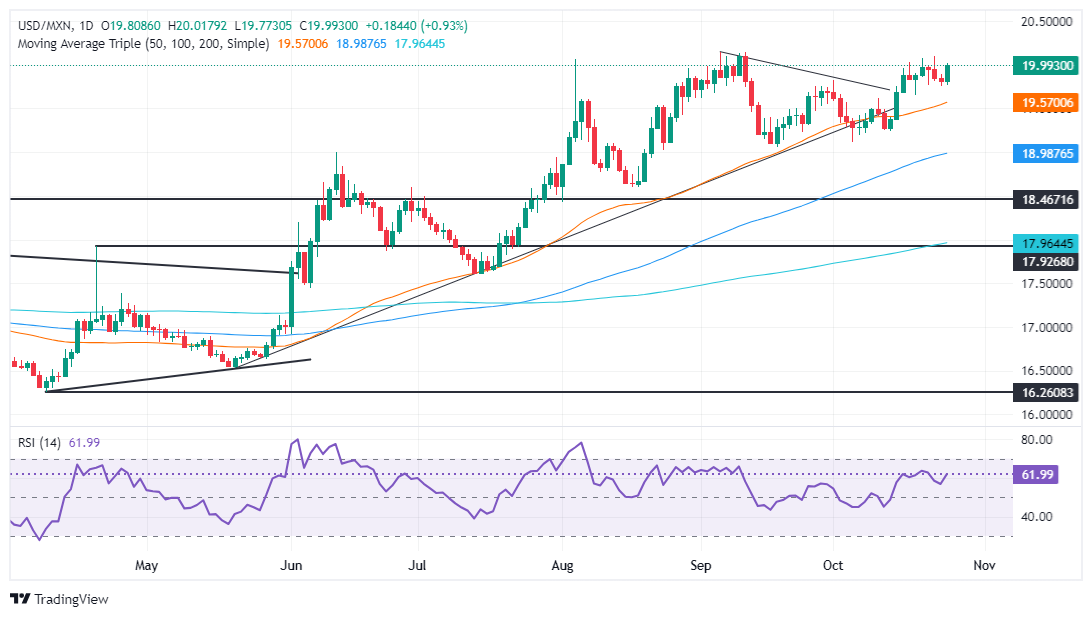
The USD/MXN is upwardly biased and approaches the psychological 20.00 figure. Momentum suggests that buyers are in charge as the Relative Strength Index (RSI) resumed its advance. Hence, the path of least resistance is tilted to the upside.
If buyers clear the 20.00 figure, they could test the weekly peak at 20.09. On further strength, the USD/MXN could aim toward the year-to-date (YTD) high at 20.22, ahead of key psychological levels of 20.50 and 21.00.
On the other hand, if sellers reclaim the October 18 low at 19.64, this could pave the way for a challenge to 19.50. The next move would be toward the October 4 swing low of 19.10 before testing 19.00.
Mexican Peso FAQs
The Mexican Peso (MXN) is the most traded currency among its Latin American peers. Its value is broadly determined by the performance of the Mexican economy, the country’s central bank’s policy, the amount of foreign investment in the country and even the levels of remittances sent by Mexicans who live abroad, particularly in the United States. Geopolitical trends can also move MXN: for example, the process of nearshoring – or the decision by some firms to relocate manufacturing capacity and supply chains closer to their home countries – is also seen as a catalyst for the Mexican currency as the country is considered a key manufacturing hub in the American continent. Another catalyst for MXN is Oil prices as Mexico is a key exporter of the commodity.
The main objective of Mexico’s central bank, also known as Banxico, is to maintain inflation at low and stable levels (at or close to its target of 3%, the midpoint in a tolerance band of between 2% and 4%). To this end, the bank sets an appropriate level of interest rates. When inflation is too high, Banxico will attempt to tame it by raising interest rates, making it more expensive for households and businesses to borrow money, thus cooling demand and the overall economy. Higher interest rates are generally positive for the Mexican Peso (MXN) as they lead to higher yields, making the country a more attractive place for investors. On the contrary, lower interest rates tend to weaken MXN.
Macroeconomic data releases are key to assess the state of the economy and can have an impact on the Mexican Peso (MXN) valuation. A strong Mexican economy, based on high economic growth, low unemployment and high confidence is good for MXN. Not only does it attract more foreign investment but it may encourage the Bank of Mexico (Banxico) to increase interest rates, particularly if this strength comes together with elevated inflation. However, if economic data is weak, MXN is likely to depreciate.
As an emerging-market currency, the Mexican Peso (MXN) tends to strive during risk-on periods, or when investors perceive that broader market risks are low and thus are eager to engage with investments that carry a higher risk. Conversely, MXN tends to weaken at times of market turbulence or economic uncertainty as investors tend to sell higher-risk assets and flee to the more-stable safe havens.
Author

Christian Borjon Valencia
FXStreet
Markets analyst, news editor, and trading instructor with over 14 years of experience across FX, commodities, US equity indices, and global macro markets.