Mexican Peso holds steady, poised for weekly losses
- USD/MXN flats near 19.58 as soft Mexican manufacturing and Banxico’s dovish tilt weigh against strong US jobs data.
- Mexico’s dismal data suggests the economic slowdown might continue as PMI hits three-year low, business confidence deteriorates.
- Banxico is seen cutting rates in May, widening policy gap with Fed and pressuring Peso outlook.

The Mexican Peso (MXN) remained firm against the US Dollar (USD), though it is poised to finish the week with losses of over 0.40% after economic data revealed in Mexico painted a gloomy economic outlook, despite the fact that the economy surprisingly grew in the first quarter of 2025. Also, solid US jobs data tempering recession fears kept USD/MXN near the 19.58 mark virtually unchanged.
Mexico’s economic docket revealed that business confidence deteriorated for the third consecutive month in April. At the same time, S&P Global revealed that manufacturing activity for the same period plummeted to its lowest level in three years, contracting for the fourth consecutive month according to the Manufacturing PMI index.
Across the northern border, positive trade news between the US and China capped the USD/MXN pair gains as the Greenback posted some losses. On the data front, April’s Nonfarm Payrolls exceeded estimates and trailed the previous reading. Alongside this, the Unemployment Rate stands pat, highlighting the US labor market's robustness.
The Federal Reserve (Fed) is expected to hold rates unchanged at next week's meeting. On the contrary, Banco de Mexico (Banxico) has signaled its intentions to continue easing monetary policy at its May meeting to support the economy, even though inflation hasn’t quite reached the 3% goal. Therefore, the divergence between both central banks could pressure the Peso and boost the US Dollar prospects.
Daily digest market movers: Mexican Peso unfazed by bad data
- Mexico’s Business Confidence in April came at 48.5, down from 49.7 revealed by the Instituto Nacional de Estadistca Geografia e Informatica (INEGI). This and S&P Global Manufacturing PMI contraction for the same period, dipping from 46.5 to 44.8, hints that the economic outlook in the future looks worse than expected.
- Although the latest Gross Domestic Product (GDP) figures surprised the markets, showing that the economy grew, tariffs imposed on Mexican products, along with the reduction of the budget, would keep the country’s financial sector stressed.
- US Nonfarm Payrolls (NFP) rose by 177K in April, beating expectations of 130K, though slightly below the downwardly revised 185K from March. The stronger-than-expected print contrasted with the weaker ADP employment report earlier in the week, which suggested slower hiring momentum.
- The Unemployment Rate held steady at 4.2%, in line with forecasts. The stable labor data may give the Federal Reserve reason to hold off on policy easing in the near term.
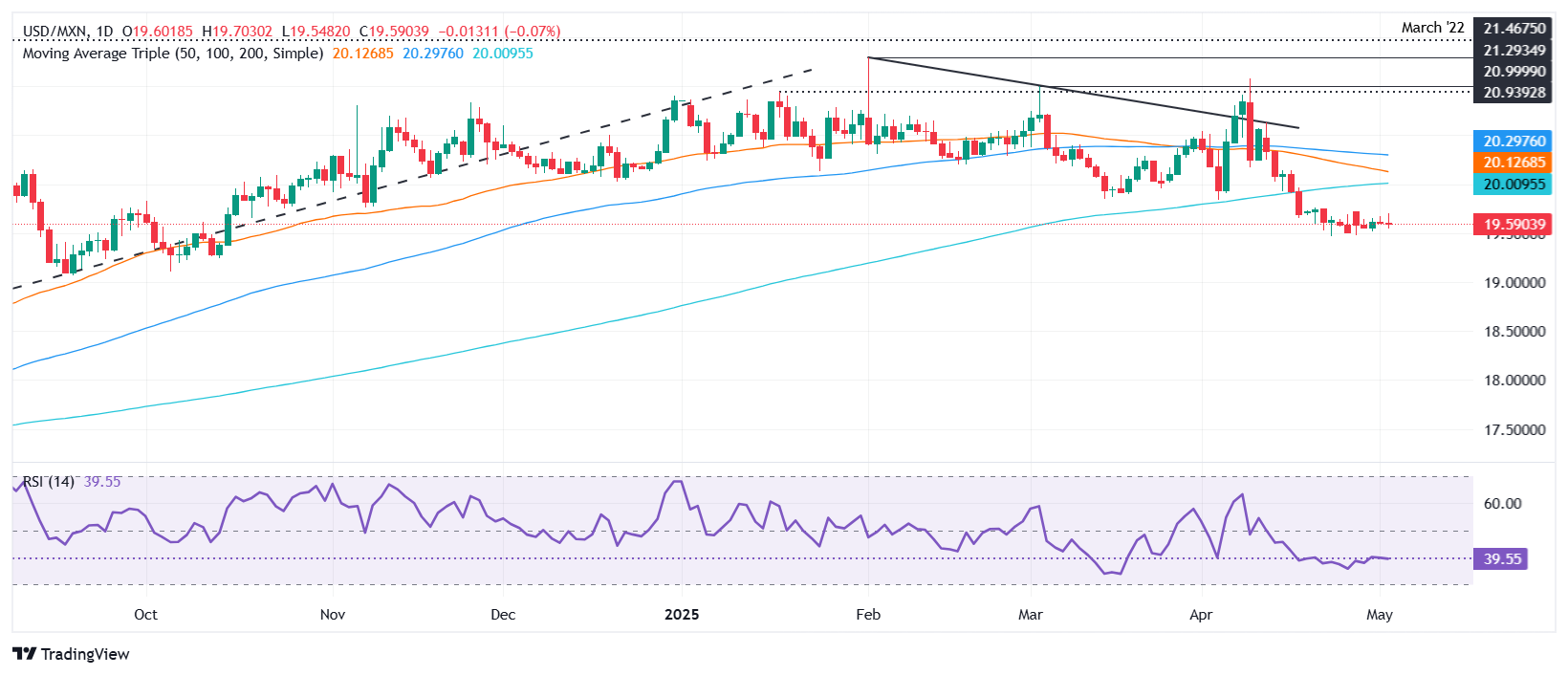
USD/MXN technical outlook: Mexican Peso remains bullish as USD/MXN stays below 200-day SMA
USD/MXN downtrend remains in place, though recent price action suggests a potential bottoming around the 19.46–19.50 range. The Relative Strength Index (RSI) flatlines near the 30 level, signaling seller exhaustion.
A drop below the YTD low at 19.46 would expose the 19.00 psychological level, and further weakness could lead to a test of the June 28 high-turned-support at 18.59.
On the flip side, moving above the 20-day SMA at 19.88 and the 200-day SMA near 19.97 would shift momentum in favor of buyers, opening the door to reclaim the 20.00 mark, followed by the 50-day SMA at 20.12.
Mexican Peso FAQs
The Mexican Peso (MXN) is the most traded currency among its Latin American peers. Its value is broadly determined by the performance of the Mexican economy, the country’s central bank’s policy, the amount of foreign investment in the country and even the levels of remittances sent by Mexicans who live abroad, particularly in the United States. Geopolitical trends can also move MXN: for example, the process of nearshoring – or the decision by some firms to relocate manufacturing capacity and supply chains closer to their home countries – is also seen as a catalyst for the Mexican currency as the country is considered a key manufacturing hub in the American continent. Another catalyst for MXN is Oil prices as Mexico is a key exporter of the commodity.
The main objective of Mexico’s central bank, also known as Banxico, is to maintain inflation at low and stable levels (at or close to its target of 3%, the midpoint in a tolerance band of between 2% and 4%). To this end, the bank sets an appropriate level of interest rates. When inflation is too high, Banxico will attempt to tame it by raising interest rates, making it more expensive for households and businesses to borrow money, thus cooling demand and the overall economy. Higher interest rates are generally positive for the Mexican Peso (MXN) as they lead to higher yields, making the country a more attractive place for investors. On the contrary, lower interest rates tend to weaken MXN.
Macroeconomic data releases are key to assess the state of the economy and can have an impact on the Mexican Peso (MXN) valuation. A strong Mexican economy, based on high economic growth, low unemployment and high confidence is good for MXN. Not only does it attract more foreign investment but it may encourage the Bank of Mexico (Banxico) to increase interest rates, particularly if this strength comes together with elevated inflation. However, if economic data is weak, MXN is likely to depreciate.
As an emerging-market currency, the Mexican Peso (MXN) tends to strive during risk-on periods, or when investors perceive that broader market risks are low and thus are eager to engage with investments that carry a higher risk. Conversely, MXN tends to weaken at times of market turbulence or economic uncertainty as investors tend to sell higher-risk assets and flee to the more-stable safe havens.
Author

Christian Borjon Valencia
FXStreet
Markets analyst, news editor, and trading instructor with over 14 years of experience across FX, commodities, US equity indices, and global macro markets.