Mexican Peso waffles despite Greenback beatdown

Most recent article: Mexican Peso rises as counterparts are hit by weak data
- The Mexican Peso held steady on Tuesday following Monday’s 1.2% backslide.
- Banxico recently delivered a rate cut despite an uptick in headline inflation figures.
- Mexico’s central bank expects inflation bump to smooth out.
The Mexican Peso (MXN) held close to flat on Tuesday, paddling around 19.00 as Peso traders find their balance following a 1.2% drop in the MXN’s value against the Greenback. The Bank of Mexico (Banxico) recently cut interest rates by a quarter-point despite an uptick in headline inflation.
US Producer Price Index (PPI) figures released on Tuesday showed business-level inflation eased in July, softening the Greenback and giving the Peso a foothold as markets pivot to focusing on September rate cut expectations.
Daily digest market movers: Peso-Dollar tug-of-war continues after USD eases on cooling PPI
- US PPI inflation for the year ended in July eased to 2.2%, below the forecast of 2.3%, while the previous period was revised to 2.7% from the initial 2.6%.
- Core US PPI inflation dropped to 2.4% YoY versus the expected 2.7%, falling even further from the previous 3.0%.
- Rate markets edged up bets of a double rate cut from the Federal Reserve (Fed) in September following Tuesday’s PPI print.
- According to the CME’s FedWatch Tool, rate markets are pricing in roughly 55% odds of a 50-basis-point cut on September 18, with 45% odds of at least a 25 bps trim.
- Key US data will continue through the week with July’s Consumer Price Index (CPI) slated to print on Wednesday. Investors expect inflation figures to continue easing.
Economic Indicator
Producer Price Index (YoY)
The Producer Price Index released by the Bureau of Labor statistics, Department of Labor measures the average changes in prices in primary markets of the US by producers of commodities in all states of processing. Changes in the PPI are widely followed as an indicator of commodity inflation. Generally speaking, a high reading is seen as positive (or bullish) for the USD, whereas a low reading is seen as negative (or bearish).
Read more.Last release: Tue Aug 13, 2024 12:30
Frequency: Monthly
Actual: 2.2%
Consensus: 2.3%
Previous: 2.6%
Source: US Bureau of Labor Statistics
Mexican Peso price forecast: Peso bulls look for a floor
The Mexican Peso (MXN) is grappling with the 19.00 handle as USD/MXN traders try to keep the pair pinned. Greenback bidders are struggling to find the gas pedal on a Dollar-negative Tuesday, giving the Peso a chance to extend near-term gains.
USD/MXN hit a 22-month high last week above 20.00, but Peso bulls have returned to the fold, chalking in a 6.44% recovery peak-to-trough. The pair remains firmly pinned on the high side of the 200-day Exponential Moving Average (EMA) at 17.59, and a firm pattern of higher lows is bolstering technical support in favor of the Greenback.
USD/MXN daily chart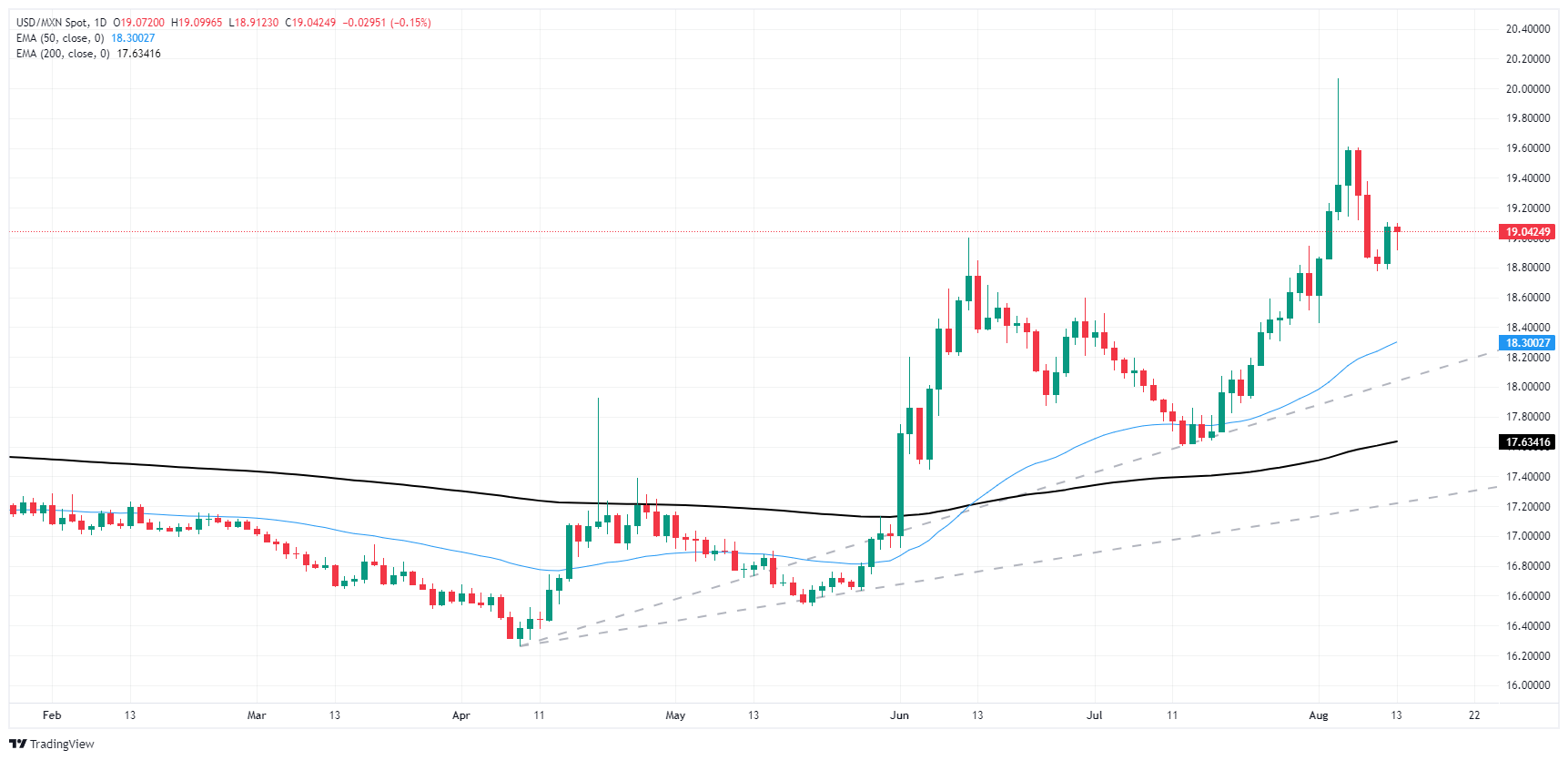
Mexican Peso FAQs
The Mexican Peso (MXN) is the most traded currency among its Latin American peers. Its value is broadly determined by the performance of the Mexican economy, the country’s central bank’s policy, the amount of foreign investment in the country and even the levels of remittances sent by Mexicans who live abroad, particularly in the United States. Geopolitical trends can also move MXN: for example, the process of nearshoring – or the decision by some firms to relocate manufacturing capacity and supply chains closer to their home countries – is also seen as a catalyst for the Mexican currency as the country is considered a key manufacturing hub in the American continent. Another catalyst for MXN is Oil prices as Mexico is a key exporter of the commodity.
The main objective of Mexico’s central bank, also known as Banxico, is to maintain inflation at low and stable levels (at or close to its target of 3%, the midpoint in a tolerance band of between 2% and 4%). To this end, the bank sets an appropriate level of interest rates. When inflation is too high, Banxico will attempt to tame it by raising interest rates, making it more expensive for households and businesses to borrow money, thus cooling demand and the overall economy. Higher interest rates are generally positive for the Mexican Peso (MXN) as they lead to higher yields, making the country a more attractive place for investors. On the contrary, lower interest rates tend to weaken MXN.
Macroeconomic data releases are key to assess the state of the economy and can have an impact on the Mexican Peso (MXN) valuation. A strong Mexican economy, based on high economic growth, low unemployment and high confidence is good for MXN. Not only does it attract more foreign investment but it may encourage the Bank of Mexico (Banxico) to increase interest rates, particularly if this strength comes together with elevated inflation. However, if economic data is weak, MXN is likely to depreciate.
As an emerging-market currency, the Mexican Peso (MXN) tends to strive during risk-on periods, or when investors perceive that broader market risks are low and thus are eager to engage with investments that carry a higher risk. Conversely, MXN tends to weaken at times of market turbulence or economic uncertainty as investors tend to sell higher-risk assets and flee to the more-stable safe havens.
Author

Joshua Gibson
FXStreet
Joshua joins the FXStreet team as an Economics and Finance double major from Vancouver Island University with twelve years' experience as an independent trader focusing on technical analysis.