Mexican Peso remains resilient as US-EU trade tensions rise
- The Mexican Peso is trading below 19.30, influenced by risk sentiment affecting emerging market (EM) currencies, even amid a weaker US Dollar.
- Trump's tariff threats against the EU demonstrate growing trade tensions and an unpredictable global growth outlook.
- The USD/MXN has been unable to overcome Moving Average resistance.

The Mexican Peso (MXN) remains steady against the US Dollar (USD) despite US President Donald Trump’s threat of sweeping tariffs on the European Union (EU).
At the time of writing, USD/MXN is trading below the key psychological level of 19.30, with traders digesting developments out of Mexico and the United States.
Recession fears rise on Trump’s proposed 50% tariff increase on EU imports
On Friday, Mexico’s Trade Balance data showed the country reported a trade deficit of $88 million in April, below the $160 million forecast by analysts.
The report, published by the National Institute of Statistics and Geography of Mexico (INEGI) on a monthly basis, reflects the difference between a country's exports and its imports. Despite posting a narrower-than-expected trade deficit, it still represents a swing from the $3.442 billion surplus reported in March.
Meanwhile, Trump published a post on his Truth Media social media, proposing a 50% tariff for imports from the EU, expected to take effect on June 1st. Trump stated that the EU was “very difficult to deal with” and “our negotiations are going nowhere”.
Recent developments in the US include the passage of Trump's ‘one big beautiful’ tax bill and a downgrade in Moody's credit rating. These events have contributed to a weaker dollar, which has boosted demand for alternative assets.
Mexican Peso daily digest: US fiscal and tariff concerns linger
- The proposed tariffs of 50% on the EU and 25% on Apple raise concerns about their impact on the global economy.
- Additionally, fiscal concerns surrounding the passing of Trump’s proposed tax bill have increased. The “Big, Beautiful Bill” is expected to increase the US federal deficit by $3.8 trillion over the 2026-2034 period, according to the US Congressional Budget Office.
- The recent rating downgrade by Moody’s agency, combined with President Trump’s tax bill, has weighed on the US Dollar. A rating downgrade reflects reduced faith in the US to repay its debt.
- The CME FedWatch tool indicates a 94.7% probability that interest rates will remain in the current range of 4.25%-4.50% in June, with analysts not expecting any Fed rate cut until September.
- With the Bank of Mexico (Banxico) cutting interest rates by 0.50% at its May meeting, the divergence in interest rate differentials between both countries should support demand for the USD.
- However, on Thursday, Mexico’s 1st half-month inflation data came in higher than expected at 0.09%, reflective of an increase in price pressures.
- Thursday’s data also showed that Mexico’s Growth Domestic Product (GDP) grew by 0.2% on the quarter and by 0.8% on the year, in line with market expectations.
- With the economy seen as resilient despite increased tariffs from the US, it could reduce pressure on Banxico to continue cutting rates in the near term.
Mexican Peso technical analysis: USD/MXN steadies below 19.30
USD/MXN has fallen back below 19.30, with prices consolidating below the 10-day and 20-day Simple Moving Average (SMA) at the respective levels of 19.39 and 19.49.
With a break above 19.30 potentially bringing these levels into play, a move and retest of the May low at 19.23 would suggest that sellers remain in control of the trend.
USD/MXN daily chart
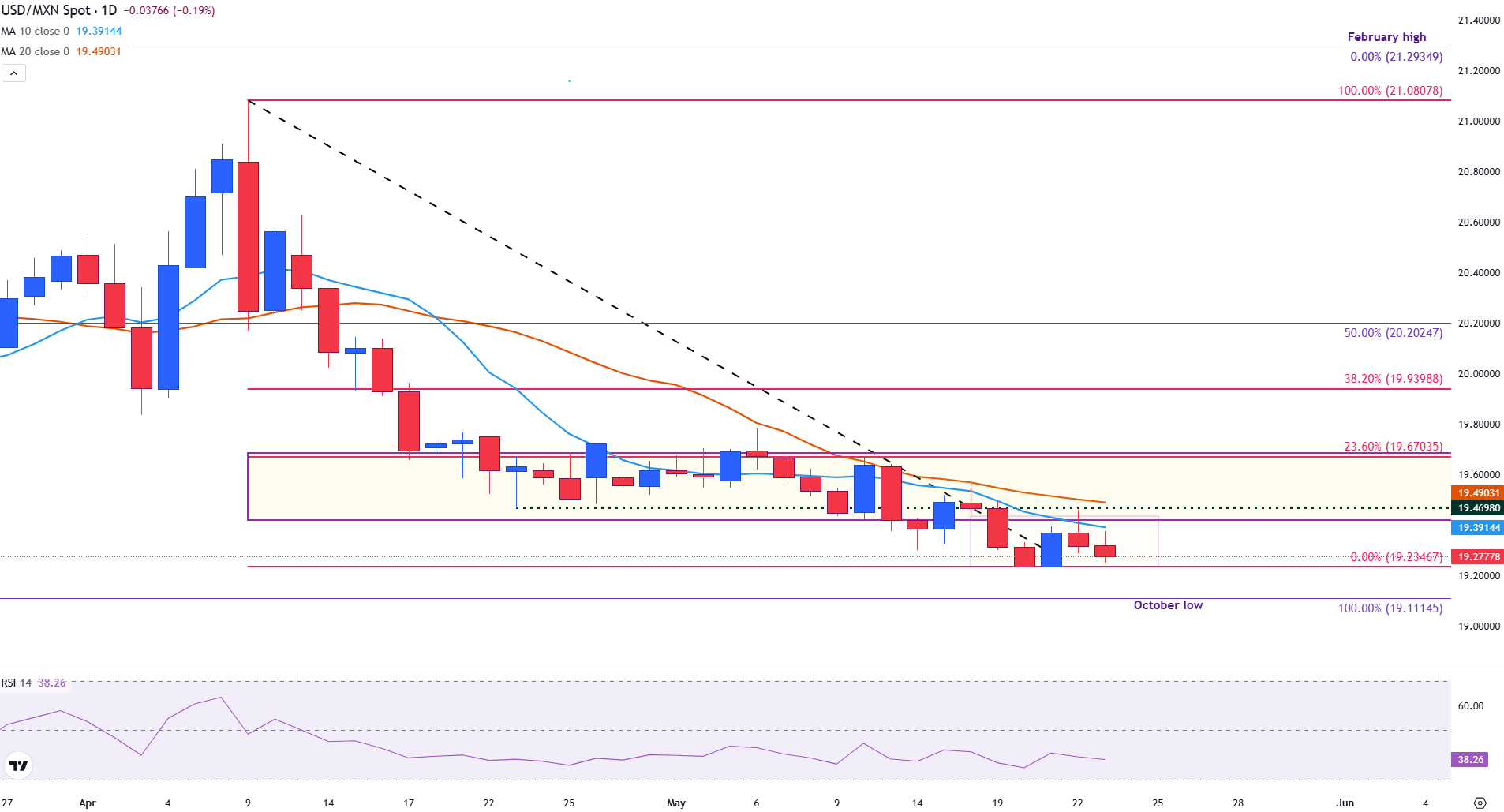
The Relative Strength (RSI) indicator is at 38.92, showing downside momentum is firm.
Should the downtrend hold, a retest of the May low of 19.23 would bring the October low of 19.11 into sight, with the next layer of support at the next psychological level of 19.00.
US Dollar FAQs
The US Dollar (USD) is the official currency of the United States of America, and the ‘de facto’ currency of a significant number of other countries where it is found in circulation alongside local notes. It is the most heavily traded currency in the world, accounting for over 88% of all global foreign exchange turnover, or an average of $6.6 trillion in transactions per day, according to data from 2022. Following the second world war, the USD took over from the British Pound as the world’s reserve currency. For most of its history, the US Dollar was backed by Gold, until the Bretton Woods Agreement in 1971 when the Gold Standard went away.
The most important single factor impacting on the value of the US Dollar is monetary policy, which is shaped by the Federal Reserve (Fed). The Fed has two mandates: to achieve price stability (control inflation) and foster full employment. Its primary tool to achieve these two goals is by adjusting interest rates. When prices are rising too quickly and inflation is above the Fed’s 2% target, the Fed will raise rates, which helps the USD value. When inflation falls below 2% or the Unemployment Rate is too high, the Fed may lower interest rates, which weighs on the Greenback.
In extreme situations, the Federal Reserve can also print more Dollars and enact quantitative easing (QE). QE is the process by which the Fed substantially increases the flow of credit in a stuck financial system. It is a non-standard policy measure used when credit has dried up because banks will not lend to each other (out of the fear of counterparty default). It is a last resort when simply lowering interest rates is unlikely to achieve the necessary result. It was the Fed’s weapon of choice to combat the credit crunch that occurred during the Great Financial Crisis in 2008. It involves the Fed printing more Dollars and using them to buy US government bonds predominantly from financial institutions. QE usually leads to a weaker US Dollar.
Quantitative tightening (QT) is the reverse process whereby the Federal Reserve stops buying bonds from financial institutions and does not reinvest the principal from the bonds it holds maturing in new purchases. It is usually positive for the US Dollar.
Author

Tammy Da Costa, CFTe®
FXStreet
Tammy is an economist and market analyst with a deep passion for financial markets, particularly commodities and geopolitics.
















