Mexican Peso soars on strong GDP, unfazed by US election woes
- Mexican Peso appreciates after Q3 GDP growth of 1% QoQ, surpassing expectations.
- Peso remains vulnerable to US election results as Trump’s tariff threats on Mexican auto imports weigh on sentiment.
- Upcoming Mexican data on Business Confidence and employment, along with US Nonfarm Payrolls and ISM Manufacturing PMI, could influence USD/MXN.

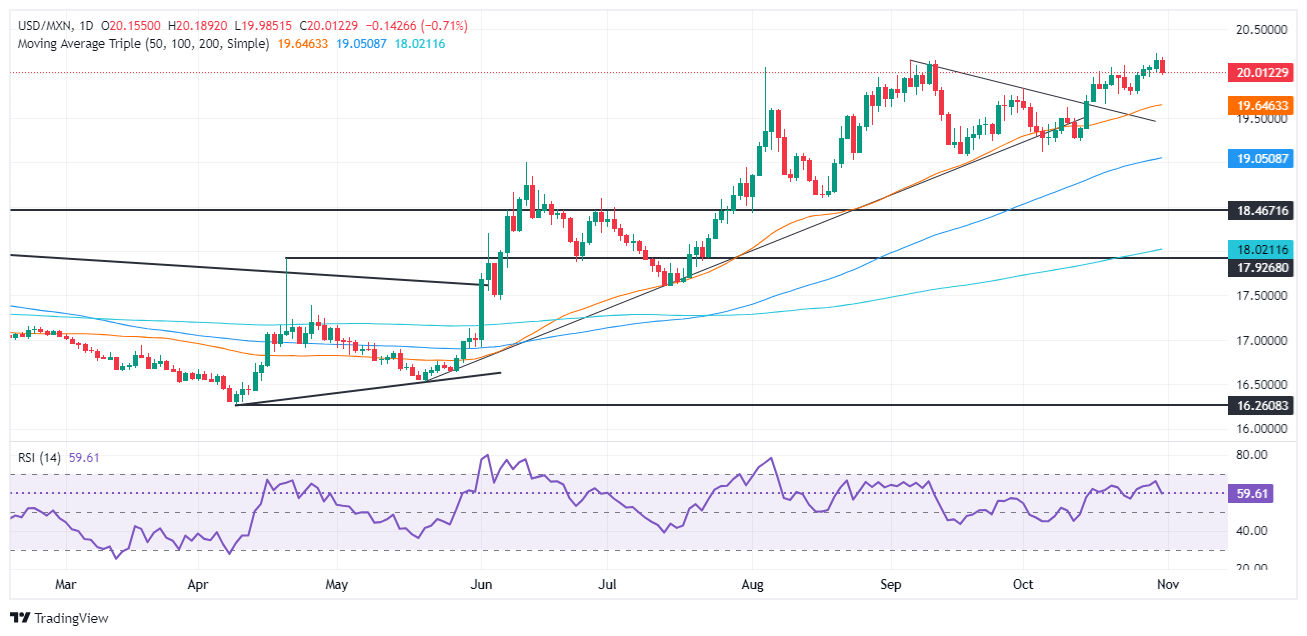
The Mexican Peso appreciated over 0.60% against the US Dollar on Thursday after posting losses for the four previous sessions. Upbeat Mexican Gross Domestic Product (GDP) figures outweighed upbeat data from the United States (US), which failed to boost the Greenback. The USD/MXN trades at 20.01 after hitting a daily high of 20.18.
Mexico’s economy in the third quarter of 2024 grew 1% QoQ, above the consensus of 0.8%, according to the Instituto Nacional de Estadistica Geografia e Informatica (INEGI). Meanwhile, annual GDP expanded by 1.5%, above estimates of 1.2% but missing the second quarter's 2.1% growth.
Despite posting solid gains, the Mexican currency will remain pressured by the outcome of the US presidential election. Former President Donald Trump's victory at the November 5 election could weigh on the Peso after his comments that he would impose 200% tariffs on automobiles manufactured in Mexico.
Joaquin Monfort, an analyst at FX Street, writes, “The election model on polling website FiveThirtyEight gives Trump a 52% chance of winning versus Vice President Kamala Harris’ 48%.” However, Monfort added that the latest opinion polls favor Harris, who leads 48.1% to 46.7%.
US data revealed that headline inflation dipped in the US. However, the core Personal Consumption Expenditures (PCE) Price Index, the Fed’s preferred inflation gauge, remained unchanged in October compared to September’s data.
Other data showed that the number of Americans filing for unemployment benefits in the week ending October 26 dipped to its lowest level in five months.
later this week, the Mexican economic schedule will feature Business Confidence figures, employment data, and the S&P Global Manufacturing PMI for October. On the US front, traders are eyeing the US Nonfarm Payrolls (NFP) for October and the Institute for Supply Management (ISM) Manufacturing PMI.
Daily digest market movers: Mexican Peso rises after strong GDP figures
- The USD/MXN remains adrift to political turmoil in Mexico after the approval of the controversial judiciary reform. Eight of the eleven Supreme Court judges announced their resignation effectively in August 2025.
- Money market futures hint that the Bank of Mexico (Banxico) is expected to cut rates between 175 to 200 basis points over the next 12 months.
- The US headline PCE retreated from 2.3% to 2.1%YoY, approaching the Fed’s goal of 2%. However, excluding volatile items, the so-called core PCE remained unchanged at 2.7% YoY, exceeding forecasts of 2.6%.
- US Initial Jobless Claims for the week ending October 26 fell from 228K to 216K, below forecasts of 230K.
- ADP National Employment Change in October, out on Wednesday, rose by 233K, above estimates of 115K and September’s 159K.
- Data from the Chicago Board of Trade, via the December fed funds rate futures contract, shows investors estimate 49 bps of Fed easing by the end of the year.
USD/MXN technical outlook: Mexican Peso recovers as USD/MXN eyes 20.00
The USD/MXN uptrend remains in place, though sellers had stepped in ahead of the upcoming US election week. Unless they break below the 20.00 psychological figure, buyers should remain hopeful of higher prices.
If USD/MXN tumbles below 20.00, the next support would be the October 24 daily low of 19.74, followed by the 50-day Simple Moving Average (SMA) at 19.62.
Otherwise, if USD/MXN stays above 20.00, the next resistance would be the year-to-date (YTD) high of 20.22. Once cleared, up next would be the psychological 20.50 level, the September 28, 2022 high at 20.57, and the August 2, 2022 peak at 20.82. Once surpassed, the next stop would be the March 8, 2022 swing high at 21.46.
Oscillators indicate that buyers are gathering steam, as displayed by the Relative Strength Index (RSI) above its neutral line, clearing previous highs reached on September 10 and August 22.
Mexican Peso FAQs
The Mexican Peso (MXN) is the most traded currency among its Latin American peers. Its value is broadly determined by the performance of the Mexican economy, the country’s central bank’s policy, the amount of foreign investment in the country and even the levels of remittances sent by Mexicans who live abroad, particularly in the United States. Geopolitical trends can also move MXN: for example, the process of nearshoring – or the decision by some firms to relocate manufacturing capacity and supply chains closer to their home countries – is also seen as a catalyst for the Mexican currency as the country is considered a key manufacturing hub in the American continent. Another catalyst for MXN is Oil prices as Mexico is a key exporter of the commodity.
The main objective of Mexico’s central bank, also known as Banxico, is to maintain inflation at low and stable levels (at or close to its target of 3%, the midpoint in a tolerance band of between 2% and 4%). To this end, the bank sets an appropriate level of interest rates. When inflation is too high, Banxico will attempt to tame it by raising interest rates, making it more expensive for households and businesses to borrow money, thus cooling demand and the overall economy. Higher interest rates are generally positive for the Mexican Peso (MXN) as they lead to higher yields, making the country a more attractive place for investors. On the contrary, lower interest rates tend to weaken MXN.
Macroeconomic data releases are key to assess the state of the economy and can have an impact on the Mexican Peso (MXN) valuation. A strong Mexican economy, based on high economic growth, low unemployment and high confidence is good for MXN. Not only does it attract more foreign investment but it may encourage the Bank of Mexico (Banxico) to increase interest rates, particularly if this strength comes together with elevated inflation. However, if economic data is weak, MXN is likely to depreciate.
As an emerging-market currency, the Mexican Peso (MXN) tends to strive during risk-on periods, or when investors perceive that broader market risks are low and thus are eager to engage with investments that carry a higher risk. Conversely, MXN tends to weaken at times of market turbulence or economic uncertainty as investors tend to sell higher-risk assets and flee to the more-stable safe havens.
Author

Christian Borjon Valencia
FXStreet
Markets analyst, news editor, and trading instructor with over 14 years of experience across FX, commodities, US equity indices, and global macro markets.