Mexican Peso keeps the offered stance unchanged beyond 20.00
- Mexican Peso loses some ground amid modest gains in the US Dollar.
- Banxico Governor adopts cautious stance on aggressive rate cuts despite lower inflation.
- Upcoming economic releases include Mexican Consumer Confidence and US CPI prior to the FOMC event next week.

The Mexican Peso gave up part of its recent rally on Monday, reacting to a slight rebound in the Greenback and a dip in Mexico’s inflation to its lowest level since April 2024. While this development hints that the Bank of Mexico (Banxico) could extend its easing cycle, USD/MXN printed acceptable gains beyond the 20.20 level as the US session drew to a close.
Mexico’s economic docket revealed that headline and core inflation in November missed estimates, edging lower after the Consumer Price Index (CPI) hit its highest level of 5.57% in July, according to the Instituto Nacional de Estadistica Geografia e Informatica (INEGI).
Last week, Banxico Governor Irene Espinosa was hawkish, saying, "At this point, too many things need to change to be able to believe that the conditions are right for a much more aggressive move." Her statement followed a query about the possibility of a cut of more than 25 points.
Across the border on Friday, the latest US Nonfarm Payrolls (NFP) report in November was stellar. The economy added 227K jobs to the workforce, exceeding estimates of 200K, though the Unemployment Rate ticked up from 4.1% to 4.2%.
Federal Reserve (Fed) officials have begun their blackout period before the December 17-18 monetary policy meeting. Policymakers failed to provide any hints regarding the meeting with most supporting a gradual approach. They are awaiting November’s Consumer Price Index (CPI) data on December 11.
This week, Mexico’s economic docket will feature Consumer Confidence and Industrial Production data. In the US, the Consumer Price Index, the Producer Price Index, and Initial Jobless Claims data will also entice traders.
Daily digest market movers: Mexican Peso gives away some of its recent gains
- Mexico’s headline inflation dipped from 4.76% to 4.55% YoY, below forecasts of 4.60%, its lowest level in eight months.
- Core figures showed an improvement of the disinflation process with November edging lower from 3.80% to 3.58%, below projections of 3.6%.
- “Mexican inflation continues to decline slightly and underlying pressures are under control. We believe that the headline CPI will increase by around 0.5% monthly in December, and that the annual rate will close 2024 at 4.4%,” explained Andrés Abadía, chief economist for LATAM at Pantheon Macroeconomics.
- Banco Base Economist Gabriela Siller said, "The Bank of Mexico is expected to cut interest rates by 25 basis points on Dec. 19. For 2025, inflation is expected to slow down to close the year at 4.1%, and the Bank of Mexico will cut the interest rate to 8.5%."
- Money market futures price in 90% odds that the Fed will lower borrowing costs by 25 basis points this month, according to the CME FedWatch Tool.
- Banxico’s November survey shows that analysts estimate Mexican inflation at 4.42% in 2024 and 3.84% in 2025. Underlying inflation figures will remain at 3.69% in 2024 and 2025. GDP is forecast at 1.55% and 1.23% for 2024 and 2025, respectively, and the USD/MXN exchange rate at 20.22 for the rest of the year and 20.71 in 2025.
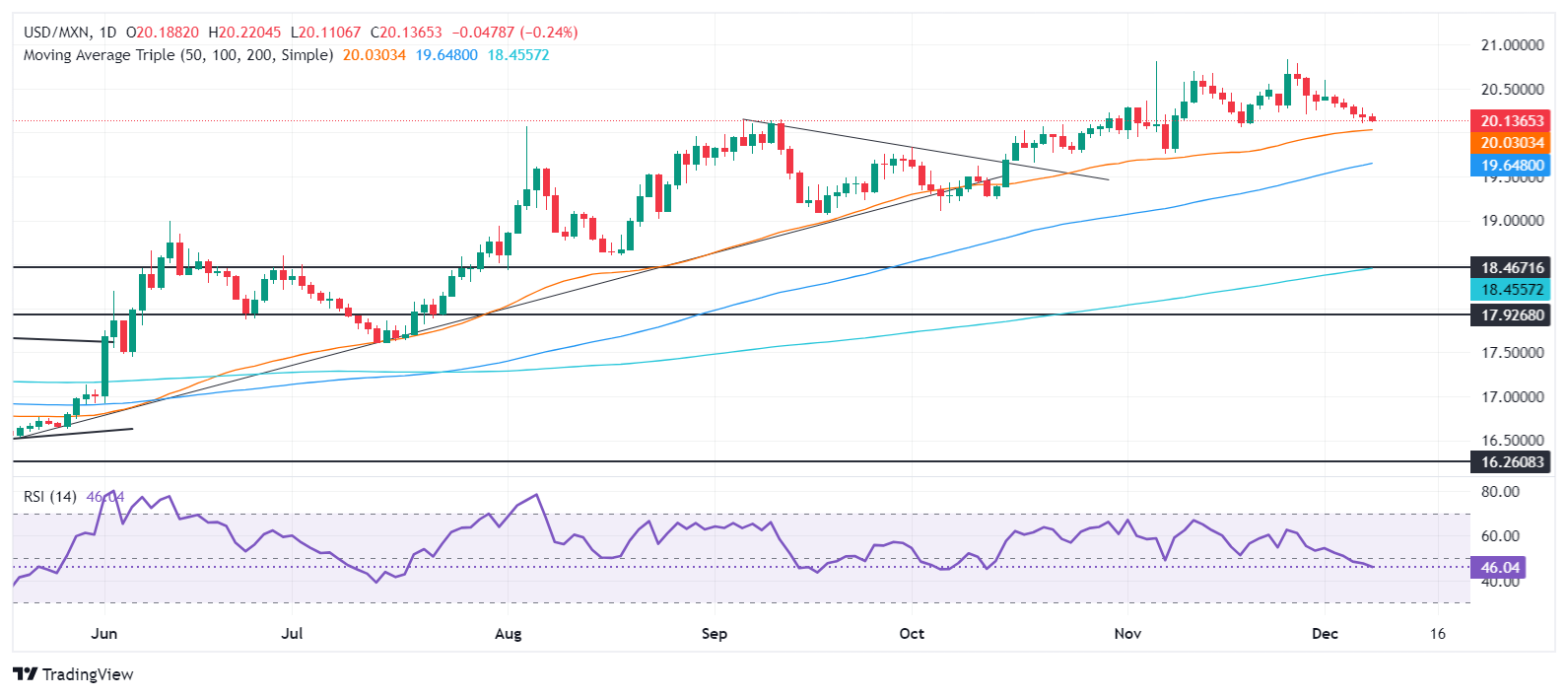
Mexican Peso technical outlook: USD/MXN faces decent contention around 20.00
The USD/MXN dipped as low as 20.09 last Friday, near the 50-day Simple Moving Average (SMA) at 20.00. Momentum shifted to the downside as the Relative Strength Index (RSI) turned bearish, indicating that the exotic pair could test the 20.00 mark.
In that outcome, the next support would be the 100-day SMA at 19.61 before testing the psychological 19.50 mark, ahead of the 19.00 figure. Otherwise, if USD/MXN climbs above the December 6 high of 20.28, that could pave the way to challenge 20.50, ahead of the year-to-date peak at 20.82, followed by the 21.00 mark.
Inflation FAQs
Inflation measures the rise in the price of a representative basket of goods and services. Headline inflation is usually expressed as a percentage change on a month-on-month (MoM) and year-on-year (YoY) basis. Core inflation excludes more volatile elements such as food and fuel which can fluctuate because of geopolitical and seasonal factors. Core inflation is the figure economists focus on and is the level targeted by central banks, which are mandated to keep inflation at a manageable level, usually around 2%.
The Consumer Price Index (CPI) measures the change in prices of a basket of goods and services over a period of time. It is usually expressed as a percentage change on a month-on-month (MoM) and year-on-year (YoY) basis. Core CPI is the figure targeted by central banks as it excludes volatile food and fuel inputs. When Core CPI rises above 2% it usually results in higher interest rates and vice versa when it falls below 2%. Since higher interest rates are positive for a currency, higher inflation usually results in a stronger currency. The opposite is true when inflation falls.
Although it may seem counter-intuitive, high inflation in a country pushes up the value of its currency and vice versa for lower inflation. This is because the central bank will normally raise interest rates to combat the higher inflation, which attract more global capital inflows from investors looking for a lucrative place to park their money.
Formerly, Gold was the asset investors turned to in times of high inflation because it preserved its value, and whilst investors will often still buy Gold for its safe-haven properties in times of extreme market turmoil, this is not the case most of the time. This is because when inflation is high, central banks will put up interest rates to combat it. Higher interest rates are negative for Gold because they increase the opportunity-cost of holding Gold vis-a-vis an interest-bearing asset or placing the money in a cash deposit account. On the flipside, lower inflation tends to be positive for Gold as it brings interest rates down, making the bright metal a more viable investment alternative.
Author

Christian Borjon Valencia
FXStreet
Markets analyst, news editor, and trading instructor with over 14 years of experience across FX, commodities, US equity indices, and global macro markets.