Mexican Peso holds up despite strong US Dollar, ahead of US PCE data

Most recent article: Mexican Peso advances amid positive trade data, soft US inflation figures
- Mexican Peso drops 0.08% amidst US economic data showing continued growth and mixed signals from Mexico.
- Strong US GDP growth for Q4 2023 and stable Durable Goods Orders could impact Fed's rate decisions, contrasting with a cooling labor market.
- In Mexico, a lower unemployment rate and rising inflation pose challenges for Banxico's policy direction.
The Mexican Peso (MXN) recovered some ground though is virtually unchanged, printing minuscule gains against the US Dollar (USD) on Thursday after economic data from the United States (US) witnessed the economy continuing to grow above trend, though below last year’s Q3 4.9% final reading. In the meantime, Mexico’s unemployment rate continued to trend lower at a non-seasonally adjusted rate, along with an uptick in inflation in the first half of January, boosting the emerging market currency. At the time of writing, the USD/MXN trades at 17.22, down 0.02% on the day.
The economy in the US remains solid, growing above trend, and might prevent interest rate cuts by the Federal Reserve (Fed) amid a possible reacceleration of inflation. The Gross Domestic Product (GDP) for the last quarter of 2023 exceeded forecasts, while Durable Goods Orders were unchanged and the labor market showed signs of cooling down.
In Mexico, the Unemployment Rate was non-seasonally adjusted for December and dipped compared to November, revealed the National Statistics Agency (INEGI). Meanwhile, according to analysts at BNP Paribas, the latest inflation report in Mexico could deter the Bank of Mexico (Banxico) from easing policy.
Daily Digest Market Movers: Mexican Peso at cross-roads following solid US data
- US GDP for Q4 2023 rose by 3.3% QoQ, smashing estimates of 2%, but less than Q3’s 4.9% increase, according to the US Bureau of Economic Analysis . In 2023, Real GDP rose by 2.5%, sponsored by “increases in consumer spending, nonresidential fixed investment, state and local government spending, exports, and federal government spending,” revealed the report.
- The US Department of Commerce revealed Durable Goods Orders were unchanged in December, with figures clocking 0%, lower than November’s 5.5% rise due to a slump in transportation equipment manufacturing.
- The US Bureau of Labor Statistics reported that for the week concluding on January 20, Initial Jobless Claims rose to 214K, surpassing both the prior week's figures and the projected 200K.
- The Unemployment Rate in Mexico slowed from 2.7% to 2.6% in December as expected by analysts.
- In Mexico, mid-month inflation increased by 0.49%, which was higher than the anticipated 0.38% but lower than December’s 0.59%. Meanwhile, core prices matched expectations at 0.25%, showing a decrease from December's 0.46%.
- Annually, general inflation in Mexico rose 4.9%, above forecasts, and the prior month’s 4.46%, while core inflation cooled from 5.19% to 4.78%, as foreseen.
- Economic Activity in November shrank -0.5% on a monthly basis, lower than forecasts and October’s -0.1% contraction. Annual figures dropped from 4.2% to 2.3%, below forecasts of 3.2% growth.
- The economy in Mexico is beginning to show the impact of high rates set by Banxico at 11.25%, even though most analysts estimate the economy will grow above 2% in 2024. Nevertheless, retail sales missing estimates, the economy growing below 3% in November, and inflation reaccelerating puts a stagflationary scenario in play.
- Pamela Diaz Loubet, Economist for Mexico at BNP Paribas, commented that the outlook for Banxico’s Governing Council is complicated and full of risks. She added that economic activity remains solid, implying that higher interest rates at 11.25% had not yet affected growth and are uncertain to do so. She estimates Mexico’s economy in 2023 grew 3.5%, though it should drop to 2.5% this year.
- Traders trimmed their bets for a dovish Federal Reserve in 2024. They stand at 139 basis points (bps) of cuts from 175 bps last week.
- Despite indications from the December meeting minutes of Banxico (the Central Bank of Mexico) that it may consider easing its monetary policy, the inflation report for January poses a potential obstacle to any such policy relaxation.
- Standard Chartered analysts estimate the Bank of Mexico (Banxico) will lower rates to 9.25% in 2024.
- On January 5, a Reuters poll suggested the Mexican Peso could weaken 5.4% to 18.00 per US Dollar in the 12 months following December.
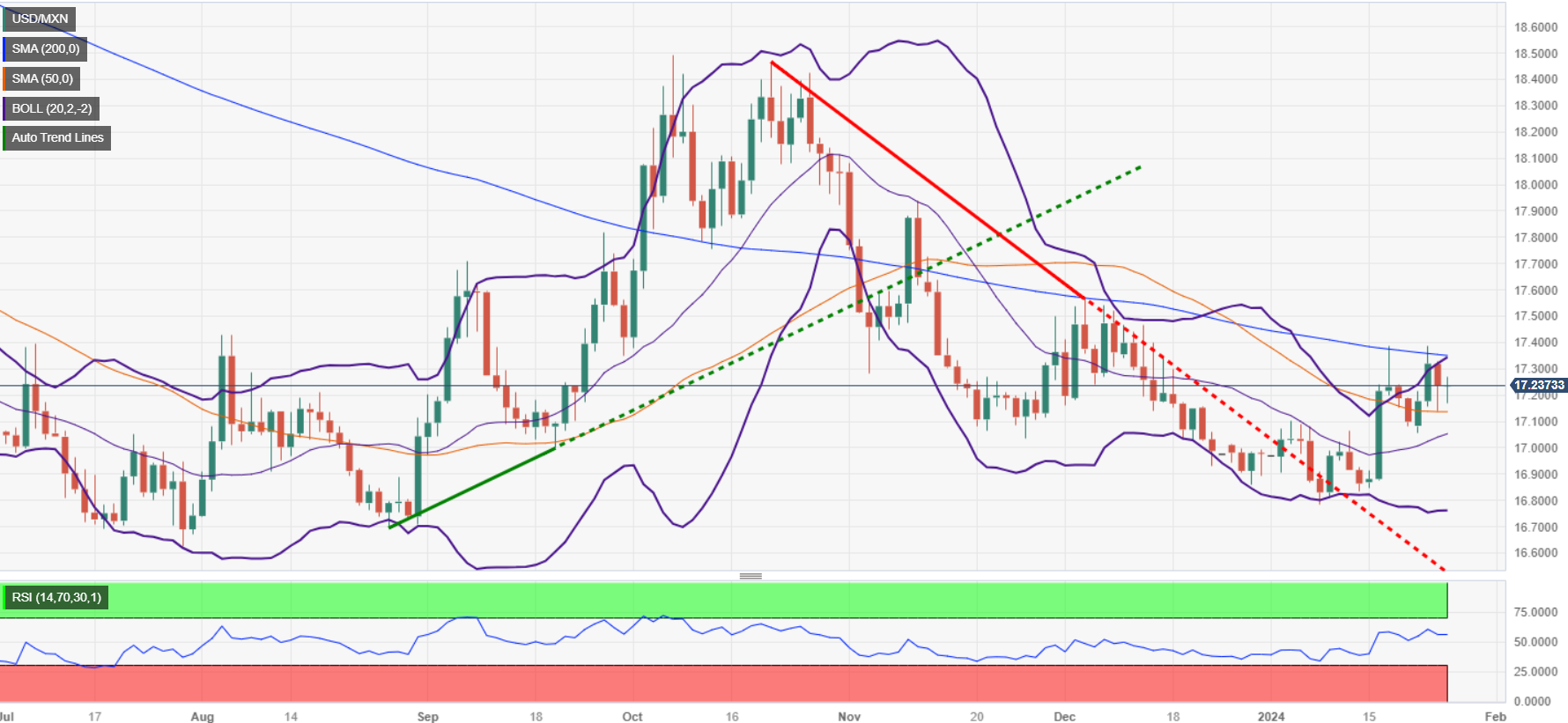
Technical Analysis: Mexican Peso stays firm as USD/MXN hovers around 17.24
The USD/MXN is virtually unchanged, though trading within familiar levels. If the exotic pair reclaims the 200-day Simple Moving Average (SMA) at 17.35, that could open the door for the pair to challenge the 100-day SMA at 17.42. Further upside is seen above the psychological 17.50 figure, ahead of rallying to the May 23 high from last year at 17.99.
Conversely, if sellers drag prices below the 50-day SMA at 17.13, that would pave the way for further downside. The following support is seen at 17.05, the January 22 low, followed by the 17.00 psychological figure.
USD/MXN Price Action – Daily Chart
US Dollar FAQs
What is the US Dollar?
The US Dollar (USD) is the official currency of the United States of America, and the ‘de facto’ currency of a significant number of other countries where it is found in circulation alongside local notes. It is the most heavily traded currency in the world, accounting for over 88% of all global foreign exchange turnover, or an average of $6.6 trillion in transactions per day, according to data from 2022.
Following the second world war, the USD took over from the British Pound as the world’s reserve currency. For most of its history, the US Dollar was backed by Gold, until the Bretton Woods Agreement in 1971 when the Gold Standard went away.
How do the decisions of the Federal Reserve impact the US Dollar?
The most important single factor impacting on the value of the US Dollar is monetary policy, which is shaped by the Federal Reserve (Fed). The Fed has two mandates: to achieve price stability (control inflation) and foster full employment. Its primary tool to achieve these two goals is by adjusting interest rates.
When prices are rising too quickly and inflation is above the Fed’s 2% target, the Fed will raise rates, which helps the USD value. When inflation falls below 2% or the Unemployment Rate is too high, the Fed may lower interest rates, which weighs on the Greenback.
What is Quantitative Easing and how does it influence the US Dollar?
In extreme situations, the Federal Reserve can also print more Dollars and enact quantitative easing (QE). QE is the process by which the Fed substantially increases the flow of credit in a stuck financial system.
It is a non-standard policy measure used when credit has dried up because banks will not lend to each other (out of the fear of counterparty default). It is a last resort when simply lowering interest rates is unlikely to achieve the necessary result. It was the Fed’s weapon of choice to combat the credit crunch that occurred during the Great Financial Crisis in 2008. It involves the Fed printing more Dollars and using them to buy US government bonds predominantly from financial institutions. QE usually leads to a weaker US Dollar.
What is Quantitative Tightening and how does it influence the US Dollar?
Quantitative tightening (QT) is the reverse process whereby the Federal Reserve stops buying bonds from financial institutions and does not reinvest the principal from the bonds it holds maturing in new purchases. It is usually positive for the US Dollar.
Author

Christian Borjon Valencia
FXStreet
Markets analyst, news editor, and trading instructor with over 14 years of experience across FX, commodities, US equity indices, and global macro markets.














