Mexican Peso gives back gains after strong start due to market risk-on
- The Mexican Peso trades mixed after a strong start due to risk-on, benefiting emerging market FX.
- A possible revival of carry trade inflows amid a weaker Japanese Yen and reduced domestic political risk are further factors.
- USD/MXN is in the midst of unfolding a bullish ‘abc’ pattern move.

The Mexican Peso (MXN) trades mixed on Tuesday after a strong start. Positive risk appetite during the US sessions on Monday, which led to further gains for the S&P 500 stock index, may have been a factor supporting the Peso since this tends to benefit emerging market currencies.
A revival of carry trade inflows could also have provided support for the Mexican Peso. This involves traders borrowing in a currency with low interest rates such as the Japanese Yen (JPY) and purchasing a currency with high interest rates such as the Mexican Peso. The difference between the interest earned on the Peso investment and that paid on the Yen loan represents the profit discounting fluctuations in the exchange rate.
The outlook for the Japanese Yen (JPY) is not looking bright after the weekend elections saw the ruling Liberal Democratic Party (LDP) coalition lose its grip on power. Opposition parties are generally against raising interest rates in Japan, which is weighing on the Yen and making the carry trade more attractive. Overnight, Yuichiro Tamaki, leader of the Japan Democratic Party for the People (DPP), said he was opposed to further rate hikes by the Bank of Japan (BoJ).
Mexican Peso impacted by political risk
The Mexican Peso may also have found support after the news that the Mexican Supreme Court Judge, Juan Luis González Alcántara Carrancá, a staunch opponent of the controversial judicial reforms the Sheinbaum administration is trying to implement, attempted a new tactic to block their implementation. The reforms enable the election of judges rather than their appointment, but Carrancá, argued on Monday, that the creation of the “Evaluation Committees” used to short-list candidates for elections in the first step, was unconstitutional in itself, according to El Financiero.
For context, the Peso depreciated over 10% in value after the June election in which Sheinbaum and her Morena party coalition gained a super majority in the Mexican Congress. Many western investors fretted over the consequences of the result since it would enable the new government to make radical reforms to the constitution, which critics viewed as market unfriendly.
On the data front, the Peso sees a busy week ahead, especially with Mexican preliminary Gross Domestic Product (GDP) data for Q3 and the Fiscal Balance out on Wednesday, and the Jobless Rate on Friday.
Recently, the International Monetary Fund (IMF) downgraded its forecasts for growth for the Mexican economy to 1.5% in 2024. GDP grew a robust 2.1% YoY in Q2, but corroboration of the IMF’s gloomy assessment from weak Q3 GDP data might weigh on the Peso.
Technical Analysis: USD/MXN unfolding leg higher
USD/MXN broadly continues unfolding a leg higher after a mild pullback. The up leg is probably the “c wave” of a bullish “abc” pattern, which began at the October 14 swing low. It will probably reach the Fibonacci 61.8% of the length of wave “a”, giving an upside target of 20.29. Such a move would gain confirmation from a break above the high of wave “b” at 20.09.
USD/MXN Daily Chart
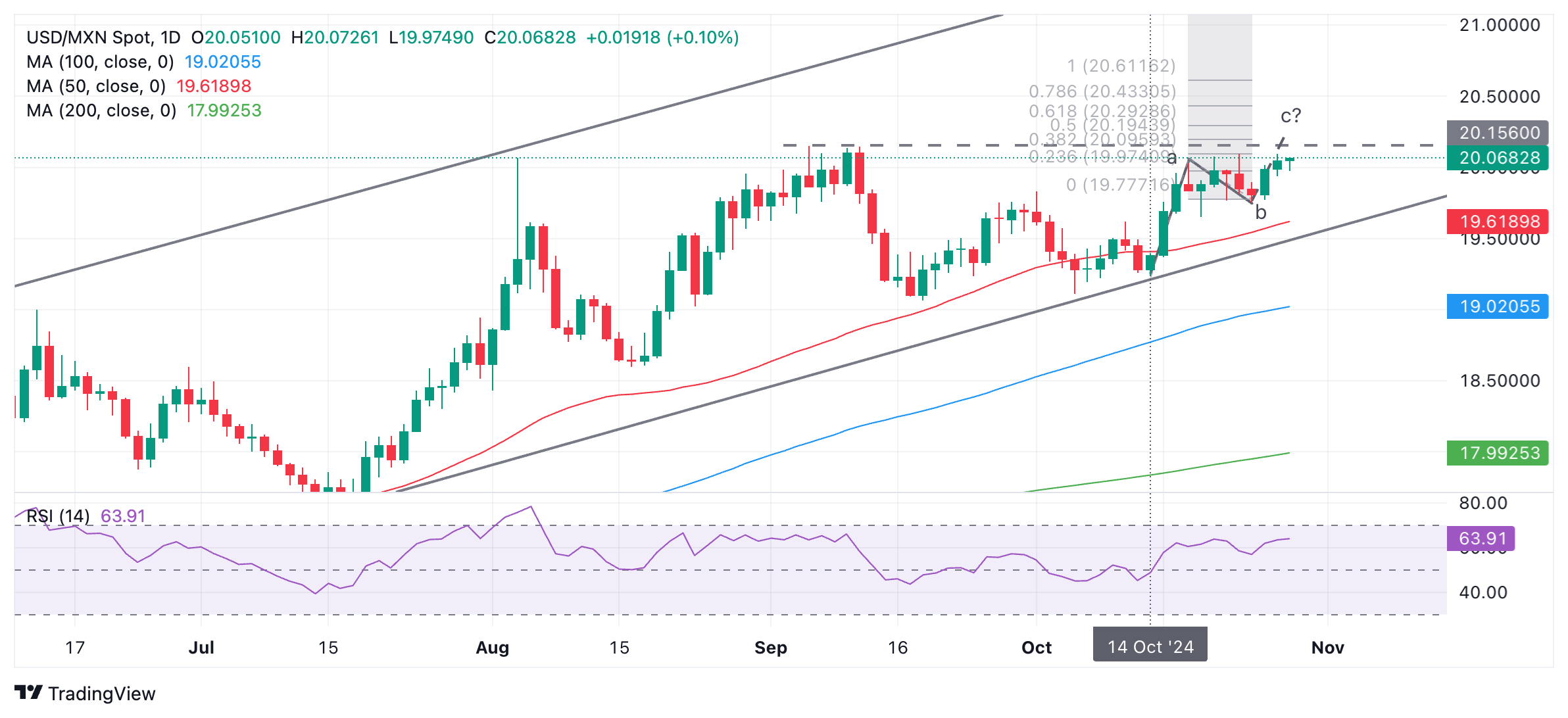
USD/MXN is probably in an uptrend on a short, medium and long-term basis and is trading in a rising channel. Given the technical dictum “the trend is your friend,” the odds favor a continuation higher.
In addition, the original break above 19.83 (October 1 high) has already confirmed a probable move up, with a target in the vicinity of the September 10 high at 20.13.
Risk sentiment FAQs
In the world of financial jargon the two widely used terms “risk-on” and “risk off'' refer to the level of risk that investors are willing to stomach during the period referenced. In a “risk-on” market, investors are optimistic about the future and more willing to buy risky assets. In a “risk-off” market investors start to ‘play it safe’ because they are worried about the future, and therefore buy less risky assets that are more certain of bringing a return, even if it is relatively modest.
Typically, during periods of “risk-on”, stock markets will rise, most commodities – except Gold – will also gain in value, since they benefit from a positive growth outlook. The currencies of nations that are heavy commodity exporters strengthen because of increased demand, and Cryptocurrencies rise. In a “risk-off” market, Bonds go up – especially major government Bonds – Gold shines, and safe-haven currencies such as the Japanese Yen, Swiss Franc and US Dollar all benefit.
The Australian Dollar (AUD), the Canadian Dollar (CAD), the New Zealand Dollar (NZD) and minor FX like the Ruble (RUB) and the South African Rand (ZAR), all tend to rise in markets that are “risk-on”. This is because the economies of these currencies are heavily reliant on commodity exports for growth, and commodities tend to rise in price during risk-on periods. This is because investors foresee greater demand for raw materials in the future due to heightened economic activity.
The major currencies that tend to rise during periods of “risk-off” are the US Dollar (USD), the Japanese Yen (JPY) and the Swiss Franc (CHF). The US Dollar, because it is the world’s reserve currency, and because in times of crisis investors buy US government debt, which is seen as safe because the largest economy in the world is unlikely to default. The Yen, from increased demand for Japanese government bonds, because a high proportion are held by domestic investors who are unlikely to dump them – even in a crisis. The Swiss Franc, because strict Swiss banking laws offer investors enhanced capital protection.
Author
Joaquin Monfort
FXStreet
Joaquin Monfort is a financial writer and analyst with over 10 years experience writing about financial markets and alt data. He holds a degree in Anthropology from London University and a Diploma in Technical analysis.