Mexican Peso depreciates as lawmakers vote on constitutional reforms
- The Mexican Peso trades slightly lower in its key pairs but remains in a firm downtrend overall.
- The passage of constitutional reforms as they are debated might provide volatility for MXN going forward.
- USD/MXN pauses within an uptrend inside a rising channel.

The Mexican Peso (MXN) trades lower in its key pairs on Tuesday as a mood of calm pervades markets although proposed reforms to the Mexican constiution currently being debated in the Mexican congress are weighing on the currency as experts fear they will harm inward investment if passed into law.
Just-released Mexican Jobless data showed an uptick in the number off unemployed to 2.9% in July YoY, in line with expectations and higher than the 2.8% of June. On a seasonally adjusted basis, however, the Jobless Rate remained unchanged at 2.7% in July, data from INEGI showed.
Gross Fixed Investment, meanwhile, fell 1.0% MoM in June after rising 0.7% in May and declined 1.3% in July after rising 6.0% in June on an annual basis.
USD/MXN gives back some of its earlier gains after the release of US ISM Manufacturing PMI data showed a slowdown in Manufacturing activity in August to 47.9 from 48.0 in July when no-change had been expected. The Employment Index, however, rose to 46.0 from 43.4 in the previous month, allaying fears regarding the reslience of the US labor market.
Mexican Peso traders eye possible volatility from constitutional reforms
Mexican Peso traders will be eyeing the passage of a controversial set of reforms to the constitution, involving the way judges are elected, which are scheduled to be debated in Mexico’s Congress on Tuesday and Wednesday, according to Reuters. Concerns around these reforms have weighed on financial markets in the past, and similar weakness is expected if they are eventually voted through and implemented.
Mexico’s Morena-led Government has more than the two-thirds majority in the lower house, which should enable them to vote the proposed reforms through. However, they are a vote short of a majority in the Senate, so there remains some uncertainty about whether they will pass into law immediately.
The reforms have been heavily criticized for undermining the rule of law and democracy although their defenders argue they will help fight the influence the criminal cartels have over the justice system. From a financial perspective, they run the risk of leading to a decline in foreign investment. This, in turn, would reduce demand for the Peso, leading to a further depreciation of the currency.
Recent Mexican macro data has been mixed, with the S&P Global Mexico Manufacturing Purchasing Managers Index (PMI) falling to 48.5 in August from 49.6 in July, and marking its lowest level in two years. Business Confidence, however, rose by two basis points to 53.2 in August.
At the time of writing, one US Dollar (USD) buys 19.86 Mexican Pesos, EUR/MXN trades at 21.93, and GBP/MXN at 26.01.
Technical Analysis: USD/MXN consolidates within uptrend
USD/MXN pauses within an uptrend inside a broader rising channel. Given that “the trend is your friend”, the odds favor an upside break, eventually taking the pair to new highs.
USD/MXN Daily Chart
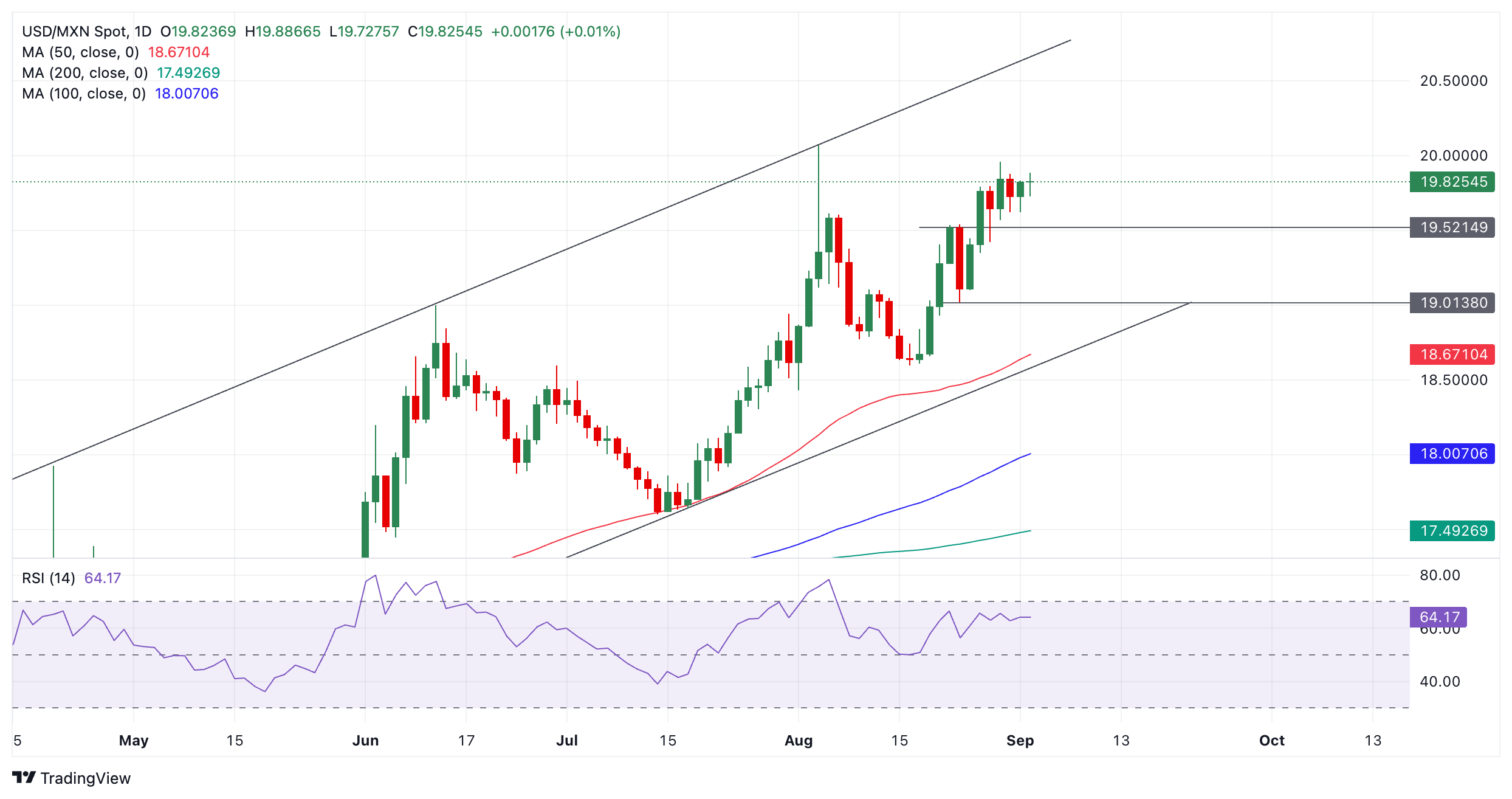
A close above 19.96 (August 29 high) would probably see a continuation of the bull trend, with the next target at the upper channel line in the 20.60s.
Economic Indicator
Jobless Rate s.a
The Jobless Rate figure released by INEGI is the number of unemployed workers in the economy. If the number rises, it indicates a lack of expansion within the Mexican labor market and thus a weakening in the economy. Normally, a decrease in the figure is seen as positive (or bullish) for the Mexican Peso, while an increase is seen as negative (or bearish).
Read more.Last release: Tue Sep 03, 2024 12:00
Frequency: Monthly
Actual: 2.7%
Consensus: -
Previous: 2.7%
Source: National Institute of Statistics and Geography of Mexico
Author

Joaquin Monfort
FXStreet
Joaquin Monfort is a financial writer and analyst with over 10 years experience writing about financial markets and alt data. He holds a degree in Anthropology from London University and a Diploma in Technical analysis.