Mexican Peso lags as Fed policy easing weighs on currency
- Mexican Peso depreciates over 0.80% as traders eye Fed’s first rate cut in four years.
- Fed lowers rates by 50 bps, yet the USD/MXN holds to earlier gains.
- Mixed Q2 data in Mexico and concerns over judicial reform may reduce investment attractiveness, adding to Peso volatility.

The Mexican Peso edged lower against the US Dollar during the North American session on Wednesday, dropping over 0.80% after the Federal Open Market Committee (FOMC decided to lower borrowing costs by 50 basis points Data from Mexico was mixed, though it failed to boost the Mexican currency. At the time of writing, the USD/MXN trades at 19.26 after hitting a low of 19.06.
Federal Reserve policymakers decided to lower borrowing costs as they grew confident that inflation is moving “sustainably” toward the bank’s 2% target. However, they acknowledged that the dual mandate of price stability and maximum employment is now roughly balanced while noting that the economic outlook remains uncertain.
The Fed’s decision was not unanimous as Governor Michelle Bowman dissented in the vote, favoring a smaller rate cut of a quarter percentage point.
The Summary of Economic Projections (SEP) shows the US central bank estimated interest rates to end at 4.4% in 2024 and 3.4% in 2025. Inflation, as measured by the Core Personal Consumption Expenditures Price Index (PCE), is projected to reach the Fed's 2% target by 2026, though it’s estimated to end at 2.6% in 2024 and 2.2% in 2025.
Fed officials also project the economy will grow at a 2% pace in 2024, with the Unemployment Rate rising to 4.4% by the end of the year.
During his press conference, Fed Chairman Jerome Powell stated that inflation risks have diminished and reaffirmed that the economy remains strong. He noted that if inflation persists, "we can dial back policy more slowly" and emphasized that the SEP indicates the Committee is not in a rush to normalize policy.
Even though the USD/MXN edged slightly lower after the FOMC’s decision, buyers stepped in and pushed the exotic pair toward current exchange rates. Meanwhile, eyes are on the Bank of Mexico (Banxico), which is expected to lower rates by 0.25% at the September 26 monetary policy meeting decision.
In the meantime, Victor Manuel Herrera, President of Instituto Mexicano de Ejecutivos de Finanzas (IMEF), commented that the judicial reform and the disappearance of autonomous organizations might affect the economy in Mexico and reduce investment attractiveness, given the phenomenon of companies relocating from the US.
Daily digest market movers: Mexican Peso weighed down by weak Mexican data, Fed decision
- USD/MXN would continue to be driven by market mood and expectations for a bigger Fed rate cut.
- Mexico’s Aggregate Demand in Q2 shrank -0.4%, below the previous reading of 1.2%. Private Spending in the second quarter plunged by 0.6% and trailed Q1’s expansion by 1.8%.
- US Building Permits in August grew by 4.9% MoM from 1.406 million to 1.475 million.
- Housing Starts expanded by 9.6% and rose from 1.237 million to 1.356 million.
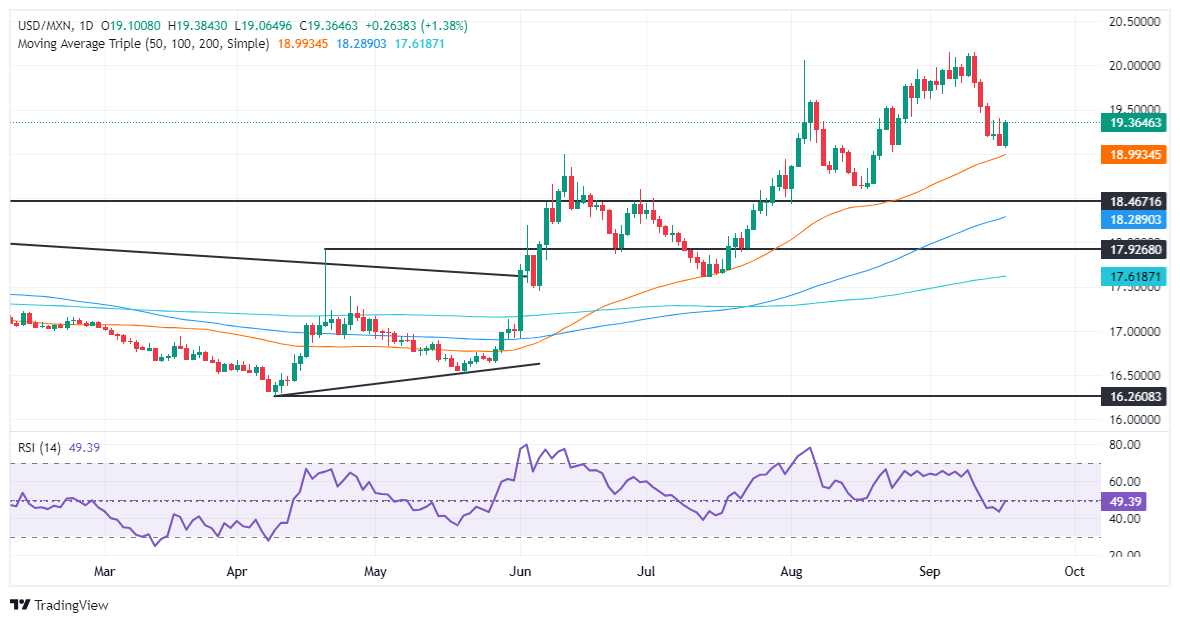
USD/MXN technical outlook: Mexican Peso falls as USD/MXN holds gains above 19.30
The USD/MXN uptrend remains intact, though the FOMC’s decision could rock the boat sharply and increase volatility. Momentum hints that bulls are gathering steam, as shown by the Relative Strength Index (RSI).
If USD/MXN climbs above 19.50, the next resistance would be the 20.00 psychological level. Further upside emerges at the yearly peak at 20.22, followed by the 20.50 mark.
Conversely, if USD/MXN drops below 19.15, key support levels emerge, like the August 23 daily low of 19.02, ahead of the 50-day Simple Moving Average (SMA) at 18.99.
Mexican Peso FAQs
The Mexican Peso (MXN) is the most traded currency among its Latin American peers. Its value is broadly determined by the performance of the Mexican economy, the country’s central bank’s policy, the amount of foreign investment in the country and even the levels of remittances sent by Mexicans who live abroad, particularly in the United States. Geopolitical trends can also move MXN: for example, the process of nearshoring – or the decision by some firms to relocate manufacturing capacity and supply chains closer to their home countries – is also seen as a catalyst for the Mexican currency as the country is considered a key manufacturing hub in the American continent. Another catalyst for MXN is Oil prices as Mexico is a key exporter of the commodity.
The main objective of Mexico’s central bank, also known as Banxico, is to maintain inflation at low and stable levels (at or close to its target of 3%, the midpoint in a tolerance band of between 2% and 4%). To this end, the bank sets an appropriate level of interest rates. When inflation is too high, Banxico will attempt to tame it by raising interest rates, making it more expensive for households and businesses to borrow money, thus cooling demand and the overall economy. Higher interest rates are generally positive for the Mexican Peso (MXN) as they lead to higher yields, making the country a more attractive place for investors. On the contrary, lower interest rates tend to weaken MXN.
Macroeconomic data releases are key to assess the state of the economy and can have an impact on the Mexican Peso (MXN) valuation. A strong Mexican economy, based on high economic growth, low unemployment and high confidence is good for MXN. Not only does it attract more foreign investment but it may encourage the Bank of Mexico (Banxico) to increase interest rates, particularly if this strength comes together with elevated inflation. However, if economic data is weak, MXN is likely to depreciate.
As an emerging-market currency, the Mexican Peso (MXN) tends to strive during risk-on periods, or when investors perceive that broader market risks are low and thus are eager to engage with investments that carry a higher risk. Conversely, MXN tends to weaken at times of market turbulence or economic uncertainty as investors tend to sell higher-risk assets and flee to the more-stable safe havens.
Author

Christian Borjon Valencia
FXStreet
Markets analyst, news editor, and trading instructor with over 14 years of experience across FX, commodities, US equity indices, and global macro markets.















