Mexican Peso depreciates as US producer inflation rise lifts USD
- Mexican Peso faces losses against a resurgent US Dollar, reacting to positive US retail and inflation reports.
- Banxico Deputy Governor Mejia signals potential for early interest rate cuts, which weighs on the Mexican currency.
- US economic strength challenges Fed's easing timeline as traders trim rate cut bets for June’s meeting.

The Mexican Peso (MXN) posts minimal losses against the US Dollar (USD) after robust economic data from the United States might deter the US Federal Reserve (Fed) from cutting rates in the first half of 2024. Bank of Mexico (Banxico) Deputy Governor Omar Mejia opened the door for an interest rate cut in a podcast on Wednesday, emphasizing that it is not premature due to the bank’s high rate level. The USD/MXN trades at 16.69, gaining 0.20%.
Market mood is negative, as reflected by US equities printing losses. The US Commerce Department revealed that Retail Sales in February improved compared to January’s plunge. At the same time, the Bureau of Labor Statistics (BLS) revealed that inflation on the producer side climbed, sparking a jump in the Greenback.
In other data, the Department of Labor revealed that Americans filing for unemployment benefits decreased below the prior week’s reading and missed estimates.
Daily digest market movers: Mexican Peso gives way to US Dollar buyers, unable to reach nine-year high
- Banxico’s Mejia commented that they have a long way to go on the disinflationary path, though he acknowledged the stickiness of services inflation. He stresses that the balance of risks for inflation is less adverse.
- Mexican economic data revealed during the week:
- Industrial production in January rose 0.4% MoM as expected, and it gained from -0.7% in December’s contraction. In the twelve months to January, production increased by 2.9%, above estimates, smashing December’s 0% reading.
- US Retail Sales in February came in at 0.6% MoM, below estimates of 0.8%, though improved from a -1.1% January contraction.
- The Producer Price Index (PPI) exceeded forecasts of 1.1% and rose by 1.6% YoY in February. Excluding volatile items, the so-called core PPI expanded by 2% YoY, unchanged, though a tick higher than the estimated 1.9%.
- Initial Jobless Claims for the week ending March 9 rose by 209K, missed estimates of 218K and stood below the previous week's reading of 218K.
- Thursday’s data added to the release of the latest Consumer Price Index (CPI) report in the United States, cementing the Federal Reserve’s case for being patient about cutting interest rates. Unless data proves the disinflationary process is sustainably trending toward the 2% goal, they will stick to the “higher for longer” mantra. The next Fed meeting is scheduled for March 19-20 next week.
- Banxico’s private analyst poll projections for February were updated. They expect inflation at 4.10%, core CPI at 4.06%, and the economy to grow by 2.40%, unchanged from January. Regarding monetary policy, they see Banxico lowering rates to 9.50% and the USD/MXN exchange rate at 18.31, down from 18.50.
- During Banxico’s quarterly report, policymakers acknowledged the progress on inflation and urged caution against premature interest rate cuts. Governor Victoria Rodriguez Ceja said adjustments would be gradual, while Deputy Governors Galia Borja and Jonathan Heath called for prudence. The latter specifically warned against the risks of an early rate cut.
- Banxico updated its economic growth projections for 2024 from 3.0% to 2.8% YoY and maintained 1.5% for 2025. The slowdown is blamed on higher interest rates at 11.25%, which sparked a shift from three of Banxico’s five governors, who are eyeing the first rate cut at the March 21 meeting.
- A Reuters poll showed investors estimate the Fed to be the first central bank to cut rates in June.
- Meanwhile, 52 of 108 economists expect the Fed to cut rates by 75 basis points in 2024, with 26 saying 100 bps.
- A Reuters poll sees the Mexican Peso depreciating 7% to 18.24 in 12 months from 16.96 on Monday, according to the median of 20 FX strategists polled between March 1-4. The forecast ranged from 15.50 to 19.00.
- A Reuters poll shows 15 analysts estimate that inflation will slow down in February, corroborating bets that Banxico could cut rates as soon as the March 21 meeting.
- The CME FedWatch Tool shows traders decreased their bets for a 25-basis-point rate cut in June, down from 72% at the beginning of the week to 60%.
Technical analysis: Mexican Peso depreciates as USD/MXN edges toward 16.70
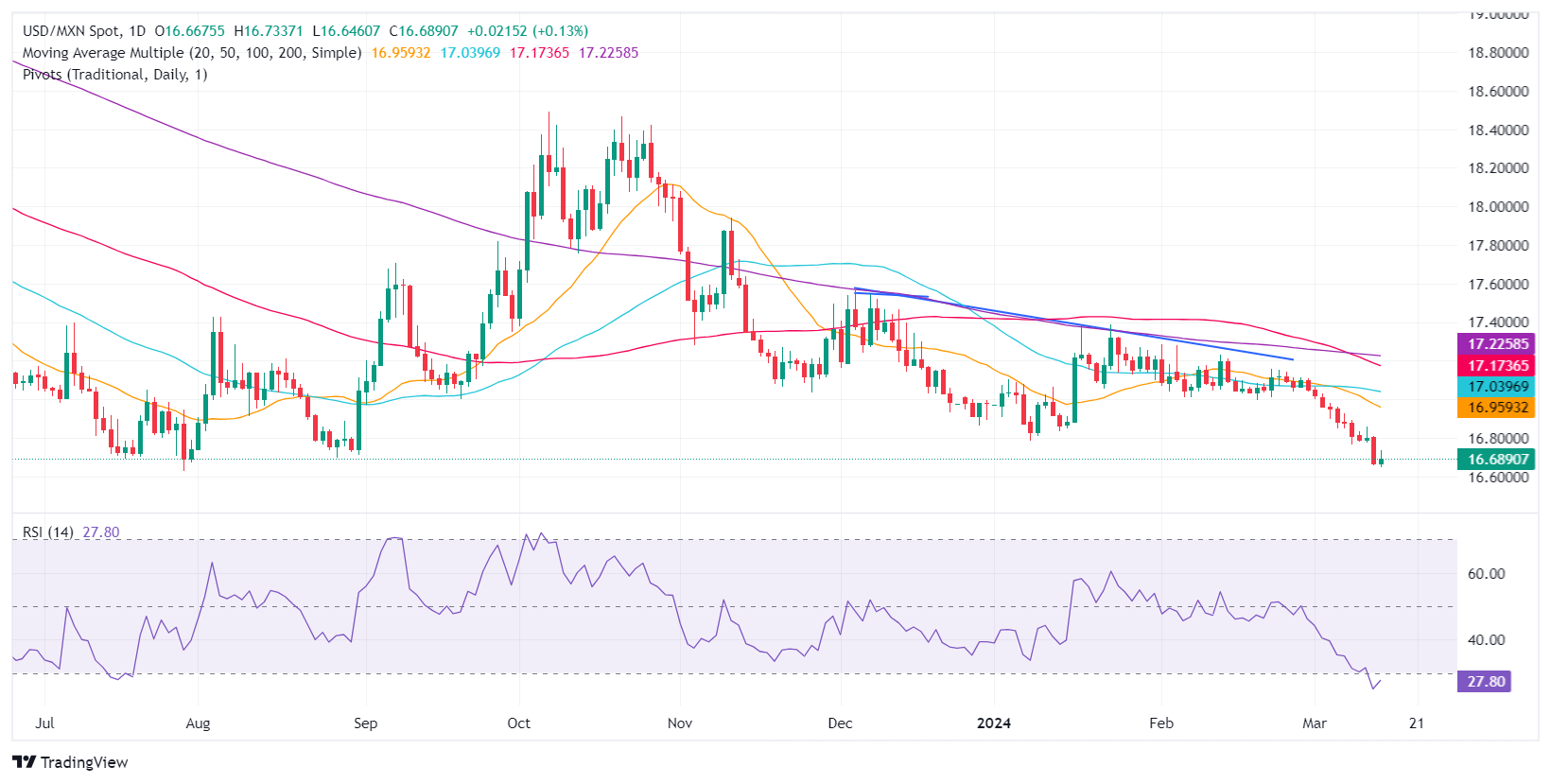
The USD/MXN downtrend remains intact, but after refreshing year-to-date lows of 16.64, the exotic pair seems to be oversold. The Relative Strength Index (RSI) was below the 30.00 level but has pierced to the upside, signaling buyers could be gathering momentum. If that’s the case, they must reclaim January’s low of 16.78 so they can challenge the 17.00 figure.
Key resistance levels lie at the 50-day Simple Moving Average (SMA) at 17.04, followed by the confluence of the 200-day SMA and the 100-day SMA at 17.23.
On the other hand, and the path of least resistance, the pair could extend its losses below 2023’s low of 16.62, which could exacerbate a drop toward October 2015’s low of 16.32, followed by the 16.00 psychological level.
USD/MXN Price Action – Daily Chart
Mexican Peso FAQs
The Mexican Peso (MXN) is the most traded currency among its Latin American peers. Its value is broadly determined by the performance of the Mexican economy, the country’s central bank’s policy, the amount of foreign investment in the country and even the levels of remittances sent by Mexicans who live abroad, particularly in the United States. Geopolitical trends can also move MXN: for example, the process of nearshoring – or the decision by some firms to relocate manufacturing capacity and supply chains closer to their home countries – is also seen as a catalyst for the Mexican currency as the country is considered a key manufacturing hub in the American continent. Another catalyst for MXN is Oil prices as Mexico is a key exporter of the commodity.
The main objective of Mexico’s central bank, also known as Banxico, is to maintain inflation at low and stable levels (at or close to its target of 3%, the midpoint in a tolerance band of between 2% and 4%). To this end, the bank sets an appropriate level of interest rates. When inflation is too high, Banxico will attempt to tame it by raising interest rates, making it more expensive for households and businesses to borrow money, thus cooling demand and the overall economy. Higher interest rates are generally positive for the Mexican Peso (MXN) as they lead to higher yields, making the country a more attractive place for investors. On the contrary, lower interest rates tend to weaken MXN.
Macroeconomic data releases are key to assess the state of the economy and can have an impact on the Mexican Peso (MXN) valuation. A strong Mexican economy, based on high economic growth, low unemployment and high confidence is good for MXN. Not only does it attract more foreign investment but it may encourage the Bank of Mexico (Banxico) to increase interest rates, particularly if this strength comes together with elevated inflation. However, if economic data is weak, MXN is likely to depreciate.
As an emerging-market currency, the Mexican Peso (MXN) tends to strive during risk-on periods, or when investors perceive that broader market risks are low and thus are eager to engage with investments that carry a higher risk. Conversely, MXN tends to weaken at times of market turbulence or economic uncertainty as investors tend to sell higher-risk assets and flee to the more-stable safe havens.
Author

Christian Borjon Valencia
FXStreet
Markets analyst, news editor, and trading instructor with over 14 years of experience across FX, commodities, US equity indices, and global macro markets.

















