Meta Platforms Stock News: META closes nearly 4% lower as NASDAQ sinks to five-month low
- Meta Platforms stock sells off one day after beating consensus on Q3 earnings.
- NASDAQ Composite declines more than 1% on continued equity market jitters.
- Preliminary Q3 US GDP arrives well above expectations at 4.9%.
- Meta trounced earnings consensus for the third quarter.
- The Q4 outlook appears shaky though as geopolitics intrudes on advertising sales.


Meta Platforms (META), the owner of Facebook and Instagram, closed 3.7% lower on Thursday in its first regular session after posting an earnings beat late Wednesday. META shares have declined from Wednesday's close just below $300 to $288.35, while shares dropped mid-session to as low as $279.40.
The last 24 hours have been a tale of “fours” for Meta Platforms. Prior to earnings, the stock price dropped 4% on Wednesday, rose 4% initially afterhours on the earnings beats, then opened down over 4% on Thursday.
The NASDAQ Composite reached an official correction on Wednesday, represented by a 10% slide from its July peak. The NASDAQ then pulled back another 1.8% on Thursday, while the S&P 500 has given up 1.2%. The NASDAQ is now trading at levels not seen since late May.
Meta Platforms stock earnings: Q4 advertising uncertainty sends shares lower
Meta Platforms reported third-quarter GAAP earnings per share (EPS) of $4.39. This was an incredible 21% above consensus from Wall Street. Revenue also trounced consensus by $700 million, coming in at $34.15 billion.
The problem, if it can be called a problem, is that founder Mark Zuckerberg’s Meta Platforms is experiencing heavier volatility in advertising sales in the first few weeks of the fourth quarter. Executives zeroed in on the Israel-Palestine crisis as causing general pessimism among marketing departments as worries persist that the war could expand into a wider geopolitical crisis.
This uncertainty led executives to provide a fourth-quarter outlook on revenue of around $38.25 billion, which was $500 million below the Street’s expectation.
Facebook’s daily active users rose 5% from a year ago to 2.09 billion – about 20 million users above the forecast. Monthly active users, the more significant number, matched consensus by rising 3% YoY to 3.05 billion.
Capital expenditure dropped by more than $2 billion from a year ago, while advertising impressions from Meta’s Family of Apps segment increased by 31% YoY and the average price per ad decreased by 6% year-over-year.
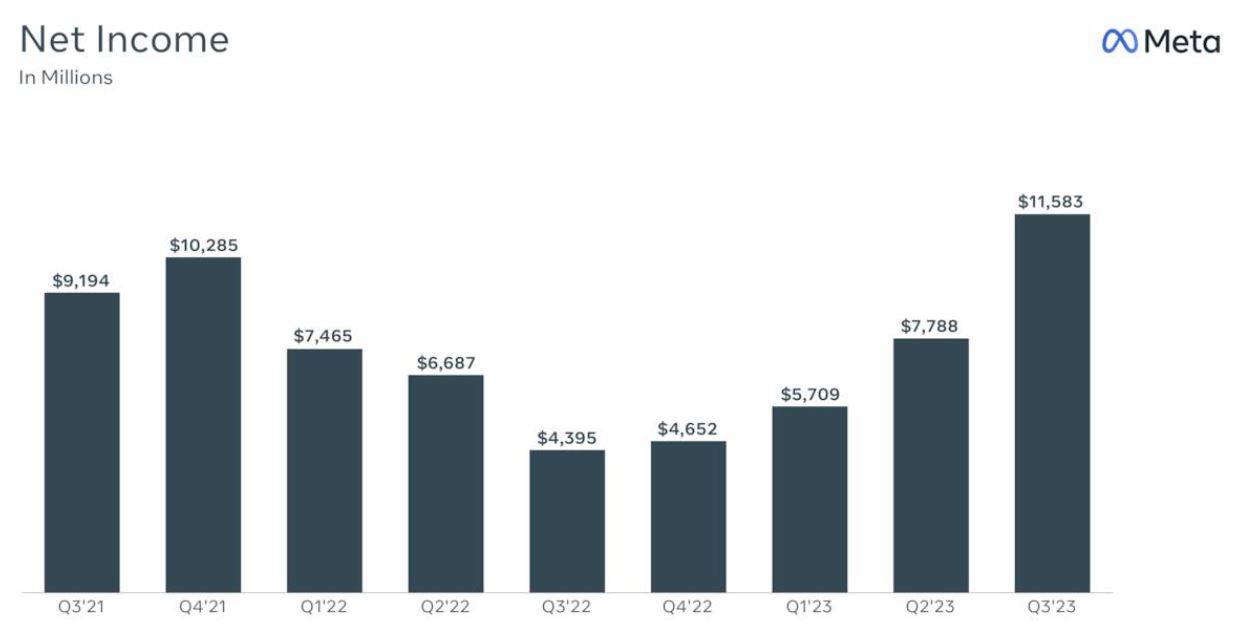
Meta Platforms Net Income Chart (Source: Meta Q3 2023 earnings)
Preliminary Q3 US GDP trounces expectations
Preliminary US GDP was released before the open on Thursday. While economists already expected a decent 4.2% showing, the print came in above consensus at 4.9%. The reading is preliminary and could be revised lower in future months, but it seems to demonstrate that the US economy is coping quite well despite the high interest rate environment.
The second quarter was eventually revised down to 2.1% on an annualized basis, so Q3’s 4.9% reading may lead some to expect core inflation to remain harder for the Federal Reserve to bring down to its 2% mandate.
Still, the odds remain on the Fed keeping rates unchanged at its November 1 meeting next week, according to CME Group’s FedWatch Tool.
Nasdaq FAQs
What is the Nasdaq?
The Nasdaq is a stock exchange based in the US that started out life as an electronic stock quotation machine. At first, the Nasdaq only provided quotations for over-the-counter (OTC) stocks but later it became an exchange too. By 1991, the Nasdaq had grown to account for 46% of the entire US securities’ market. In 1998, it became the first stock exchange in the US to provide online trading. The Nasdaq also produces several indices, the most comprehensive of which is the Nasdaq Composite representing all 2,500-plus stocks on the Nasdaq, and the Nasdaq 100.
What is the Nasdaq 100?
The Nasdaq 100 is a large-cap index made up of 100 non-financial companies from the Nasdaq stock exchange. Although it only includes a fraction of the thousands of stocks in the Nasdaq, it accounts for over 90% of the movement. The influence of each company on the index is market-cap weighted. The Nasdaq 100 includes companies with a significant focus on technology although it also encompasses companies from other industries and from outside the US. The average annual return of the Nasdaq 100 has been 17.23% since 1986.
How can I trade the Nasdaq 100?
There are a number of ways to trade the Nasdaq 100. Most retail brokers and spread betting platforms offer bets using Contracts for Difference (CFD). For longer-term investors, Exchange-Traded Funds (ETFs) trade like shares that mimic the movement of the index without the investor needing to buy all 100 constituent companies. An example ETF is the Invesco QQQ Trust (QQQ). Nasdaq 100 futures contracts allow traders to speculate on the future direction of the index. Options provide the right, but not the obligation, to buy or sell the Nasdaq 100 at a specific price (strike price) in the future.
What Factors Drive the Nasdaq 100
Many different factors drive the Nasdaq 100 but mainly it is the aggregate performance of the component companies revealed in their quarterly and annual company earnings reports. US and global macroeconomic data also contributes as it impacts on investor sentiment, which if positive drives gains. The level of interest rates, set by the Federal Reserve (Fed), also influences the Nasdaq 100 as it affects the cost of credit, on which many corporations are heavily reliant. As such the level of inflation can be a major driver too as well as other metrics which impact on the decisions of the Fed.
Meta Platforms stock forecast
Despite its steep sell-off, Meta Platforms stock is beginning to find a supportive base on Thursday. Bulls are buying the dip, driving the price off the intraday low of $279.40 back up toward $290.
If the pullback develops further over the next few sessions, shareholders can take advantage of the August 18 and August 25 lows above $274 and $276, respectively, for buying opportunities. Below that supportive band lies the $244 level that worked all the way back in September 2020.
As the 9-day Simple Moving Average (SMA) moves below its 21-day SMA counterpart on Thursday for the first time in several weeks, traders will likely expect more downside to come until META stock retakes the $300 psychological level.
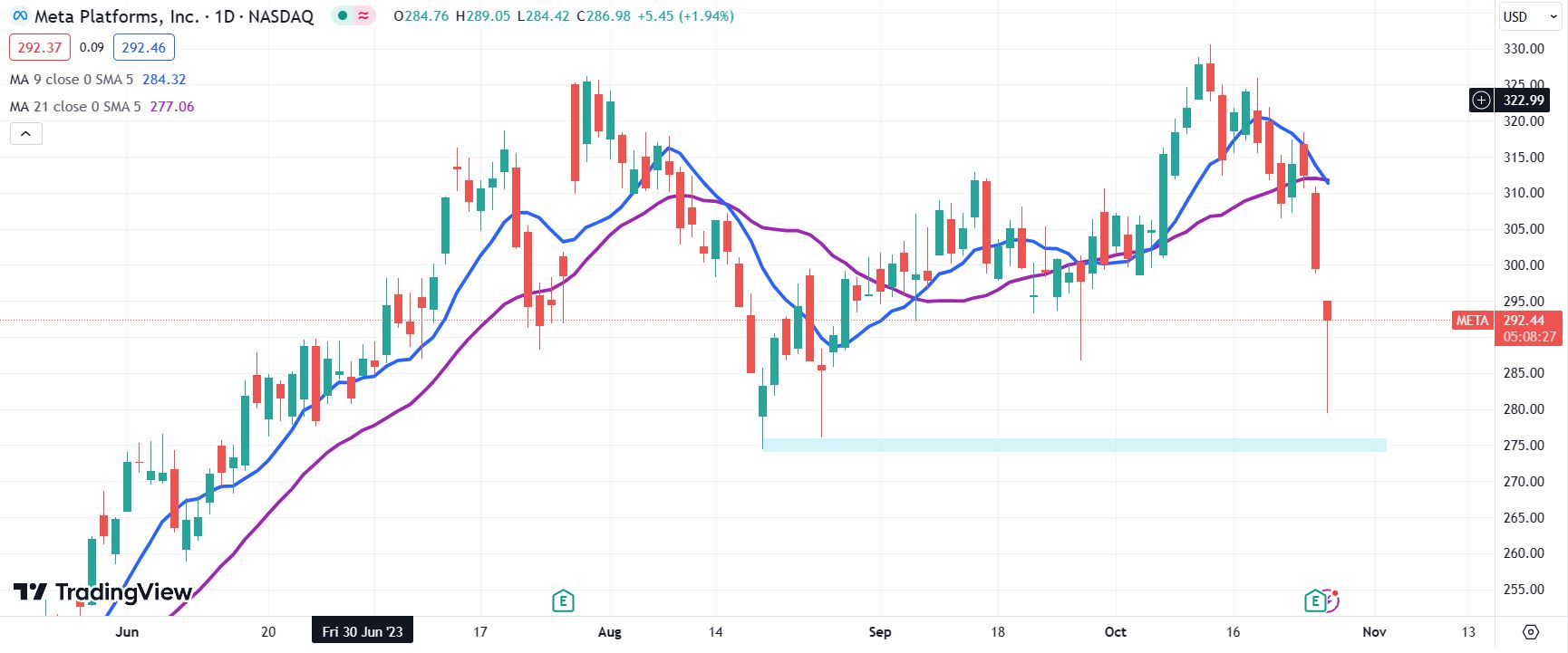
META daily chart
Premium
You have reached your limit of 3 free articles for this month.
Start your subscription and get access to all our original articles.
Author
Clay Webster
FXStreet
Clay Webster grew up in the US outside Buffalo, New York and Lancaster, Pennsylvania. He began investing after college following the 2008 financial crisis.

















