Mastercard's stability vs Affirm's velocity: Which has more upside?


Key takeaways
- AFRM reports 34% revenue growth and 42% GMV gains driven by major merchant integrations and Affirm Card.
- AFRM expands its ecosystem to 24.1M consumers and 419,000 merchants while enhancing AI-powered underwriting.
- MA posts 17% Q3 revenue growth supported by higher volumes, cross-border strength and value-added services.
The payments landscape is experiencing a significant transformation as Buy Now, Pay Later (BNPL) emerges as a popular financing choice. What used to be a niche choice at checkout is now challenging decades of credit-card dominance. In this evolving landscape, Mastercard Incorporated (MA - Free Report) and Affirm Holdings, Inc. (AFRM - Free Report) are now in a race to shape the future of short-term credit in the digital economy.
Despite their distinct backgrounds, both companies share a common goal: to make credit more flexible, predictable and seamlessly available across both digital and physical commerce, while enhancing consumer experience. The BNPL trend is no longer limited to online checkouts; it is expanding into cards, in-store purchases and everyday spending. As consumers seek alternatives to traditional credit, BNPL is becoming a key area for growth.
Let’s dive deep and closely compare the fundamentals of the two stocks to determine which stock is more attractive now.
The case for Mastercard
Mastercard, with a market cap $489.4 billion, brings together consumers, financial institutions, digital partners, businesses, merchants and various organizations around the globe by facilitating electronic payments and ensuring these transactions are secure, straightforward, smart and accessible for everyone. Rather than competing directly with BNPL companies, MA leverages its position as a global network to help banks, fintechs, lenders, merchants and wallets to provide installment solutions through Mastercard Installments.
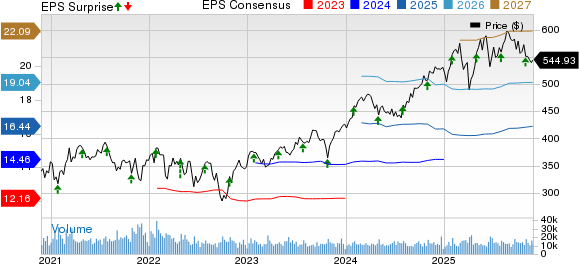
The company’s net revenues rose 17% year over year in the third quarter of 2025, along with 12% growth in Payment network net revenue. The top line benefited from increased gross dollar volume, cross-border volumes, strong demand for value-added services and growth in switched transactions due to robust consumer spending. It beat earnings estimates in each of the past four quarters, with an average surprise of 3.1%.
Mastercard incorporated price, consensus and EPS surprise
Moreover, innovation goes way beyond just BNPL. The company is continuously focusing on and investing in areas like tokenization, cybersecurity, stablecoins, digital identity, open banking and real-time payments that strengthen its position in a landscape where alternatives are rapidly scaling. It is also focusing on AI-powered solutions. MA’s series of fresh and renewal partnerships strengthens its long-term relationships, and also helps solidify its global network and support consistent growth in transactions. However, the upside was partly offset by escalating operating expenses and higher rebates and incentives. In the third quarter, adjusted operating expenses rose 15% year over year; we expect them to rise 15.8% in 2025. Its long-term debt-to-capital ratio of 70.6% is higher than the industry’s average of 37.9% but marginally below AFRM’s average.
MA’s strong cash position enables substantial share buybacks and dividend payouts and supports inorganic growth and financial stability. With $10.4 billion in cash and no short-term debt, Mastercard maintains a solid capital position.
The case for affirm
Affirm has established itself as a key player in the BNPL space, aiming to transform short-term borrowing by focusing on transparency and using data-driven underwriting. It offers payment plans with clear schedules, no late fees, no compounding interest and no hidden costs. These features are especially appealing to younger users who value cost certainty over revolving balances.
One of the key drivers behind the company’s impressive growth has been its partnerships with merchants and platforms. By teaming up with giants like Amazon, Shopify, Apple Pay and Williams-Sonoma, AFRM is seamlessly integrated into the checkout process for millions of shoppers. These integrations not only enhance gross merchandise volume (GMV) but also allow merchants to offer 0% APR promotions. The company boasts a growing base of 24.1 million active consumers and 419,000 active merchants as of Sept. 30, 2025, a clear indication of its expanding ecosystem. The firm also uses AI to enhance internal productivity and customer support, including a chatbot that automates thousands of daily interactions.
AFRM’s AI-powered underwriting tools and real-time risk assessments allow it to approve users with greater accuracy and grow profitably. It is also broadening its relationship with blue-chip forward flow buyers while scaling its ABS program. In the first quarter of fiscal 2026, the company posted $933 million in revenues, up 34% year over year, along with 38% growth in network revenues. Its GMV rose 42% year over year in the same period, benefiting from solid direct merchant point-of-sale integrations, direct-to-consumer business led by Affirm Card and wallet partnerships.
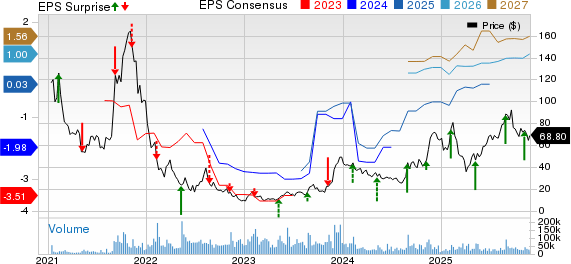
However, it continues to face a rise in total expenses. Total operating expenses rose 4.6% year over year in the first quarter. The metric is rising mainly due to higher funding costs, provision for credit losses and processing and servicing expenses. It beat earnings estimates in each of the past four quarters with an average surprise of 129.3%.
Affirm holdings, Inc price, consensus and EPS surprise
How do zacks estimates compare for MA & AFRM?
Estimates are in favor of AFRM at this stage. The Zacks Consensus Estimate expects MA’s 2025 sales and earnings per share (EPS) to grow 15.8% and 12.6% year over year, respectively. For 2026, EPS is expected to climb another 15.8%. Meanwhile, AFRM’s fiscal 2026 sales and EPS estimates point to 26% and 566.7% year-over-year increases, followed by a 56.4% EPS rise in fiscal 2027. Notably, both companies have seen multiple upward estimate revisions in the past 30 days.
Price performance comparison
Over the year-to-date period, Mastercard stock delivered a respectable 3.5% return while the S&P 500 grew 17.6%. Affirm, despite a dramatic ride, as u can see in the figure below, delivering a 13% increase, outperformed MA.
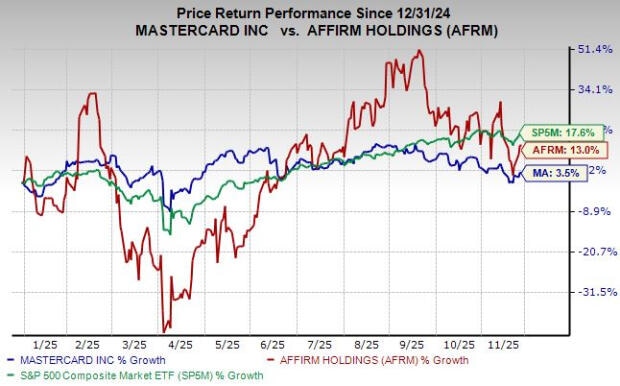
Image Source: Zacks Investment Research
Valuation: MA vs AFRM
On a price-to-sales basis, MA sits at 13.46X forward revenues, significantly above Affirm’s multiple of 5.11X. AFRM’s cheaper P/S multiple leaves room for significant growth as business expansion accelerates.
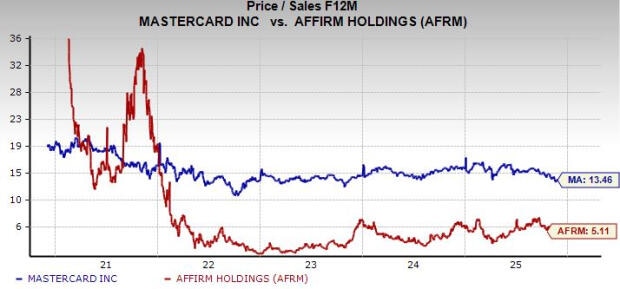
Image Source: Zacks Investment Research
Mastercard currently trades below its average analyst price target of $659.38, implying a 21% potential upside from current levels. Meanwhile, Affirm currently trades below its average analyst price target of $94.73, implying an attractive 37.7% potential upside from current levels.
Conclusion
Both Mastercard and Affirm are standout payment facilitators with strong growth narratives, but Affirm currently has more room to run. Its rapid user adoption, keen focus on BNPL innovation and strong merchant integrations put it in a prime position to take advantage of the changing ways consumers borrow and shop. In a market that increasingly values flexible and transparent credit options, AFRM’s momentum and disruptive approach offer a more compelling long-term growth story than MA.
For investors seeking rapid future gains rather than stability, Affirm has the edge at the moment, even though the companies currently carry a Zacks Rank #3 (Hold) each.
Want the latest recommendations from Zacks Investment Research? Download 7 Best Stocks for the Next 30 Days. Click to get this free report
Author
Zacks
Zacks Investment Research
Zacks Investment Research provides unbiased investment research and tools to help individuals and institutional investors make confident investing decisions.

















