|

Mark Stock Price: Remark Holding inc may rise while other shares fall on coronavirus second wave fears

  • Remark Holdings Inc is trading marginally lower, falling alongside the broad stock market.
  • Pessimism from the Federal Reserve may hurt various shares but may skip NASDAQ:MARK.
  • Concerns about a second coronavirus wave may already boost the firm while weighing on stocks.

Have broader stock markets hit the peak? Remark Holding could stand out and climb while that happens. The primary reason for the fall is the Federal Reserve's pessimism about an economic recovery. The world's most powerful central bank foresees a return to pre-pandemic output not before 2022. Only then do some officials consider raising rates, while the vast majority leave it beyond the horizon.

The Fed will continue buying bonds at an elevated pace and called on the government to do more. Jerome Powell, Chairman of the Federal Reserve, emphasized by saying that the bank is "not even thinking about thinking of raising rates." The pessimism is weighing on markets and Remark is not immune to the falls.

The stock is holding above the June low, a bullish sign. However, it needs to recapture the previous peaks above $3 to confirm a fresh uptrend.
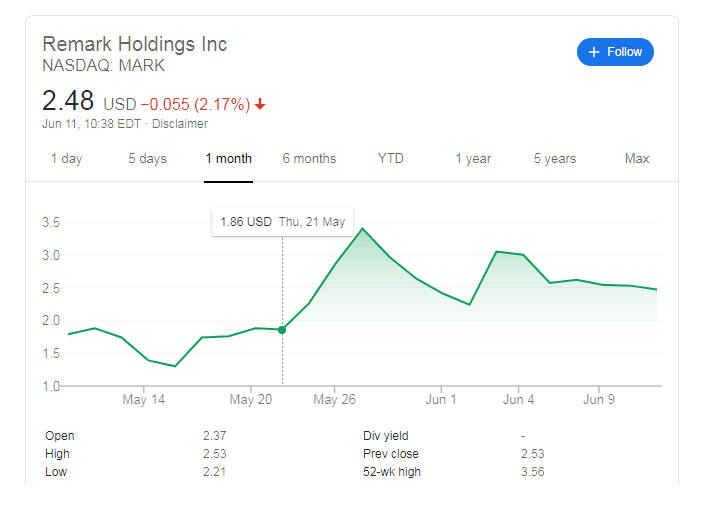
Mark stock news

However, another market downer is one that NASDAQ: MARK may benefit from. Investors are growingly concerned with a potential second wave of coronavirus in the US. While the greater New York area is bending the curve down, cases are on the rise in three large states – California, Texas, and Florida. 

Remark's thermal scanners are useful for detecting people with fever, allowing for a safer return to normal – or preventing new lockdowns. The equipment can scan up to 120 people per minute, allowing for quick movement into small and large spaces alike. 

Moreover, Remark produces AI kit that is coming into high demand in China. That may also allow the stock to hold its ground and rise. Remark also has a stake in a company founded by Dr. Oz.

Author

Yohay Elam

Yohay Elam

FXStreet

Yohay is in Forex since 2008 when he founded Forex Crunch, a blog crafted in his free time that turned into a fully-fledged currency website later sold to Finixio.


More from Yohay Elam
Share:

Editor's Picks

GBP/USD remains offered; bears target 1.3600

GBP/USD now leaves behind part of its recent recovery and revisits the low 1.3600s at the beginning of the week. Indeed, Cable trades with a mild downward bias amid decent gains in the Greenback as investors remain wary of upcoming US data releases and the Jackson Hole event.

EUR/USD remains sidelined above 1.1650

EUR/USD trades on the defensive following the closing bell on Wall Street on Monday, hovering around the 1.1660 region and adding to Friday’s small decline. The pair’s pullback comes in response to an acceptable rebound in the US Dollar in a context of generalised caution ahead of key US data releases and Chair Warsh’s speech in Jackson Hole.

Gold poised to extend its bullish run

Gold surrenders part of its initial advance, although it keeps its bullish pace well and sound above the $4,600 mark per troy ounce on Monday. The precious metal’s move higher comes despite slight gains in the US Dollar and a modest pullback in US Treasury yields across the curve.

XRP surged 72%, but is the rally really about XRP?
Ripple (XRP) surged more than 72% in less than a week, its strongest rally since July 2025, as cryptocurrency prices broadly broke out. But the move has a problem: it may have little to do with XRP itself. The token's near-term rally appears to have been driven largely by a broader liquidity shift after the US Treasury expanded long-end bond buybacks, pulling yields lower and lifting risk assets.
Convulsion in credit markets
The United States government just posted a $432.3 billion deficit for July, the largest monthly shortfall since March of 2021. That single burst of red ink pushed the yeartodate deficit to $1.8 trillion, with two months still remaining in fiscal 2026. At this pace, Washington will soon wax nostalgic for the “good old days” when annual deficits were only $2 trillion.
$20 billion offered, $2 billion taken: Why Treasury doubled its buyback cap

The US Treasury moved off its own calendar on Wednesday, and that is the part worth sitting with. At 12:32 GMT, the department said it would at least double the size of liquidity support buyback operations in the 10-year to 20-year and 20-year to 30-year sectors, lifting the maximum from $2 billion per operation to at least $4 billion, effective September 9 and running to November 4.















