JPMorgan, Goldman Sachs gain as Dow Jones ends historic sell-off
- The Dow Jones index rose by a hair to end ten straight sessions of losses.
- JPMorgan and Goldman Sachs both ended higher, helping the index hold onto gains.
- The Fed's reduced outlook for next year's schedule of interest rate cuts has forced a major sell-off in stocks.
- Higher inflation expectations under Trump are reducing the attractiveness of stocks writ large.

Two of the Dow Jones Industrial Average’s (DJIA) financial institutions, Goldman Sachs (GS) and JPMorgan (JPM), led the traditional index out of its worst performance in decades by a thread. After closing lower for ten straight sessions, the DJIA’s worst streak since 1978, the index gained 0.04% on Thursday.
JPMorgan stock closed up 1.12%, and Goldman Sachs shares gained 0.68% despite trading ahead by 2% earlier in the session. Both the S&P 500 and the NASDAQ lost ground in the session.
JPMorgan, Goldman Sachs news
Both banking stocks lost severe ground on Wednesday after the Federal Reserve’s (Fed) dot plot showed Fed governors predicting fewer interest rate cuts in 2025. Whereas as recently as September the consensus was a full percentage-point cut next year, the dot plot shows just two 25 bps cuts in 2025, half the prior level.
Though higher interest rates are normally better for banks, the fact that the second Trump presidency is expected to push inflation higher is starting to affect the entire equity market. Stocks have been trending upward all year with the view that lower interest rates would make bonds less attractive and stock would fill their place.
The much slower pace of interest rate cuts threatens to upend that relationship, so market bulls have to wonder if the entire 2024 rally and post-election Trump bump were errors. JPMorgan stock surged 11.5% on November 6, the day after Trump won.
The thinking was that Trump would make it easier for firms to merge, the bank’s bread and butter. But a continued high interest rate environment might have an adverse effect on GDP, causing fewer firms to be interested in financing major changes.
"A lot of bankers, they're dancing in the streets because they've had successive years of regulations, a lot of which stymied credit,” JPMorgan CEO Jamie Dimon said after the election.
Recent news reports have surfaced saying that the incoming Trump administration is debating whether to end the Federal Deposit Insurance Corporation and consolidate other agencies like the Office of the Comptroller of the Currency and the Federal Reserve.
Trump’s focus on tariffs, however, already threatening China, Canada and Mexico, the nation’s three biggest trading partners, bode ill for trade. His focus on mass arrests and deportations should also likely increase the cost of labor, which can lead to an inflationary spiraling effect.
Credit card data for November showed that net charge-offs have been climbing. The average net charge-off rate 3.69% in October surged to 4.29% in November. The rate was 3.91% one year earlier.
This data could be a bad sign for JPMorgan, a major credit card issuer, as well as the economy at large. JPMorgan’s net charge-off rate of 1.64% in November edged up from 1.62% in October but remained below the year-ago figure of 1.75%.
“[N]et charge-offs remained sticky and above pre-pandemic levels despite healthy labor market conditions," wrote Saul Martinez of HSBC in a client note.
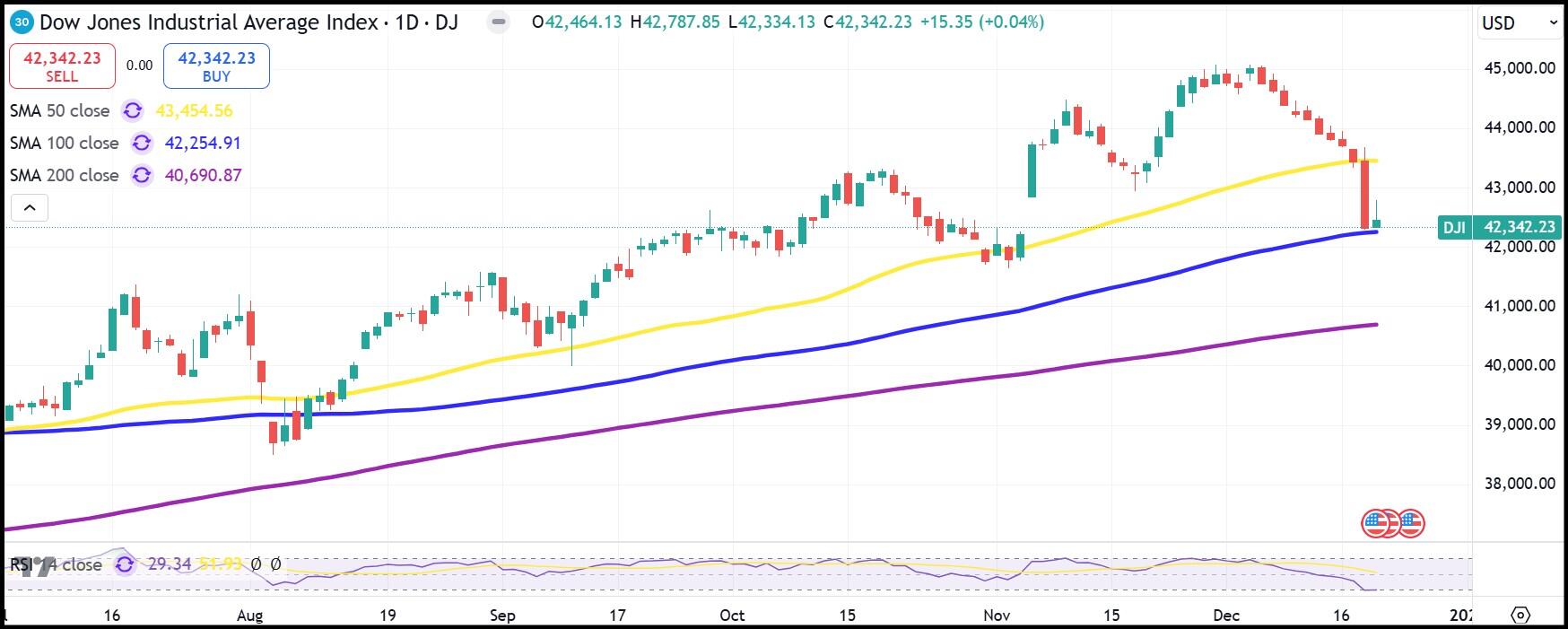
Dow Jones Industrial Average daily chart
Author

Clay Webster
FXStreet
Clay Webster grew up in the US outside Buffalo, New York and Lancaster, Pennsylvania. He began investing after college following the 2008 financial crisis.