Johnson & Johnson Earnings: JNJ breaks above resistance following Q1 beat, targets $180
- Johnson & Johnson beat Q1 consensus on earnings, revenue.
- JNJ pops 2% on news, moving above $166 resistance point.
- Sales revenue rises 5.6% YoY.
- Johnson & Johnson raises full-year guidance.

Johnson & Johnson (JNJ) stock rose 2% in Tuesday's premarket after the healthcare and consumer goods conglomerate reported first quarter adjusted earnings per share (EPS) of $2.68, 18 cents above Wall Street analysts' projections. Revenue of $24.7 billion was also $1.1 billion above consensus. JNJ stock broke above its $166 resistance barrier.
Johnson & Johnson stock news: 2023 guidance raised
Despite poor US retail spending data from last week, Johnson & Johnson's suite of pharamceuticals, medical devices and consumer staples were in strong demand with revenue rising 5.6% YoY. Most of this growth was domestic with the US seeing a 9.7% sales gain YoY. Its foreign operations saw just 1.8% growth YoY.
In addition, management does not seem to see storm clouds on the horizon like a lot of other firms. Full-year 2023 revenue guidance was raised to a range of $97.9 billion to $98.9 billion. The range was boosted by exactly $1 billion on the top and bottom from prior guidance. The range is above Wall Street consensus of $97.65 billion.
Johnson & Johnson also raised its prior range for adjusted earnings of $10.45 to $10.65 per share to $10.60 to $10.70 per share. This is well above Wall Street's projection for $10.51.
“Our first quarter results demonstrate strong performance across all three segments of our business and reflect the dedication of Johnson & Johnson colleagues around the world,” said Chairman and CEO Joaquin Duato. “With this momentum, I look forward to the remainder of the year, one filled with exciting catalysts that will create both near- and long-term value for patients and all of our stakeholders.”
The company did not report any new information regarding its decision two weeks ago to refile bankruptcy proceedings for its TMT subsidiary that houses its talc-based baby powder business, which came under scrutiny for claims that it causes cancer. The company announced on April 4 that it is willing to resolve all claims for $8.9 billion paid over 25 years.
Johnson & Johnson stock forecast
The weekly chart below shows JNJ stock struggling at the $166 resistance point over the past few weeks. That level is right below the 30-week moving average. However, JNJ stock has shot up to near $169 in the premarket, even breaking above the 30-week moving average in a testament to its bearish year to date price action coming to an end. Expect bulls to target $180 next. That price level is where JNJ stock ran into resistance back in December. The Moving Average Convergence Divergence (MACD) indicator has also crossed over on the weekly chart, which is much more bullish of a signal than a mere daily chart crossover.
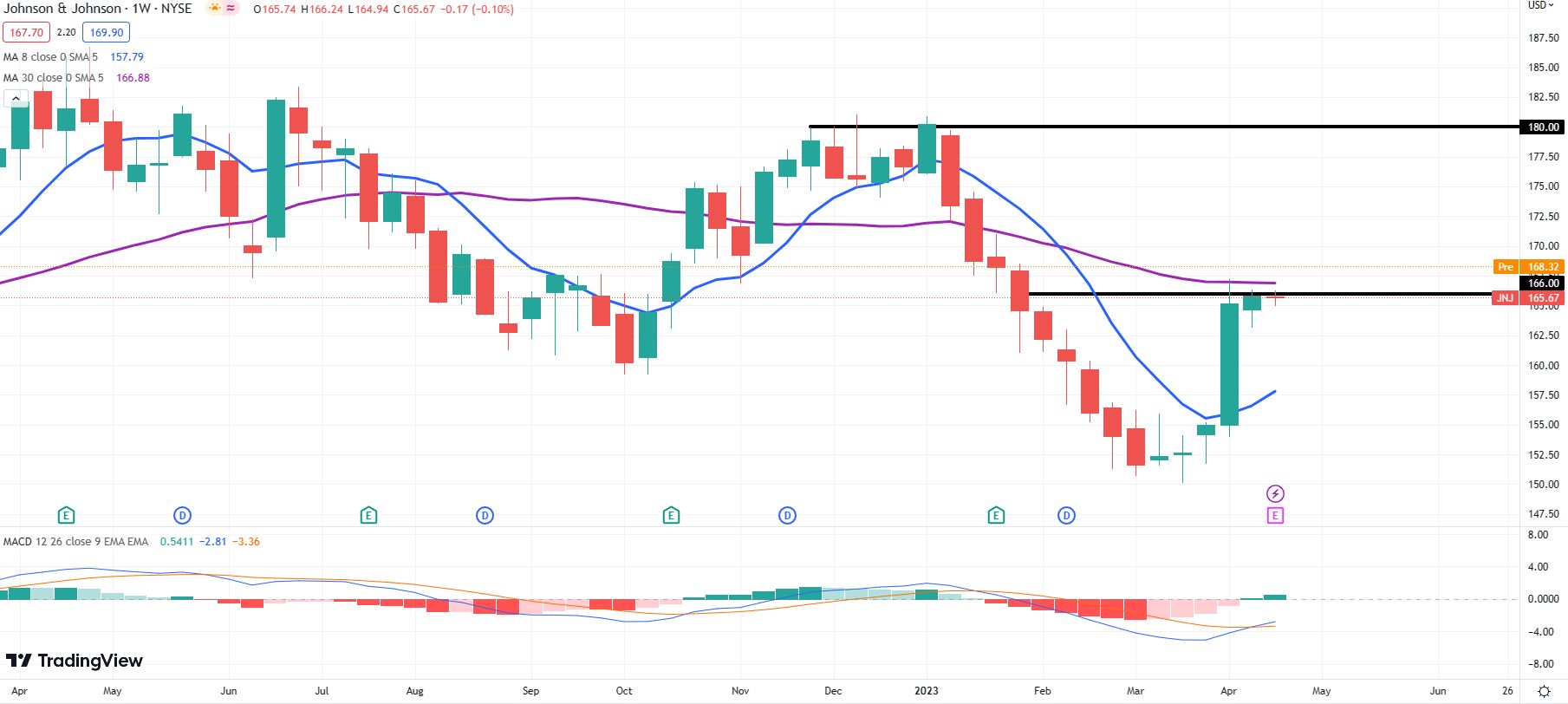
JNJ weekly chart
Author

Clay Webster
FXStreet
Clay Webster grew up in the US outside Buffalo, New York and Lancaster, Pennsylvania. He began investing after college following the 2008 financial crisis.

















