Japanese Yen falters on BoJ rate hike doubts; USD/JPY hits two-week high on firmer USD
- The Japanese Yen weakens further amid bets that Takaichi's policies could delay BoJ rate hikes.
- The recent record-setting run in equity markets also undermines demand for the safe-haven JPY.
- Fed rate cut bets and the US government shutdown act as a headwind for the USD and USD/JPY.

The Japanese Yen (JPY) hits a fresh low since early August against a broadly firmer US Dollar (USD) during the early European session on Tuesday and seems vulnerable to slide further. An unexpected result from Japan’s leadership contest sets the country on course for more expansionary fiscal policies, which could further complicate the Bank of Japan's (BoJ) task. In fact, traders have started pricing out the possibility of an interest rate hike by the BoJ later this month, which turns out to be a key factor behind the JPY's relative underperformance.
Meanwhile, Asian stocks tracked the overnight gains on Wall Street amid persistent optimism over artificial intelligence. This further seems to undermine the JPY's safe-haven status. However, data released earlier today showed that Household Spending in Japan rose at a faster pace than expected in August and backs the case for a further policy tightening by the BoJ, which could act as a tailwind for the JPY. Furthermore, dovish Federal Reserve (Fed) expectations might keep a lid on any meaningful USD appreciation and cap gains for the USD/JPY pair.
Japanese Yen bears have the upper hand amid fading BoJ rate hike bets
- The Internal Affairs Ministry reported earlier this Tuesday showed that Household Spending in Japan rose for the fourth consecutive month, by 2.3% from a year earlier. The data backs the Bank of Japan's plans to keep raising interest rates despite a fiscal dove Sanae Takaichi's win at the Liberal Democratic Party (LDP) leadership election on Saturday.
- Takaichi stood out in the race as the only supporter of big spending and is expected to be confirmed as Japan's first female Prime Minister during a parliamentary session in mid-October. Expectations for more expansionary economic policies could complicate the BoJ's task, which, in turn, continues to exert downward pressure on the Japanese Yen.
- The Nasdaq and the S&P 500 registered fresh record closing highs on Monday ahead of third-quarter earnings next week, which could act as a fresh catalyst for investors. Moreover, Japan's Nikkei 225 index touches a fresh record high amid expectations for more expansionary economic policies and further undermines the safe-haven JPY.
- Meanwhile, the US Dollar regains some positive traction following the previous day's late pullback from the vicinity of the late September swing high. This turns out to be another factor that contributes to the USD/JPY pair's move up to its highest level since early August. The USD bulls, however, lack conviction amid dovish Federal Reserve expectations.
- According to the CME FedWatch tool, the possibility of a 25-basis-point interest rate cut by the US Federal Reserve in October and December stands at around 95% and 84%, respectively. Furthermore, concerns that a prolonged US government shutdown could potentially disrupt economic activity act as a headwind for the USD and the USD/JPY pair.
- In fact, the US federal government remained shuttered for the sixth consecutive day on Monday, with the Senate closing its session without reaching a consensus on a spending bill. Democrats had repeatedly rejected a Republican-backed spending bill and have been calling for the continuation of healthcare subsidies for millions of Americans.
- Traders now look to speeches from influential FOMC members this week, including Fed Chair Jerome Powell's appearance on Thursday. Apart from this, the FOMC meeting minutes on Wednesday could offer more cues on interest rate cuts amid growing risks to the US economy. This, in turn, will drive the USD and the USD/JPY pair.
USD/JPY seems poised to test August swing high and climb further beyond 151.00
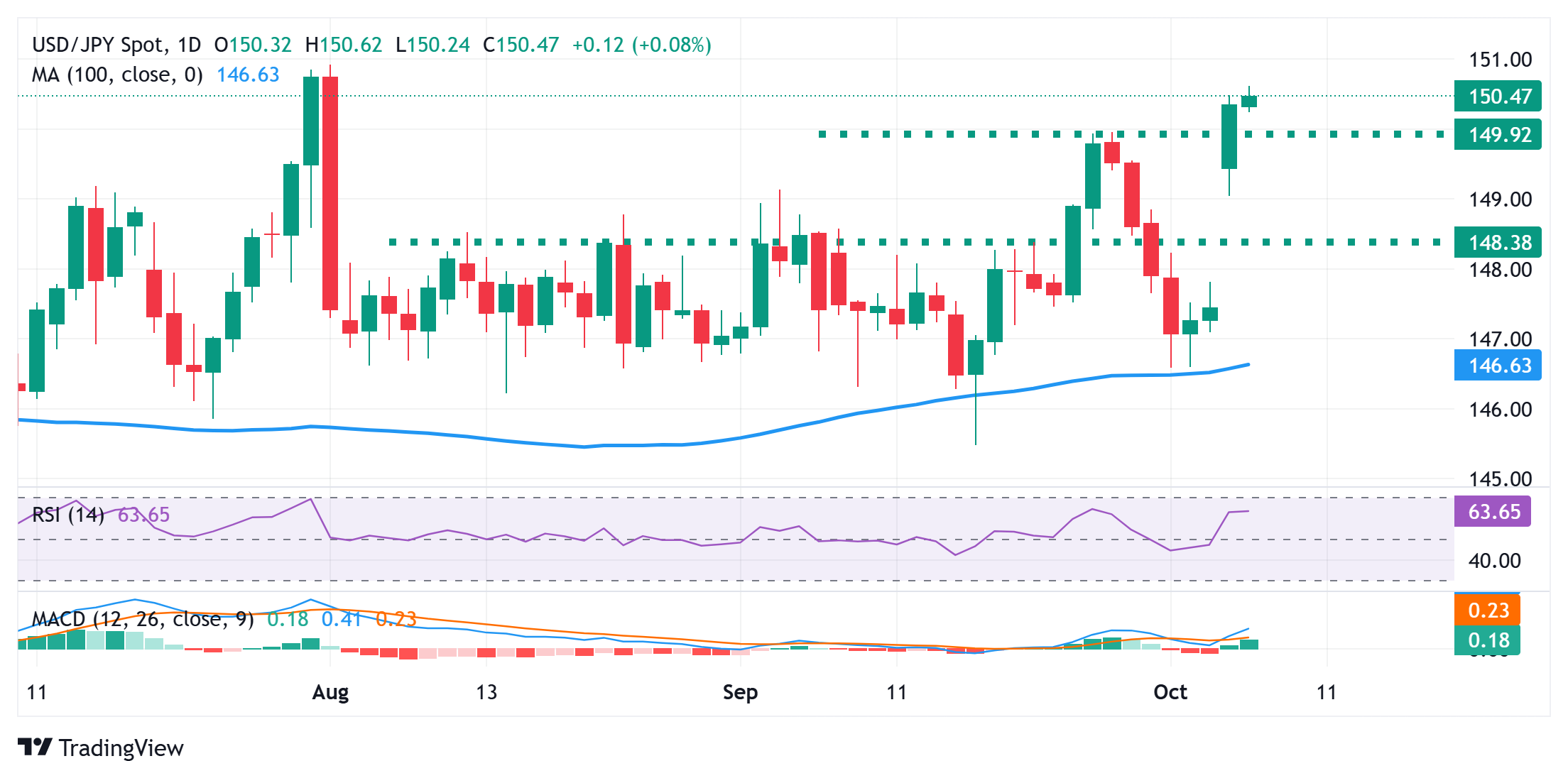
The overnight breakout through the 150.00 psychological mark comes on top of last week's rebound from the 100-day Simple Moving Average (SMA) support and favors the USD/JPY bulls. Moreover, oscillators on the daily chart are holding in positive territory and are still away from being in the overbought territory, suggesting that the path of least resistance for spot prices is to the upside. Hence, some follow-through strength towards testing the August swing high, around the 151.00 neighborhood, looks like a distinct possibility. A subsequent strength beyond the said handle should pave the way for a further near-term appreciating move.
On the flip side, corrective pullbacks might now find decent support below the 150.00 mark. Any further slide could be seen as a buying opportunity near the 149.40 area, which should help limit the downside for the USD/JPY pair near the 149.00 mark. A convincing break below the latter could drag spot prices to the next relevant support near the 148.35 region en route to the 148.00 round figure and the 147.80 zone. Failure to defend the said support levels might shift the near-term bias in favor of bearish traders.
US Dollar Price This week
The table below shows the percentage change of US Dollar (USD) against listed major currencies this week. US Dollar was the strongest against the Japanese Yen.
| USD | EUR | GBP | JPY | CAD | AUD | NZD | CHF | |
|---|---|---|---|---|---|---|---|---|
| USD | 0.30% | -0.04% | 0.77% | -0.02% | -0.20% | 0.02% | 0.05% | |
| EUR | -0.30% | -0.45% | 0.40% | -0.36% | -0.54% | -0.31% | -0.28% | |
| GBP | 0.04% | 0.45% | 0.93% | 0.09% | -0.09% | 0.14% | 0.17% | |
| JPY | -0.77% | -0.40% | -0.93% | -0.75% | -1.02% | -0.81% | -0.76% | |
| CAD | 0.02% | 0.36% | -0.09% | 0.75% | -0.13% | 0.05% | 0.08% | |
| AUD | 0.20% | 0.54% | 0.09% | 1.02% | 0.13% | 0.23% | 0.27% | |
| NZD | -0.02% | 0.31% | -0.14% | 0.81% | -0.05% | -0.23% | 0.03% | |
| CHF | -0.05% | 0.28% | -0.17% | 0.76% | -0.08% | -0.27% | -0.03% |
The heat map shows percentage changes of major currencies against each other. The base currency is picked from the left column, while the quote currency is picked from the top row. For example, if you pick the US Dollar from the left column and move along the horizontal line to the Japanese Yen, the percentage change displayed in the box will represent USD (base)/JPY (quote).
Author

Haresh Menghani
FXStreet
Haresh Menghani is a detail-oriented professional with 10+ years of extensive experience in analysing the global financial markets.
















