Japanese Yen languishes near three-week low against retreating USD; US PCE data in focus
- The Japanese Yen attracts some safe-haven flows amid a slight deterioration in the risk sentiment.
- Expectations that the BoJ might delay rate hikes hold back the JPY bulls from placing fresh bets.
- The USD pauses for a breather ahead of the US PCE data and acts as a headwind for USD/JPY.

The Japanese Yen (JPY) continues with its relative underperformance as softer consumer inflation figures from Tokyo, Japan's capital city, validate the view that the Bank of Japan (BoJ) could delay raising interest rates. Apart from this, domestic political uncertainty and concerns about economic headwinds stemming from US President Donald Trump's trade tariffs keep the JPY depressed near a three-week low touched against its American counterpart during the Asian session on Friday.
Meanwhile, Trump's new round of tariffs on a broad range of imported goods announced on Thursday weighs on investors' sentiment amid persistent geopolitical tensions. This, in turn, drives some safe-haven flows towards the JPY, which, along with a modest US Dollar (USD) pullback from a three-year high, acts as a headwind for the USD/JPY pair. Traders now look to the release of the US Personal Consumption Expenditure (PCE) Price Index for some impetus heading into the weekend.
Japanese Yen bulls remain on the sidelines as BoJ uncertainty offsets reviving safe-haven demand
- The Statistics Bureau of Japan reported earlier this Friday that the headline Tokyo Consumer Price Index (CPI) rose 2.5% from a year earlier in September, down slightly compared to 2.6% in the previous month and missing consensus estimates. Adding to this, Tokyo CPI ex Fresh Food remained unchanged and rose 2.5% YoY during the reported month against 2.8% expected.
- Furthermore, a core gauge, which excludes both Fresh Food and Energy prices, and is closely watched by the Bank of Japan as a gauge of underlying inflation, eased to 2.5% in September from 3.0% in the previous month. This undermines the Japanese Yen and drags it to a fresh low since early August against a broadly firmer US Dollar during the Asian session on Friday.
- Japan's Liberal Democratic Party (LDP) leadership election will take place on 4 October and the outcome could delay the next interest rate hike by the BoJ if a candidate with dovish views is selected. This adds a layer of uncertainty amid concerns about economic headwinds stemming from US President Donald Trump's 15% baseline tariff on most Japanese imports.
- Meanwhile, Trump on Thursday announced a 100% tariff on imports of branded or patented pharmaceutical products, 25% levies on imports of all heavy-duty trucks, and 50% tariffs on kitchen cabinets from October 1. Trump also said he would start charging a 30% tariff on upholstered furniture next week. This underpins the JPY's safe-haven status and limits losses.
- The US Dollar, on the other hand, holds steady near a three-week high, as stronger-than-expected US economic data released on Thursday fueled uncertainty over the pace of interest rate cuts by the Federal Reserve. The revised US GDP print showed that the economy grew at an annualised 3.8% pace during the second quarter compared to the 3.3% estimated initially.
- Adding to this, the US Labor Department reported that Initial Jobless Claims fell to 218K for the week ending September 20, well below the 235K expected and the previous week’s 232K (revised from 231K). This helps ease concerns about a softening labor market and raises questions as to how much the Fed may cut interest rates again by the end of this year.
- Nevertheless, traders are still pricing in a greater chance that the US central bank will lower borrowing costs again in October and December. This keeps a lid on any further USD gains and caps the USD/JPY pair. Traders also seem reluctant to place fresh bullish bets and opt to wait for the release of the US Personal Consumption Expenditure (PCE) Price Index.
USD/JPY seems poised to climb further; breakout through the 200-day SMA remains in play
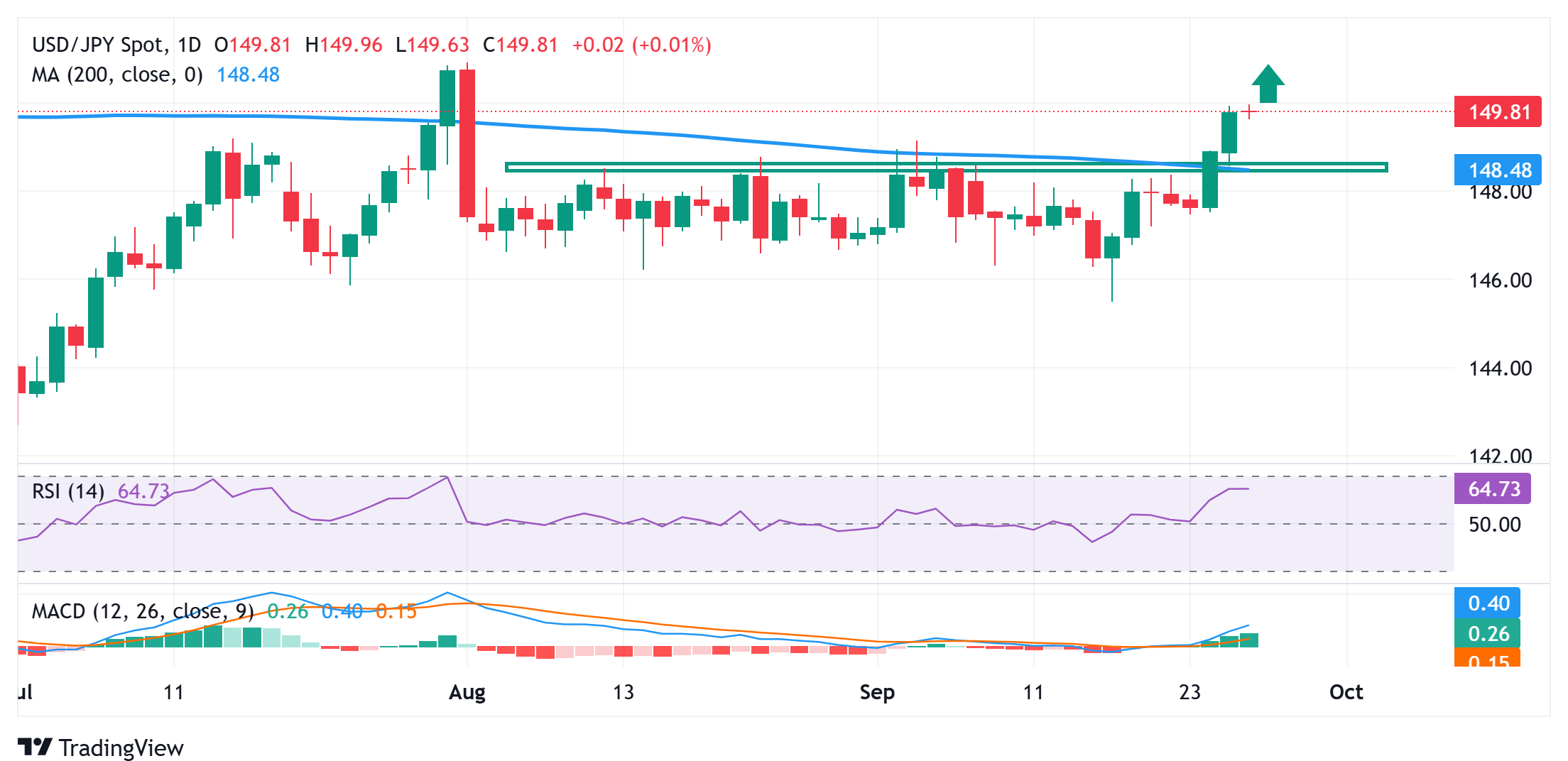
The USD/PY pair's strong rise on Thursday reaffirmed this week's breakout through a technically significant 200-day Simple Moving Average (SMA) hurdle. Given that oscillators on the daily chart are holding comfortably in positive territory and are still away from being in the overbought zone, some follow-through buying beyond the 150.00 psychological mark should pave the way for additional gains. Spot prices might then aim towards testing the August monthly swing high, around the 151.00 neighborhood, with some intermediate hurdle near the 150.55-150.60 region.
On the flip side, any meaningful corrective pullback might now find decent support and attract fresh buyers near the 149.15 region. This should help limit the downside for the USD/JPY pair near the 149.00 mark, which, if broken, could pave the way for a slide towards retesting the 200-day SMA, currently pegged near mid-148.00s. Failure to defend the said support levels might negate the near-term positive outlook and drag spot prices below the 148.00 round figure, towards testing the weekly swing low, around the 147.50-147.45 region.
Economic Indicator
Core Personal Consumption Expenditures - Price Index (YoY)
The Core Personal Consumption Expenditures (PCE), released by the US Bureau of Economic Analysis on a monthly basis, measures the changes in the prices of goods and services purchased by consumers in the United States (US). The PCE Price Index is also the Federal Reserve’s (Fed) preferred gauge of inflation. The YoY reading compares the prices of goods in the reference month to the same month a year earlier. The core reading excludes the so-called more volatile food and energy components to give a more accurate measurement of price pressures." Generally, a high reading is bullish for the US Dollar (USD), while a low reading is bearish.
Read more.Next release: Fri Sep 26, 2025 12:30
Frequency: Monthly
Consensus: 2.9%
Previous: 2.9%
Source: US Bureau of Economic Analysis
After publishing the GDP report, the US Bureau of Economic Analysis releases the Personal Consumption Expenditures (PCE) Price Index data alongside the monthly changes in Personal Spending and Personal Income. FOMC policymakers use the annual Core PCE Price Index, which excludes volatile food and energy prices, as their primary gauge of inflation. A stronger-than-expected reading could help the USD outperform its rivals as it would hint at a possible hawkish shift in the Fed’s forward guidance and vice versa.
Author

Haresh Menghani
FXStreet
Haresh Menghani is a detail-oriented professional with 10+ years of extensive experience in analysing the global financial markets.