Japanese Yen languishes near six-month low against stronger USD on Takaichi policy bets
- The Japanese Yen remains depressed amid bets that Takaichi's policies could delay BoJ rate hikes.
- The USD shrugs off Fed rate cut bets and the US government shutdown, lending support to USD/JPY.
- Traders now look forward to the release of the FOMC meeting Minutes for some meaningful impetus.

The Japanese Yen (JPY) sticks to its bearish bias through the early European session on Wednesday, which, along with a broadly firmer US Dollar (USD), assists the USD/JPY pair to stand firm near its highest level since mid-February. Expectations for more expansionary fiscal policy from Japan's incoming first female Prime Minister, Sanae Takaichi, could further complicate the task facing the Bank of Japan (BoJ). Moreover, Takuji Aida, who is considered among Takaichi's closest advisers on economic policy, said that a move by the BoJ to raise interest rates this month would be too early. This, in turn, contributes to the JPY's steep fall witnessed since the beginning of this week.
Takuji, however, reaffirmed market expectations for a further policy tightening by the BoJ and said that Takaichi will tolerate another 25 bps interest rate hike by January if the economy is in firm shape. In contrast, traders are pricing in the possibility that the US Federal Reserve (Fed) will lower borrowing costs two more times this year. This, along with concerns that a prolonged US government shutdown could affect the economy, might cap the USD. Moreover, the divergent BoJ-Fed policy outlooks support the lower-yielding JPY and act as a headwind for the USD/JPY pair.
Japanese Yen selling bias remains unabated amid fading BoJ rate hike bets
- Sanae Takaichi's surprise win in the ruling Liberal Democratic Party's (LDP) leadership race on Saturday fueled speculations of more stimulus. This, in turn, forced investors to scale back their expectations for a Bank of Japan (BoJ) interest rate hike this month and dragged the Japanese Yen for the third straight day on Wednesday.
- Meanwhile, inflation in Japan has stayed at or above the BoJ’s 2% target for more than three years, and the economy expanded for a fifth straight quarter in the three months through June. Moreover, two out of the nine BoJ board members voted against keeping the interest rate on hold last month, citing still sticky inflationary pressures.
- Takuji Aida – one of Takaichi's closest economic advisers – said that a 25-basis-point interest rate hike in January would be on condition the BoJ maintains relatively loose monetary policy with no further rate hikes likely until 2027. Nevertheless, this keeps hopes alive for another interest rate hike by the BoJ early next year.
- This marks a significant divergence in comparison to rising bets for two rate reductions by the US Federal Reserve in October and December . The US Dollar, however, seems unaffected by dovish Fed expectations and climbs to its highest level since late August, contributing to the USD/JPY pair's momentum.
- The US government shutdown enters its second week with very few signs of progress toward a deal as Republicans and Democrats remain committed to their positions. A prolonged US government closure could affect the economic performance, and any furloughing of federal workers presents risks for the labor market.
- The market focus now shifts to the release of FOMC Minutes later this Wednesday. Apart from this, Fed Chair Jerome Powell's appearance on Thursday could offer more cues on interest rate cuts. This, in turn, will play a key role in influencing the near-term USD price dynamics and provide a fresh impetus to the USD/JPY pair.
USD/JPY could extend positive momentum further towards reclaiming 153.00
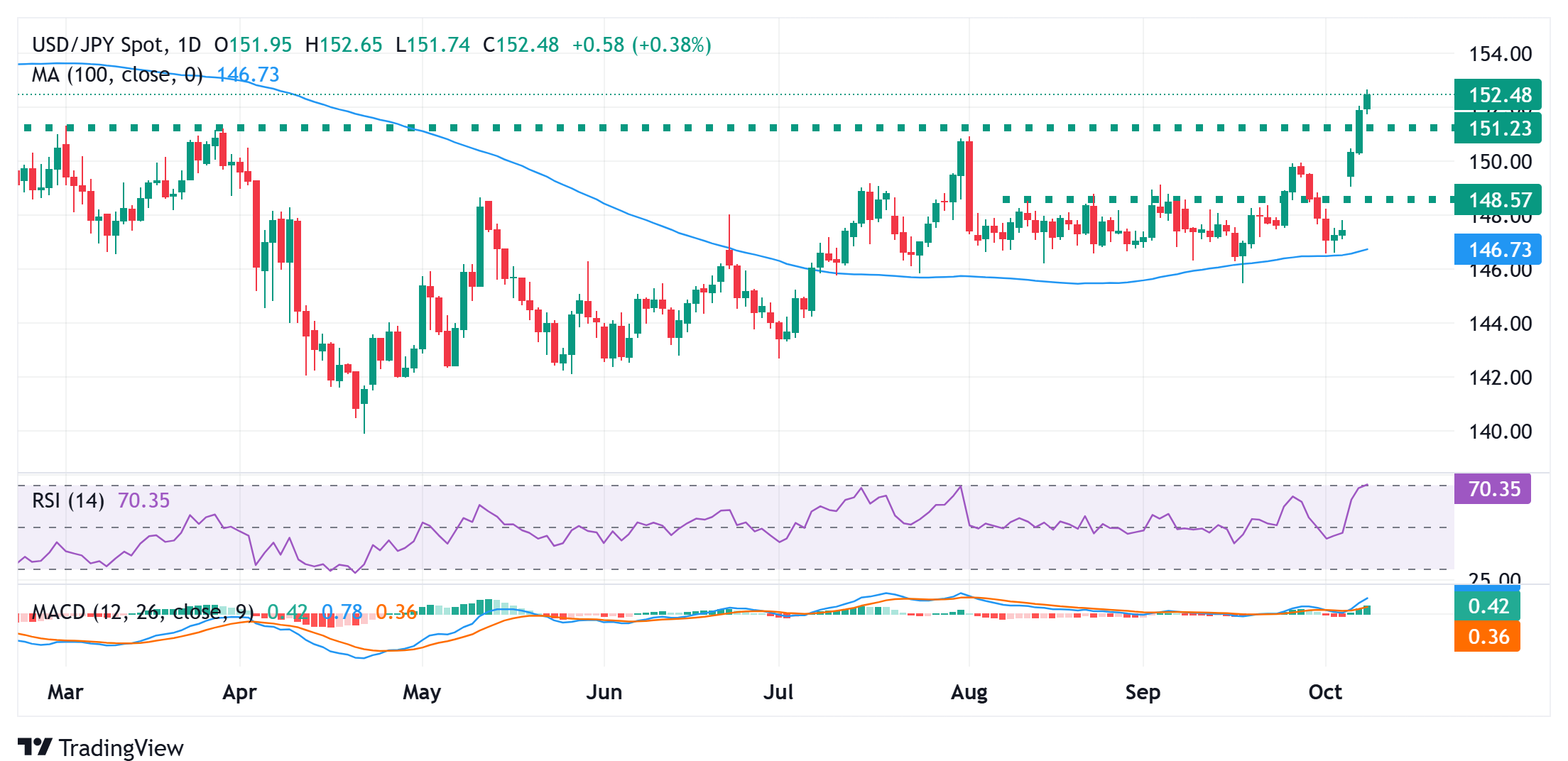
The overnight breakout through the 151.00 horizontal barrier and a subsequent strength beyond the 152.00 mark could be seen as a fresh trigger for the USD/JPY bulls. That said, the daily Relative Strength Index (RSI) has moved close to the overbought territory, making it prudent to wait for some near-term consolidation or a modest pullback before positioning for further gains. Any corrective slide, however, could find some support near the 152.00 round figure ahead of the Asian session low, around the 151.75 region, and the 151.00 mark. The latter should act as a strong near-term base for spot prices, which, if broken, could pave the way for deeper losses.
Nevertheless, the USD/JPY pair seems poised to prolong its uptrend towards the 153.00 mark en route to the next relevant hurdle near the 153.25-153.30 region. The momentum could extend further beyond the 153.70 intermediate hurdle as bulls aim to conquer the 154.00 mark for the first time since February.
Interest rates FAQs
Interest rates are charged by financial institutions on loans to borrowers and are paid as interest to savers and depositors. They are influenced by base lending rates, which are set by central banks in response to changes in the economy. Central banks normally have a mandate to ensure price stability, which in most cases means targeting a core inflation rate of around 2%. If inflation falls below target the central bank may cut base lending rates, with a view to stimulating lending and boosting the economy. If inflation rises substantially above 2% it normally results in the central bank raising base lending rates in an attempt to lower inflation.
Higher interest rates generally help strengthen a country’s currency as they make it a more attractive place for global investors to park their money.
Higher interest rates overall weigh on the price of Gold because they increase the opportunity cost of holding Gold instead of investing in an interest-bearing asset or placing cash in the bank. If interest rates are high that usually pushes up the price of the US Dollar (USD), and since Gold is priced in Dollars, this has the effect of lowering the price of Gold.
The Fed funds rate is the overnight rate at which US banks lend to each other. It is the oft-quoted headline rate set by the Federal Reserve at its FOMC meetings. It is set as a range, for example 4.75%-5.00%, though the upper limit (in that case 5.00%) is the quoted figure. Market expectations for future Fed funds rate are tracked by the CME FedWatch tool, which shapes how many financial markets behave in anticipation of future Federal Reserve monetary policy decisions.
Author

Haresh Menghani
FXStreet
Haresh Menghani is a detail-oriented professional with 10+ years of extensive experience in analysing the global financial markets.