Japanese Yen extends its intraday descent against a firmer USD; USD/JPY retakes 148.00
- The Japanese Yen drifts lower in reaction to the disappointing Japan Manufacturing PMI.
- A modest USD uptick further contributes to the USD/JPY pair’s modest intraday rise.
- The divergent BoJ-Fed policy expectations could limit losses for the lower-yielding JPY.

The Japanese Yen (JPY) maintains its bid tone through the first half of the European session on Wednesday, which, along with the emergence of some US Dollar (USD) dip-buying, lifts the USD/JPY pair further beyond the 148.00 mark. A private survey showed that manufacturing sector activity in Japan fell at the fastest pace in six months in September. This comes amid concerns about economic headwinds stemming from US tariffs, which, along with domestic political uncertainty, might give the Bank of Japan (BoJ) more reasons to delay raising interest rates further and is seen undermining the JPY.
Meanwhile, hawkish dissents to the BoJ's on-hold decision last week underscore mounting pressure within the central bank to phase out its massive monetary stimulus. This marks a significant divergence in comparison to the US Federal Reserve's (Fed) dovish signal that two more rate cuts will follow through the rest of this year. The latter should keep a lid on any meaningful USD appreciation. Furthermore, the divergent BoJ-Fed policy outlooks should contribute to limiting losses for the lower-yielding JPY, warranting some caution before placing aggressive bullish bets around the USD/JPY pair.
Japanese Yen intraday selling bias remains unabated despite supportive fundamental backdrop
- The S&P Global flash Japan Manufacturing Purchasing Managers' Index (PMI) declined from 49.7 in August to 48.4 in September, or the steepest decline since March. This also marked the 14th month of contraction in the past 15 and exerts some downward pressure on the Japanese Yen during the Asian session on Wednesday.
- Furthermore, a Liberal Democratic Party (LDP) leadership election will take place on 4 October, and the outcome could delay the next interest rate hike by the Bank of Japan if a candidate with dovish views is selected. The BoJ, however, signaled that rate hikes remain on the table if the economy and prices move in line with forecasts.
- Moreover, investors are still pricing in the possibility of a 25-basis-point rate hike by the BoJ in October amid signs of economic resilience. This contrasts with the US Federal Reserve (Fed) dovish pivot, which reinforces policy divergence and, in turn, should help limit any meaningful depreciating move for the lower-yielding JPY.
- The US Dollar attracts some buyers and, for now, seems to have stalled a two-day pullback from an over one-week top touched on Monday in the wake of Fed Chair Jerome Powell's remarks on Tuesday. Powell said that policymakers faced a challenging situation in deciding whether to prioritise fighting inflation or protecting jobs.
- Powell added that easing too aggressively could leave the inflation job unfinished and need to reverse course. The comments pushed back against market expectations of more interest rate cuts in the coming months, which revived the USD demand and assisted the USD/JPY pair to gain some positive traction after a two-day downtick.
- Traders now look to the release of New Home Sales from the US for some impetus later during the North American session. The focus, however, remains glued to other important US macro data scheduled during the latter part of the week, including the final GDP print and the Personal Consumption Expenditure (PCE) Price Index.
- Apart from this, traders this week will also confront the release of Tokyo Consumer Price Index (CPI) on Friday, which could influence BoJ rate hike expectations and drive the JPY. Nevertheless, the fundamental backdrop favors the JPY bulls and warrants caution before positioning for any meaningful USD/JPY appreciation.
USD/JPY bulls might now towards challenging 200-day SMA hurdle, around mid-148.00s
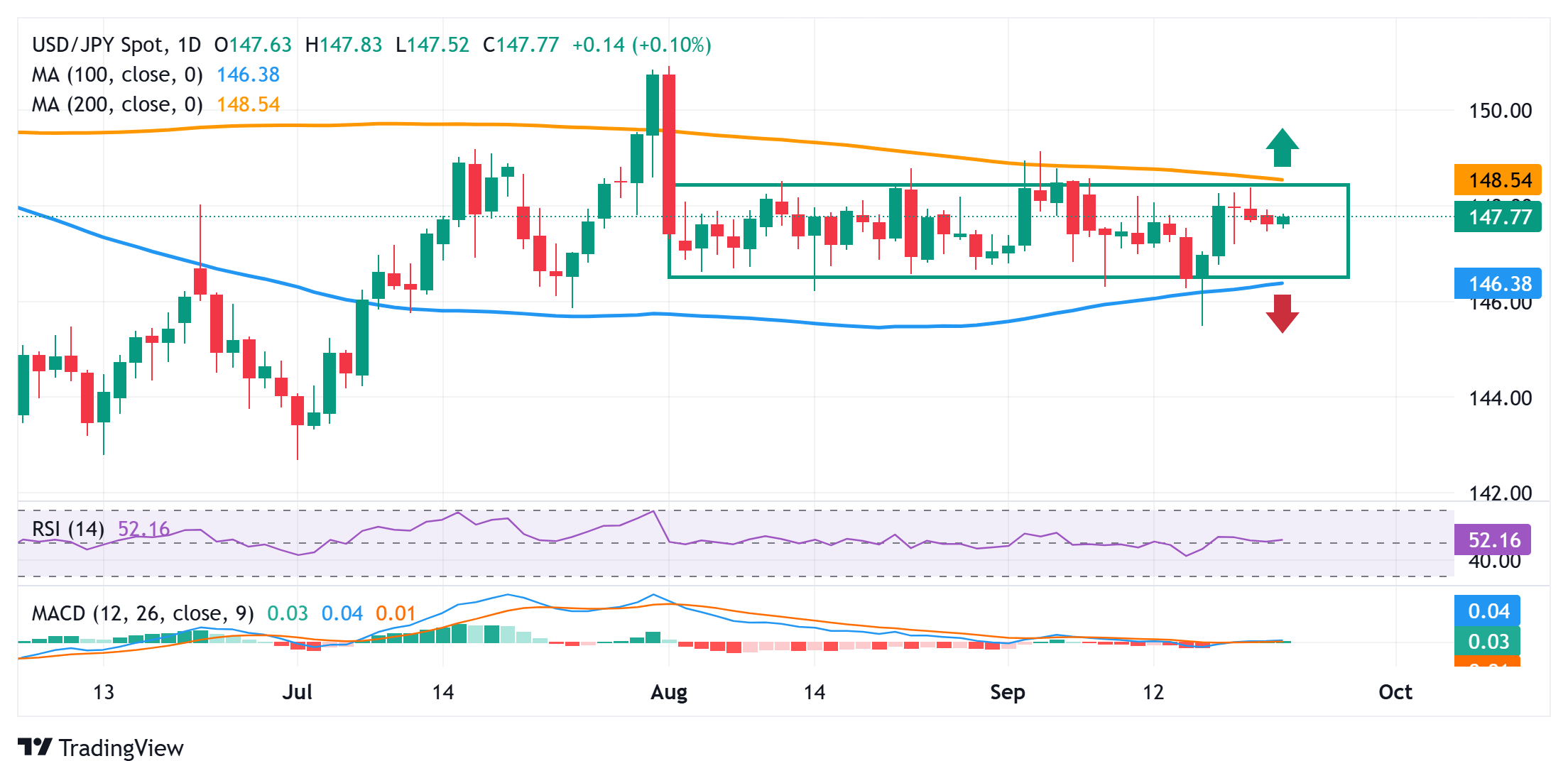
The USD/JPY pair, barring a few knee-jerk moves in either direction, has been trading in a familiar range since early August. This constitutes the formation of a rectangle, indicating a consolidation phase. Moreover, mostly neutral oscillators on the daily chart warrant caution before positioning for a firm near-term direction. Spot prices, meanwhile, remain below the 200-day Simple Moving Average (SMA), and the lack of meaningful buying beyond the 148.00 mark suggests that the path of least resistance for the pair is to the downside.
Hence, any subsequent move up is likely to confront an immediate hurdle near the 148.00 round figure. This is followed by the 148.35-148.40 region, or a two-week high touched on Monday, and the 200-day (SMA), around the 148.55 area. A sustained strength beyond the latter has the potential to lift the USD/JPY pair to the 149.00 mark en route to the monthly high, around the 149.15 area.
On the flip side, weakness below the Asian session low, around mid-147.00s, could find some support near last Friday's post-BoJ swing low, around the 147.20 zone. This is followed by the 147.00 mark, below which the USD/JPY pair could accelerate the decline towards the 146.20 horizontal support. The downward trajectory could extend further towards the 145.50-145.45 region, or the lowest level since July 7, which was touched last Wednesday.
US Dollar FAQs
The US Dollar (USD) is the official currency of the United States of America, and the ‘de facto’ currency of a significant number of other countries where it is found in circulation alongside local notes. It is the most heavily traded currency in the world, accounting for over 88% of all global foreign exchange turnover, or an average of $6.6 trillion in transactions per day, according to data from 2022. Following the second world war, the USD took over from the British Pound as the world’s reserve currency. For most of its history, the US Dollar was backed by Gold, until the Bretton Woods Agreement in 1971 when the Gold Standard went away.
The most important single factor impacting on the value of the US Dollar is monetary policy, which is shaped by the Federal Reserve (Fed). The Fed has two mandates: to achieve price stability (control inflation) and foster full employment. Its primary tool to achieve these two goals is by adjusting interest rates. When prices are rising too quickly and inflation is above the Fed’s 2% target, the Fed will raise rates, which helps the USD value. When inflation falls below 2% or the Unemployment Rate is too high, the Fed may lower interest rates, which weighs on the Greenback.
In extreme situations, the Federal Reserve can also print more Dollars and enact quantitative easing (QE). QE is the process by which the Fed substantially increases the flow of credit in a stuck financial system. It is a non-standard policy measure used when credit has dried up because banks will not lend to each other (out of the fear of counterparty default). It is a last resort when simply lowering interest rates is unlikely to achieve the necessary result. It was the Fed’s weapon of choice to combat the credit crunch that occurred during the Great Financial Crisis in 2008. It involves the Fed printing more Dollars and using them to buy US government bonds predominantly from financial institutions. QE usually leads to a weaker US Dollar.
Quantitative tightening (QT) is the reverse process whereby the Federal Reserve stops buying bonds from financial institutions and does not reinvest the principal from the bonds it holds maturing in new purchases. It is usually positive for the US Dollar.
Author

Haresh Menghani
FXStreet
Haresh Menghani is a detail-oriented professional with 10+ years of extensive experience in analysing the global financial markets.