Japanese Yen lacks firm direction as traders assess Japan's political landscape
- The Japanese Yen weakens amid renewed concerns about Japan’s fiscal health.
- Japan’s ruling LDP party and the Ishin are set to form a coalition government.
- The divergent BoJ-Fed policy expectations cap the upside for the USD/JPY pair.

The Japanese Yen (JPY) struggles to capitalize on its modest intraday bounce against a broadly softer US Dollar (USD) as traders assess political developments in Japan. Media reports indicated that Japan's ruling Liberal Democratic Party (LDP) and the Japan Innovation Party (JIP) have agreed to form a coalition government. This set the stage for Sanae Takaichi to become Japan's first female Prime Minister and fueled speculations about big spending and loose monetary policy, which, in turn, prompted some intraday selling around the JPY.
However, the fragile new coalition, still a minority, would need cooperation from other opposition groups to pass any legislation. Moreover, recent comments from BoJ officials suggested that the central bank will stick to its policy normalization path, which, in turn, assists the JPY to attract some buyers at lower levels. The USD, on the other hand, struggles to lure buyers amid bets for two more interest rate cuts by the US Federal Reserve (Fed) in 2025. This contributes to capping the USD/JPY pair and the intraday pullback of around 75 pips.
Japanese Yen traders seem non-committed amid political uncertainty
- Kyodo news agency reported that Japan's Liberal Democratic Party and the Japan Innovation Party, known as Ishin, are set to sign an agreement sealing their alliance on Monday. The new coalition will vote in parliament on Tuesday for Sanae Takaichi to be Japan's first female Prime Minister.
- Takaichi supports the former Premier Shinzo Abe's economic policies, which advocated for big spending and monetary stimulus to support the economy. Takaichi is also expected to oppose further policy tightening by the Bank of Japan, which, in turn, is seen exerting pressure on the Japanese Yen.
- Furthermore, global trade uncertainties could allow the BoJ to maintain the status quo at this month's meeting. However, BoJ Deputy Governor Shinichi Uchida said on Friday that the central bank will continue raising interest rates if economic and price developments move in line with its forecasts.
- Meanwhile, inflation in Japan has stayed at or above the BoJ’s 2% target for more than three years, and the economy expanded for a fifth straight quarter in the three months through June. This, in turn, keeps the door open for another interest rate hike by the BoJ, either in December or in January.
- In contrast, the CME Group's FedWatch Tool indicates that traders have fully priced in a 25-basis-point rate cut by the US Federal Reserve in October and in December. This fails to assist the US Dollar to capitalize on Friday's move higher and could offer support to the lower-yielding JPY.
- The US government shutdown has now stretched into its 20th day, with the Senate preparing for its 11th vote on the stopgap funding bill later this Monday amid the unresolved impasse between Democrats and Republicans. This might contribute to capping gains for the USD/JPY pair.
USD/JPY needs to weaken below the 150.00 mark for bears to regain control
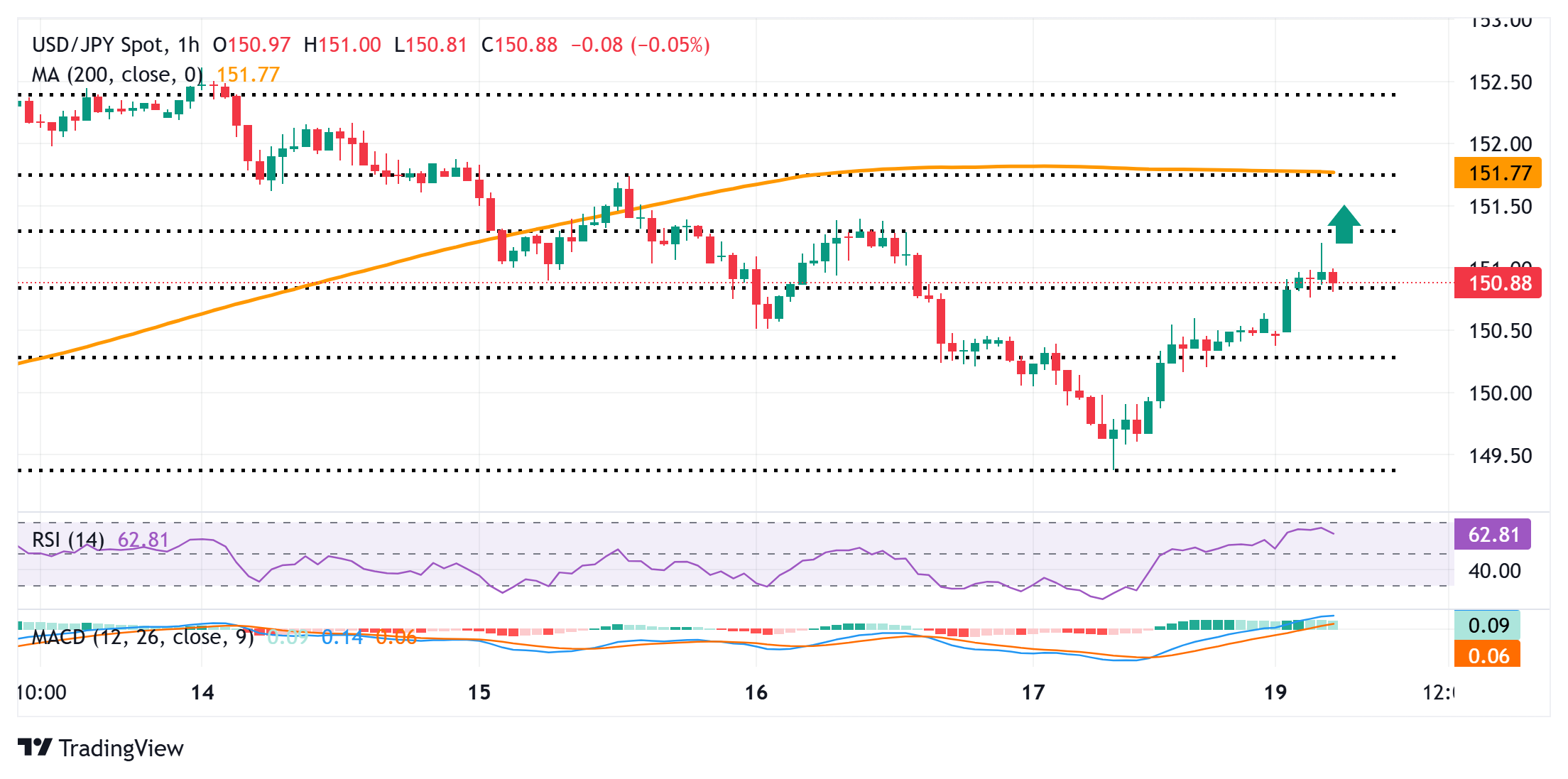
The intraday move up lifts spot prices beyond the 38.2% Fibonacci retracement level of the recent decline from the monthly peak. Moreover, positive oscillators on 1-hour/daily charts back the case for a further appreciating move towards the 151.75 confluence – comprising the 61.8% Fibo. retracement level and the 200-hour Simple Moving Average (SMA). A sustained move beyond the latter should allow the USD/JPY pair to surpass the 152.00 mark and climb further towards the next relevant hurdle near the 152.25 supply zone en route to the 153.00 mark.
On the flip side, the 150.50-150.45 region now seems to protect the immediate downside ahead of the 150.25 zone, or the 23.6% Fibo. retracement level and the 150.00 psychological mark. A convincing break below the latter might expose the 149.40-149.35 area, or a nearly two-week low touched on Friday. The USD/JPY pair could extend the fall further towards the 149.00 round figure before eventually dropping to the 148.45-148.40 strong horizontal resistance-turned-support.
Japanese Yen FAQs
The Japanese Yen (JPY) is one of the world’s most traded currencies. Its value is broadly determined by the performance of the Japanese economy, but more specifically by the Bank of Japan’s policy, the differential between Japanese and US bond yields, or risk sentiment among traders, among other factors.
One of the Bank of Japan’s mandates is currency control, so its moves are key for the Yen. The BoJ has directly intervened in currency markets sometimes, generally to lower the value of the Yen, although it refrains from doing it often due to political concerns of its main trading partners. The BoJ ultra-loose monetary policy between 2013 and 2024 caused the Yen to depreciate against its main currency peers due to an increasing policy divergence between the Bank of Japan and other main central banks. More recently, the gradually unwinding of this ultra-loose policy has given some support to the Yen.
Over the last decade, the BoJ’s stance of sticking to ultra-loose monetary policy has led to a widening policy divergence with other central banks, particularly with the US Federal Reserve. This supported a widening of the differential between the 10-year US and Japanese bonds, which favored the US Dollar against the Japanese Yen. The BoJ decision in 2024 to gradually abandon the ultra-loose policy, coupled with interest-rate cuts in other major central banks, is narrowing this differential.
The Japanese Yen is often seen as a safe-haven investment. This means that in times of market stress, investors are more likely to put their money in the Japanese currency due to its supposed reliability and stability. Turbulent times are likely to strengthen the Yen’s value against other currencies seen as more risky to invest in.
Author

Haresh Menghani
FXStreet
Haresh Menghani is a detail-oriented professional with 10+ years of extensive experience in analysing the global financial markets.

















