Japanese Yen weakens further after Japan's Rengo agree to lower wage hike than demanded
- The Japanese Yen drifts lower amid a slight improvement in the global risk sentiment.
- Japan's Rengo trade union secured an average wage hike of 5.46% for fiscal 2025.
- Hawkish BoJ expectations should back the JPY and cap USD/JPY amid Fed rate cut bets.

The Japanese Yen (JPY) adds to its heavy intraday losses after Japan's largest trade union group, Rengo secured an average wage hike of 5.46% for fiscal 2025, compared to the demand for a 6.09% hike. This comes after a source familiar with the Bank of Japan's (BoJ) thinking said that the heightening global uncertainty could affect the rate-hike timing. Moreover, a positive risk tone, bolstered by some positive comments out of the US-Canada trade talks and reports that there will be enough Democratic votes to avoid a US government shutdown, seems to undermine the safe-haven JPY.
Apart from this, a modest US Dollar (USD) strength lifts the USD/JPY pair to the 149.00 mark during the early European session on Friday. Any meaningful JPY depreciation, however, seems elusive amid rising bets that the BoJ will hike interest rates. Moreover, the recent sharp narrowing of the rate differential between Japan and other countries should limit losses for the lower-yielding JPY. This, along with the lack of follow-through USD buying on the back of expectations for more rate cuts by the Federal Reserve (Fed), warrants caution before placing bullish bets around the currency pair.
Japanese Yen adds to heavy intraday losses after Japan's Rengo announced first-round wage hike of 5.46%
- Japan's largest trade union group, Rengo’s first-round data shows an average wage hike of 5.46% for fiscal 2025, compared to the demand of a 6.09% hike. The 5.46% wage hike is higher than last year's average of 5.1%, exceeding 5% for the second straight year.
- A major Japanese labour union group said on Thursday its member unions had struck agreements for substantial wage hikes and the average rise was just over 5%, slightly smaller than last year.
- The preliminary results of Japan's annual spring labor negotiations, known as Shunto, are due this Friday amid hopes that bumper wage hikes seen last year will continue this year.
- Japan’s Prime Minister Shigeru Ishiba, earlier this week, underscored the significance of the spring wage negotiations and urged trade unions and companies to boost worker’s pay.
- "Japan's economy and price developments appear on track, but overseas risks have risen," said a source familiar with the Bank of Japan's thinking. "The heightening global uncertainty is a concern and could affect the BoJ's rate-hike timing," the source added, a view echoed by two more sources.
- Ontario Premier Doug Ford said that the meeting with US Commerce Secretary Howard Lutnick was positive and productive and that it has lowered the temperature on the ongoing trade war.
- Adding to this, Canada's Industry Minister Francois-Philippe Champagne and Finance Minister Dominic LeBlanc said that the discussion was constructive and that talks would continue.
- Senate Minority Leader Chuck Schumer signaled that Democrats will vote with Republicans to pass a six-month spending bill that would keep the US government funded through September.
- Russian President Vladimir Putin expressed conditional support for a 30-day cease-fire proposal put forward by the US and Ukraine, providing a modest lift to the global risk sentiment.
- Meanwhile, signs of broadening inflationary pressures in Japan give the Bank of Japan headroom to hike rates further, keeping the Japanese government bond yields elevated.
- The yield on the benchmark 10-year JGB remains close to its highest level since October 2008 touched on Monday, which, in turn, should continue to underpin the Japanese Yen.
- The US Dollar, on the other hand, struggles to attract any meaningful buyers and hangs near a multi-month low amid bets that the Federal Reserve will resume its rate-cutting cycle soon.
- In fact, market participants are currently pricing in the possibility of three 25 basis point Fed rate cuts each at the June, July, and October monetary policy meetings.
- The bets were lifted by Thursday's data showing that the US Producer Price Index (PPI) was unchanged in February and the yearly rate slowed to 3.2% from 3.7% in January.
- This comes on top of softer-than-expected US Consumer Price Index (CPI) report on Wednesday and points to signs of easing inflation, which should allow the Fed to cut rates further.
- Traders now look forward to the Preliminary release of the Michigan US Consumer Sentiment and Inflation Expectations Index for short-term opportunities on the last day of the week.
USD/JPY moves back closer to weekly high, struggles to find acceptance above the 149.00 round-figure mark
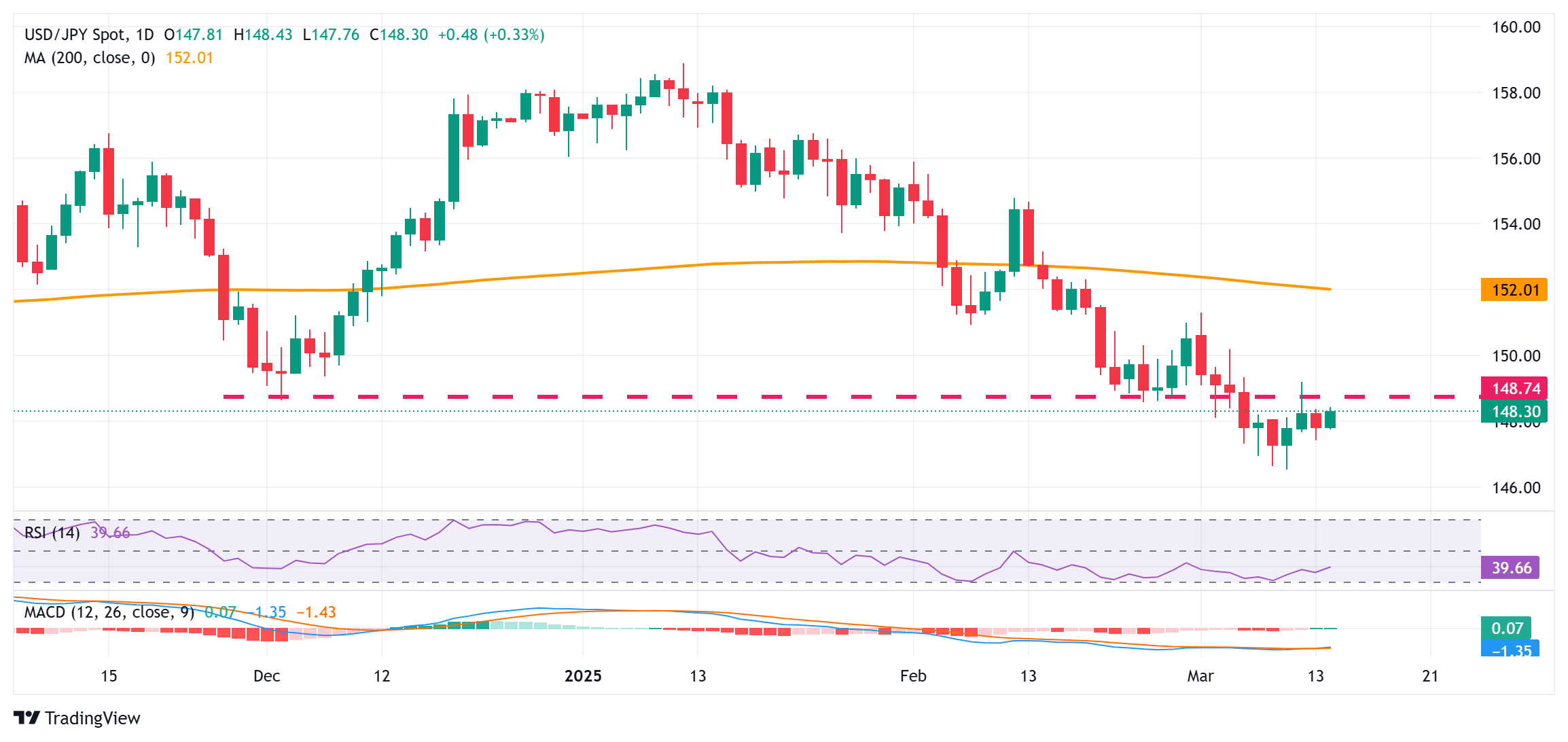
From a technical perspective, any subsequent move-up is likely to confront some resistance near the 148.60-148.70 support breakpoint ahead of the 149.00 mark and the weekly swing high, around the 149.20 region. A sustained strength beyond the latter could trigger a short-covering rally towards the 150.00 psychological mark, above which the USD/JPY pair could climb to the 150.65-150.70 zone. The momentum could extend further towards the 151.00 mark and the monthly peak, around the 151.30 region.
On the flip side, the 147.75-147.70 horizontal zone now seems to have emerged as an immediate support. A convincing break below could make the USD/JPY pair vulnerable to accelerate the fall towards the 147.00 round figure en route to the 146.55-146.50 region, or the lowest level since October touched earlier this week. Given that oscillators on the daily chart are holding in negative territory and are still away from being in the oversold zone, some follow-through selling will be seen as a fresh trigger for bears and pave the way for further losses.
Bank of Japan FAQs
The Bank of Japan (BoJ) is the Japanese central bank, which sets monetary policy in the country. Its mandate is to issue banknotes and carry out currency and monetary control to ensure price stability, which means an inflation target of around 2%.
The Bank of Japan embarked in an ultra-loose monetary policy in 2013 in order to stimulate the economy and fuel inflation amid a low-inflationary environment. The bank’s policy is based on Quantitative and Qualitative Easing (QQE), or printing notes to buy assets such as government or corporate bonds to provide liquidity. In 2016, the bank doubled down on its strategy and further loosened policy by first introducing negative interest rates and then directly controlling the yield of its 10-year government bonds. In March 2024, the BoJ lifted interest rates, effectively retreating from the ultra-loose monetary policy stance.
The Bank’s massive stimulus caused the Yen to depreciate against its main currency peers. This process exacerbated in 2022 and 2023 due to an increasing policy divergence between the Bank of Japan and other main central banks, which opted to increase interest rates sharply to fight decades-high levels of inflation. The BoJ’s policy led to a widening differential with other currencies, dragging down the value of the Yen. This trend partly reversed in 2024, when the BoJ decided to abandon its ultra-loose policy stance.
A weaker Yen and the spike in global energy prices led to an increase in Japanese inflation, which exceeded the BoJ’s 2% target. The prospect of rising salaries in the country – a key element fuelling inflation – also contributed to the move.
Author

Haresh Menghani
FXStreet
Haresh Menghani is a detail-oriented professional with 10+ years of extensive experience in analysing the global financial markets.

















