Japanese Yen remains on the front foot against broadly weaker USD
- The Japanese Yen attracts some dip-buyers and reverses a part of the overnight losses.
- BoJ rate cut bets and growing recession fears drive safe-haven flows towards the JPY.
- Dovish Fed expectations weigh on the USD and also exert pressure on USD USD/JPY.

The Japanese Yen (JPY) sticks to its positive bias against a broadly weaker US Dollar (USD) and keeps the USD/JPY pair depressed below mid-147.00s heading into the European session on Tuesday. Firming expectations that the Bank of Japan (BoJ) will continue raising interest rates in 2025, amid signs of broadening domestic inflation, assists the JPY in regaining positive traction and snapping a two-day losing streak. Apart from this, worries about the potential economic fallout from US President Donald Trump's sweeping reciprocal tariffs turn out to be another factor underpinning the safe-haven JPY.
However, concerns that harsher US reciprocal tariffs could negatively impact Japan's economy, along with a slight improvement in the global risk sentiment, might cap the JPY. The USD, on the other hand, attracts fresh sellers in the wake of rising bets that a tariffs-driven US economic slowdown might force the Federal Reserve (Fed) to resume its rate-cutting cycle soon. This marks a big divergence in comparison to hawkish BoJ expectations, which suggests that the path of least resistance for the lower-yielding JPY is to the upside and supports prospects for a further depreciating move for the USD/JPY pair.
Japanese Yen remains supported by tariff jitters; bulls seem reluctant amid positive risk tone
- Data released on Monday showed that Nominal Wages in Japan rose 3.1% year-on-year in February compared to the previous month's downwardly revised 1.8% increase. Meanwhile, inflation-adjusted real wages contracted 1.2% in February, marking the second consecutive monthly decline and suggesting that high inflation is weighing on earnings.
- In fact, the consumer inflation rate the government uses to calculate real wages grew 4.3% year-on-year. This comes on top of positive spring wage negotiations – which resulted in an agreement of 5.47% growth on average and offered a positive signal for the domestic economy – and backs the case for further policy normalization by the Bank of Japan.
- Investors remain worried that US President Donald Trump's sweeping reciprocal tariffs will disrupt the global trading system and hit economic activity across the world. Furthermore, Trump upped the ante in his trade war with China and threatened an additional 50% tariff on China if it doesn't withdraw a retaliatory 34% import fee on American products.
- This further fuels worries that steep trade barriers around the world's largest consumer market could lead to a recession, which, in turn, assists the safe-haven Japanese Yen to attract some dip-buyers. The US Dollar, on the other hand, stalls a two-day-old recovery move from a multi-month low amid bets for aggressive interest rate cuts by the Federal Reserve.
- Fed Chair Jerome Powell said on Friday that the US central bank was well positioned to wait for greater clarity before making changes like rate reductions and added that Trump's tariffs could have a strong inflationary impact. Meanwhile, Trump called for the Fed to cut interest rates as soon as possible, arguing that the US economy is in a strong position.
- Moreover, traders are now pricing in a greater possibility that the Fed will resume its rate-cutting cycle in June and deliver at least four rate cuts by the end of this year. This, in turn, would result in the further narrowing of the rate differential between the US and Japan, which suggests that the path of least resistance for the lower-yielding JPY is to the upside.
- There isn't any relevant market-moving economic data due for release from the US on Tuesday, leaving the USD at the mercy of trade-related developments and San Francisco Fed President Mary Daly's scheduled speech. The focus, meanwhile, remains on the release of FOMC meeting minutes on Wednesday and US consumer inflation figures on Thursday.
USD/JPY seems vulnerable while below the 148.00 mark amid a bearish technical setup
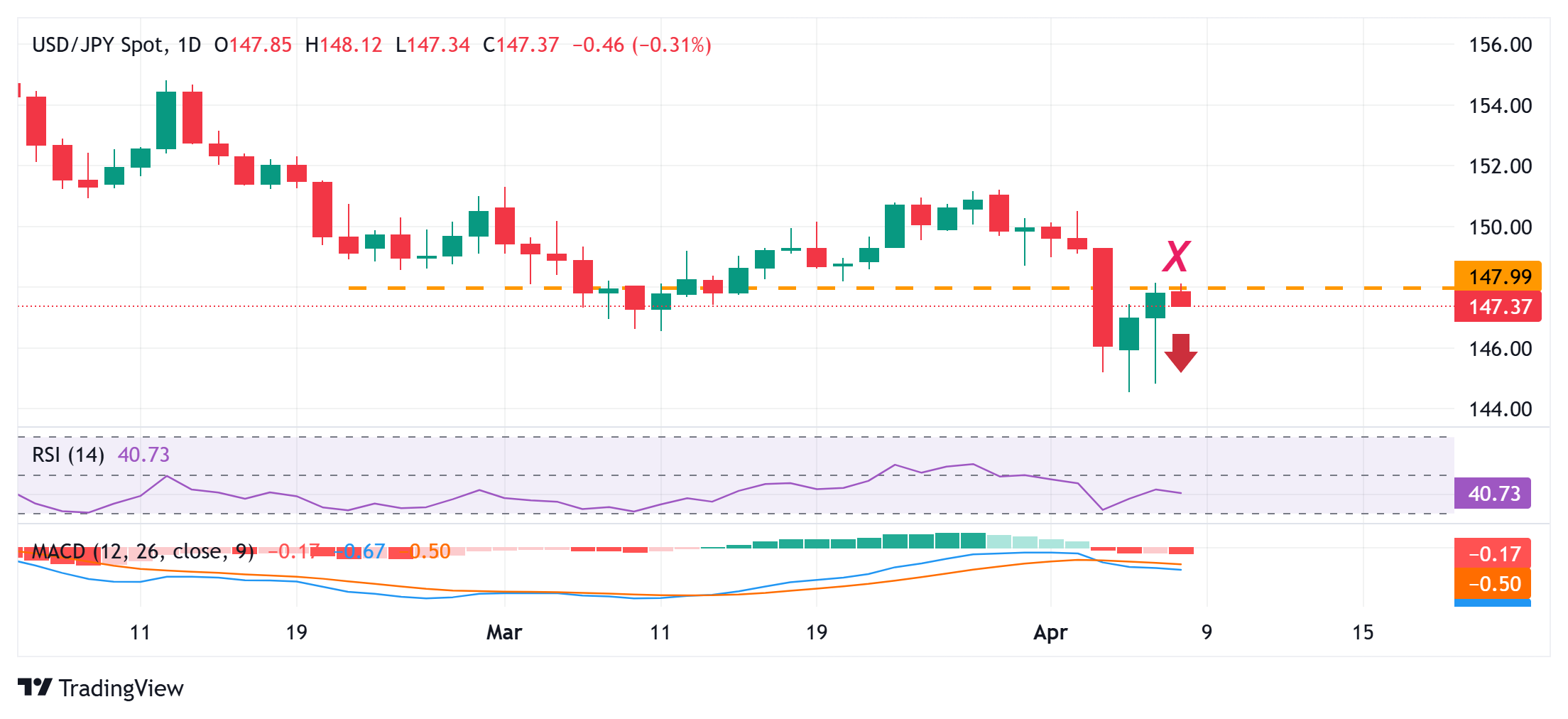
From a technical perspective, the USD/JPY pair's inability to find acceptance above the 148.00 mark and the subsequent slide warrant caution for bullish traders. Moreover, oscillators on the daily chart are holding in negative territory and are still away from being in the oversold zone, validating the near-term negative outlook for the currency pair. However, a sustained move beyond the Asian session high, around the 148.15 region, might trigger a short-covering rally and lift spot prices to the 148.70 intermediate hurdle en route to the 149.00 round figure. The next relevant barrier is pegged near the 149.35-149.40 region, which if cleared should pave the way for a move towards reclaiming the 150.00 psychological mark.
On the flip side, the 147.00 mark could offer some support, below which the USD/JPY pair could accelerate the slide back towards the 146.00 round figure before dropping to the 145.40 region. Some follow-through selling could make spot prices vulnerable and may weaken further below the 145.00 psychological mark and test the multi-month low, around the 144.55 region, touched on Monday. The subsequent downfall has the potential to drag the currency pair towards the 144.00 mark.
US Dollar PRICE Today
The table below shows the percentage change of US Dollar (USD) against listed major currencies today. US Dollar was the strongest against the Japanese Yen.
| USD | EUR | GBP | JPY | CAD | AUD | NZD | CHF | |
|---|---|---|---|---|---|---|---|---|
| USD | -0.73% | -0.50% | -0.34% | -0.66% | -1.28% | -1.33% | -0.66% | |
| EUR | 0.73% | 0.19% | 0.34% | 0.06% | -0.54% | -0.55% | 0.06% | |
| GBP | 0.50% | -0.19% | 0.17% | -0.11% | -0.73% | -0.74% | -0.06% | |
| JPY | 0.34% | -0.34% | -0.17% | -0.31% | -0.92% | -1.01% | -0.27% | |
| CAD | 0.66% | -0.06% | 0.11% | 0.31% | -0.62% | -0.64% | 0.06% | |
| AUD | 1.28% | 0.54% | 0.73% | 0.92% | 0.62% | -0.01% | 0.67% | |
| NZD | 1.33% | 0.55% | 0.74% | 1.01% | 0.64% | 0.00% | 0.69% | |
| CHF | 0.66% | -0.06% | 0.06% | 0.27% | -0.06% | -0.67% | -0.69% |
The heat map shows percentage changes of major currencies against each other. The base currency is picked from the left column, while the quote currency is picked from the top row. For example, if you pick the US Dollar from the left column and move along the horizontal line to the Japanese Yen, the percentage change displayed in the box will represent USD (base)/JPY (quote).
BRANDED CONTENT
Finding the right broker for your trading strategy is essential, especially when specific features make all the difference. Explore our selection of top brokers, each offering unique advantages to match your needs.
Author

Haresh Menghani
FXStreet
Haresh Menghani is a detail-oriented professional with 10+ years of extensive experience in analysing the global financial markets.