Japanese Yen hangs near monthly low against USD; moves little after Ueda's comments
- The Japanese Yen edges higher as strong domestic CPI reaffirms BoJ rate hike bets.
- Trade uncertainties and rising geopolitical tensions also benefit the safe-haven JPY.
- Reduced bets for a BoJ rate hike in 2025 cap the JPY and the hawkish Fed supports the USD.

The Japanese Yen (JPY) trades with a mild positive bias against its American counterpart through the early European session on Friday, though it lacks bullish conviction and remains close to the monthly low touched the previous day. Data released earlier today showed that Japan's annual National Consumer Price Index (CPI) remained well above the Bank of Japan's (BoJ) 2% target in May. This reaffirms market bets that the BoJ will hike interest rates again, which, along with rising geopolitical tensions, acts as a tailwind for the safe-haven JPY.
Meanwhile, the BoJ's cautious approach to unwinding its decade-long monetary stimulus forced investors to push back their expectations about the likely timing of the next interest rate hike to Q1 2026. Adding to this, investors remain worried about the potential economic fallout from existing 25% US tariffs on Japanese vehicles and 24% reciprocal levies on other imports. This, in turn, caps gains for the JPY. The USD, on the other hand, draws some support from the Federal Reserve's hawkish stance and further lends support to the USD/JPY pair.
Japanese Yen bulls remain on the sidelines amid mixed BoJ rate hike cues
- BoJ Governor Kazuo Ueda said that the underlying inflation is likely to converge towards levels consistent with price target and that Japan's real rate remains significantly low. Expect to keep raising interest rates if economy, prices follow projections, Ueda added further.
- However, the BoJ earlier this week signaled its preference to move cautiously in normalizing still-easy monetary policy and decided to slow the pace of reduction in its bond purchases from fiscal 2026. Adding to this, the gloomy economic outlook and the uncertainty over US President Donald Trump's tariffs suggest that the BoJ could forgo hiking interest rates in 2025.
- The Japan Statistics Bureau reported this Friday that the headline National Consumer Price Index (CPI) rose by 3.5% YoY in May, compared to the previous reading of 3.6%. Meanwhile, the National core CPI, which excludes volatile fresh food prices, picked up from the 3.5% YoY rate in April and grew 3.7% last month – marking the highest level since January 2023.
- Further details revealed a core reading that excludes both fresh food and energy prices and is closely watched by the Bank of Japan as a gauge of underlying inflation rose 3.3% YoY in May from 3.0% in the prior month. Stronger CPI prints pointed to broadening inflationary pressures in Japan and gives the BoJ more impetus to hike interest rates in the coming months.
- The Federal Reserve, on the other hand, projected two rate cuts by the end of 2025, though officials forecast only one 25-basis points rate cut in each of 2026 and 2027. Furthermore, seven of the 19 policymakers indicated they wanted no cuts this year, up from four in March, amid persistent worries that the Trump administration's tariffs could push up consumer prices.
- Meanwhile, Trump earlier this week said that tariffs on the pharma sector are coming soon. This adds a layer of uncertainty in the markets ahead of the July 9 deadline for higher reciprocal US tariffs. Adding to this, rising geopolitical tensions continue to weigh on investors' sentiment, which, along with relatively hawkish BoJ expectations, underpins the Japanese Yen.
- On the geopolitical front, the Iran-Israel conflict enters its eighth day as Trump weighs US involvement in the war. According to the White House, Trump said that he will allow two weeks for diplomacy to proceed before deciding whether to launch a strike on Iran. European foreign ministers are slated to meet Iranian officials on Friday and press them to de-escalate.
USD/JPY seems poised to climb further beyond the 146.00 round-figure mark
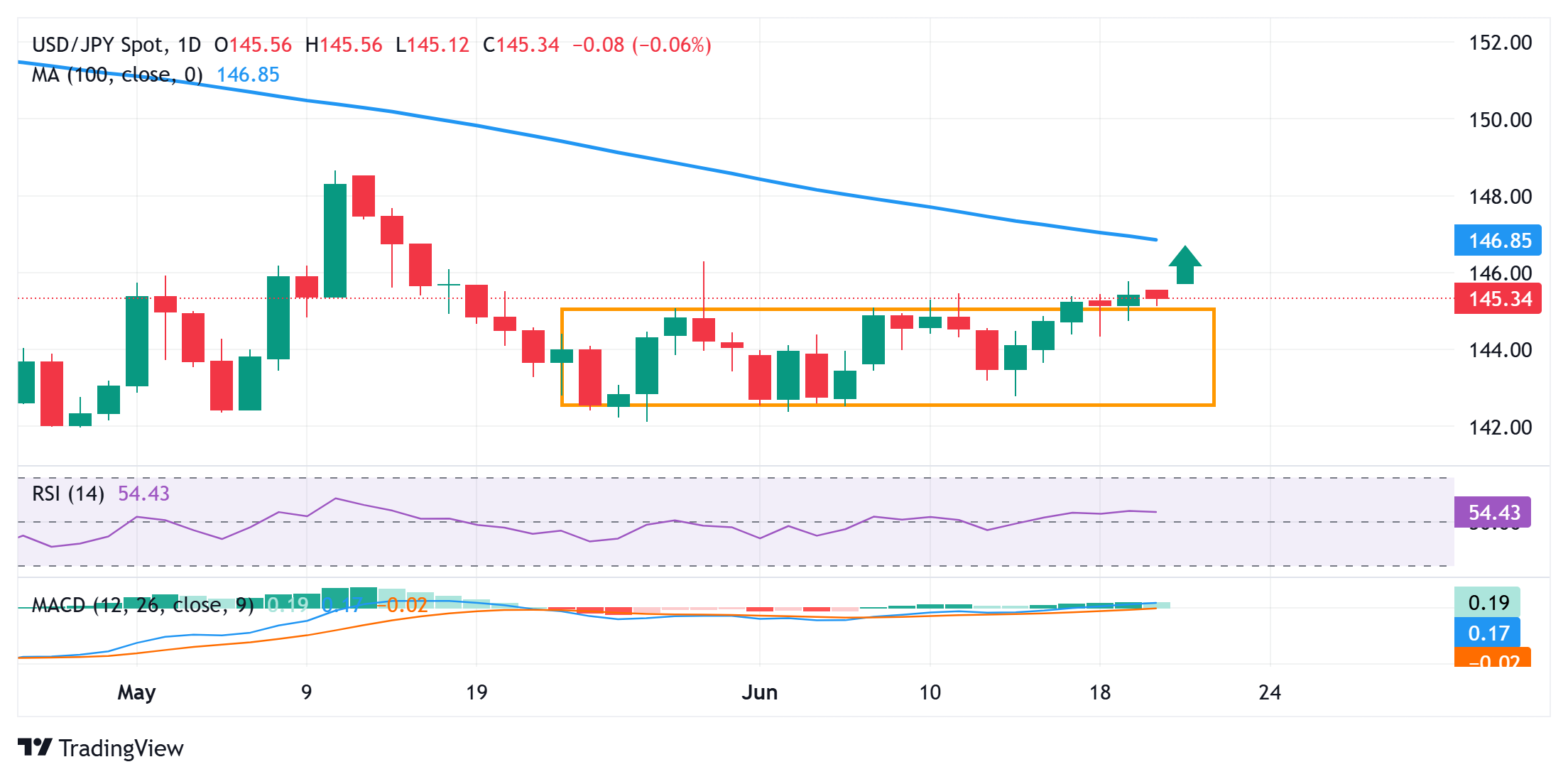
From a technical perspective, the USD/JPY par's back-to-back close above the 145.00 psychological mark this week, along with the overnight move beyond the previous monthly peak, around the 145.45 area, was seen as a fresh trigger for bulls. Moreover, oscillators on the daily chart have just started gaining positive traction and suggest that the path of least resistance for spot prices remains to the upside. Hence, any further pullback could be seen as a buying opportunity near the 144.50-144.45 area. This, in turn, should help limit losses near the 144.00 round figure. A convincing break below the latter, however, would negate the positive outlook and shift the near-term bias in favor of bearish traders.
On the flip side, the 145.75 area, or the monthly top touched on Thursday, could act as an immediate hurdle ahead of the 146.00 mark. This is closely followed by the May 29 peak, around the 146.25-146.30 region, above which the USD/JPY pair could aim to challenge the 100-day Simple Moving Average (SMA), currently pegged just ahead of the 147.00 round figure. Some follow-through buying might then pave the way for a move towards the 147.40-147.45 intermediate hurdle en route to the 148.00 mark and 148.65 region, or the May monthly swing high.
Fed FAQs
Monetary policy in the US is shaped by the Federal Reserve (Fed). The Fed has two mandates: to achieve price stability and foster full employment. Its primary tool to achieve these goals is by adjusting interest rates. When prices are rising too quickly and inflation is above the Fed’s 2% target, it raises interest rates, increasing borrowing costs throughout the economy. This results in a stronger US Dollar (USD) as it makes the US a more attractive place for international investors to park their money. When inflation falls below 2% or the Unemployment Rate is too high, the Fed may lower interest rates to encourage borrowing, which weighs on the Greenback.
The Federal Reserve (Fed) holds eight policy meetings a year, where the Federal Open Market Committee (FOMC) assesses economic conditions and makes monetary policy decisions. The FOMC is attended by twelve Fed officials – the seven members of the Board of Governors, the president of the Federal Reserve Bank of New York, and four of the remaining eleven regional Reserve Bank presidents, who serve one-year terms on a rotating basis.
In extreme situations, the Federal Reserve may resort to a policy named Quantitative Easing (QE). QE is the process by which the Fed substantially increases the flow of credit in a stuck financial system. It is a non-standard policy measure used during crises or when inflation is extremely low. It was the Fed’s weapon of choice during the Great Financial Crisis in 2008. It involves the Fed printing more Dollars and using them to buy high grade bonds from financial institutions. QE usually weakens the US Dollar.
Quantitative tightening (QT) is the reverse process of QE, whereby the Federal Reserve stops buying bonds from financial institutions and does not reinvest the principal from the bonds it holds maturing, to purchase new bonds. It is usually positive for the value of the US Dollar.
Author

Haresh Menghani
FXStreet
Haresh Menghani is a detail-oriented professional with 10+ years of extensive experience in analysing the global financial markets.