Japanese Yen benefits from global flight to safety; BoJ uncertainty might cap gains
- The Japanese Yen attracts some intraday buyers amid intervention fears and reviving safe-haven demand.
- A modest USD pullback triggers an intraday retracement slide for USD/JPY from a nearly nine-month high.
- The BoJ rate hike uncertainty and the Fed’s hawkish tilt could help limit any further depreciation for the pair.

The Japanese Yen (JPY) attracts some safe-haven flows on Tuesday amid a turnaround in the global risk sentiment. Adding to this, Bank of Japan (BoJ) Governor Kazuo Ueda's hawkish hints last week, signaling the possibility of a rate hike in December or January next year, and intervention fears, provides a strong boost to the JPY. This, along with a modest US Dollar (USD) pullback from a three-month top, drags the USD/JPY pair away from its highest level since February 12, touched earlier this Tuesday.
Any meaningful JPY appreciation, however, seems elusive amid the uncertainty over the timing of the next BoJ rate hike, fueled by expectations that Japan's new Prime Minister Sanae Takaichi will pursue aggressive fiscal spending plans. Furthermore, reduced bets for another interest rate cut by the US Federal Reserve (Fed) in December could limit deeper USD losses and lend support to the USD/JPY pair. This, in turn, warrants some caution before placing aggressive bearish bets around the pair.
Japanese Yen attracts strong safe-haven flows amid intervention fears
- The Bank of Japan remains reluctant to commit to further interest rate hikes amid Japan's new Prime Minister Sanae Takaichi's pro-stimulus stance, keeping the Japanese Yen depressed against a bullish US Dollar through the Asian session on Tuesday.
- Meanwhile, data released last Friday showed that the core Consumer Price Index in Tokyo – Japan's capital city – has stayed above the BoJ's 2% target for three-and-a-half-years. This, in turn, backs the case for further policy tightening by the central bank.
- Moreover, BoJ Governor Kazuo Ueda said last week that the likelihood of its baseline scenario materialising has heightened and reiterated that the central bank will continue to raise the policy rate if the economy and prices move in line with the forecast.
- Adding to this, the risk of currency intervention from Japanese authorities could limit deeper JPY losses, though sustained US Dollar buying remains supportive of the bid tone surrounding the USD/JPY pair, near its highest level since February.
- Fed Chair Jerome Powell last week pushed back against market expectations for a further reduction in the policy rate at the December meeting and assisted the USD Index (DXY) to build on a one-week-old uptrend, pushing it to a three-month top.
- The US government shutdown will hit the 35-day mark on Tuesday night and is poised to become the longest on record, previously set in 2019, as Republican and Democratic lawmakers in Congress remain deadlocked on the funding bill.
- Senate Majority Leader John Thune said he is optimistic about ending the government shutdown this week, and that the upper chamber would vote for the 14th time on the Republican-backed and House-passed funding bill later this Tuesday.
- Investors now seem worried that a prolonged government closure could cause economic damage, which, in turn, warrants caution before positioning for an extension of the USD appreciating move and further gains for the USD/JPY pair.
USD/JPY bears need to wait for break below 153.30-153.25 resistance-turned-support
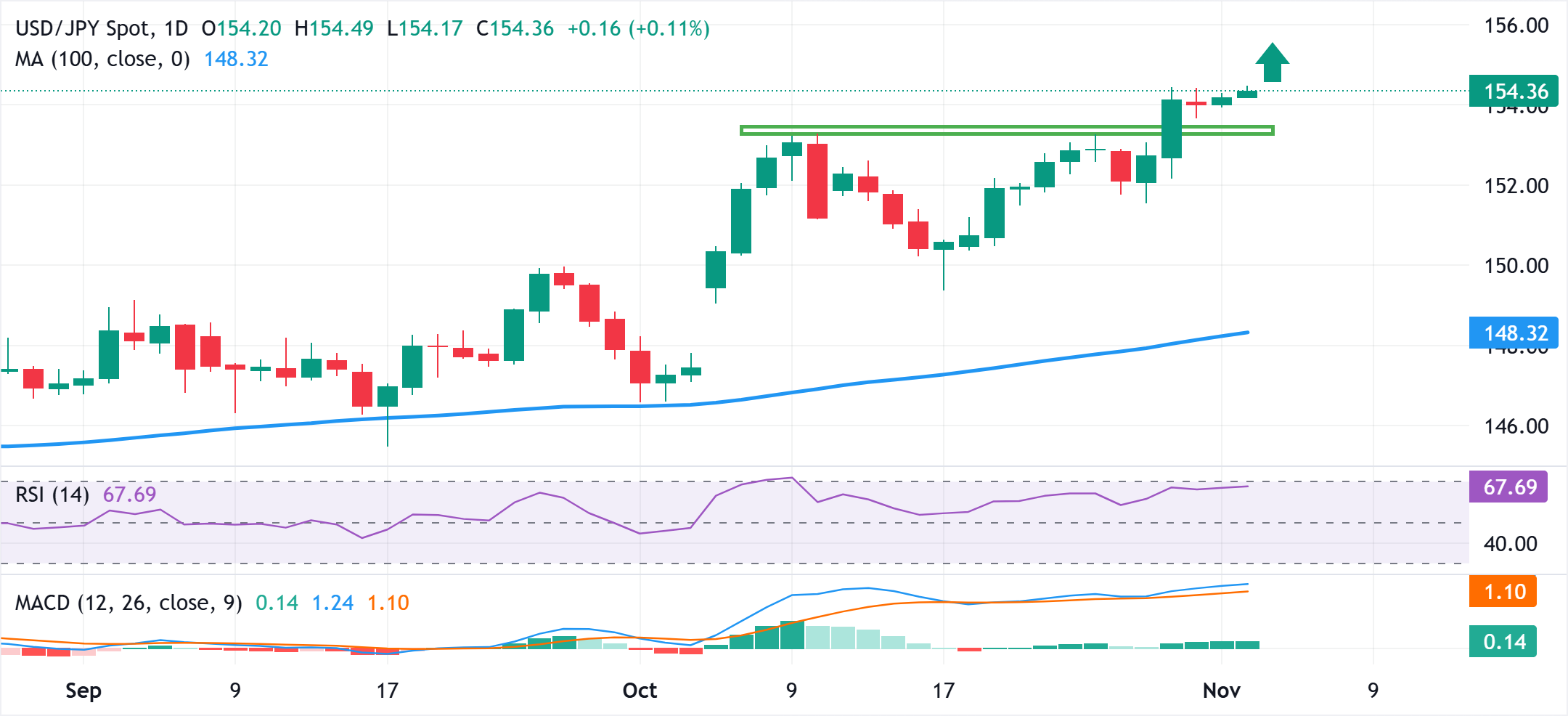
From a technical perspective, last week's breakout through the 153.25-153.30 hurdle and a subsequent strength beyond the 154.00 mark was seen as a key trigger for the USD/JPY bulls. Moreover, oscillators on the daily chart are holding comfortably in positive territory and are still away from being in the overbought zone. This, in turn, backs the case for a move beyond the 154.75-154.80 intermediate hurdle, towards reclaiming the 155.00 psychological mark.
On the flip side, any corrective pullback now seems to find some support near the 154.00 mark ahead of last Friday's swing low, around the 153.65 region. This is followed by the 153.30-153.25 resistance-turned-support and the 153.00 mark, which, if broken decisively, might expose the 152.15 region. Some follow-through selling below the 152.00 mark would negate the near-term positive outlook and drag the USD/JPY pair to the 151.55-151.50 area en route to the 151.10-151.00 key support.
(This story was corrected at 03:19 GMT to say in the first para that the Japanese Yen drops, not climbs, to its lowest level since February 12, not the highest.)
Risk sentiment FAQs
In the world of financial jargon the two widely used terms “risk-on” and “risk off'' refer to the level of risk that investors are willing to stomach during the period referenced. In a “risk-on” market, investors are optimistic about the future and more willing to buy risky assets. In a “risk-off” market investors start to ‘play it safe’ because they are worried about the future, and therefore buy less risky assets that are more certain of bringing a return, even if it is relatively modest.
Typically, during periods of “risk-on”, stock markets will rise, most commodities – except Gold – will also gain in value, since they benefit from a positive growth outlook. The currencies of nations that are heavy commodity exporters strengthen because of increased demand, and Cryptocurrencies rise. In a “risk-off” market, Bonds go up – especially major government Bonds – Gold shines, and safe-haven currencies such as the Japanese Yen, Swiss Franc and US Dollar all benefit.
The Australian Dollar (AUD), the Canadian Dollar (CAD), the New Zealand Dollar (NZD) and minor FX like the Ruble (RUB) and the South African Rand (ZAR), all tend to rise in markets that are “risk-on”. This is because the economies of these currencies are heavily reliant on commodity exports for growth, and commodities tend to rise in price during risk-on periods. This is because investors foresee greater demand for raw materials in the future due to heightened economic activity.
The major currencies that tend to rise during periods of “risk-off” are the US Dollar (USD), the Japanese Yen (JPY) and the Swiss Franc (CHF). The US Dollar, because it is the world’s reserve currency, and because in times of crisis investors buy US government debt, which is seen as safe because the largest economy in the world is unlikely to default. The Yen, from increased demand for Japanese government bonds, because a high proportion are held by domestic investors who are unlikely to dump them – even in a crisis. The Swiss Franc, because strict Swiss banking laws offer investors enhanced capital protection.
Author

Haresh Menghani
FXStreet
Haresh Menghani is a detail-oriented professional with 10+ years of extensive experience in analysing the global financial markets.

















