Japanese Yen buying remains unabated as safe-haven demand offsets political jitters
- The Japanese Yen continues to attract safe-haven flows amid renewed US-China trade tensions.
- The divergent BoJ-Fed policy expectations further exert downward pressure on the USD/JPY pair.
- A heightened level of domestic political uncertainty may deter the JPY bulls from placing new bets.

The Japanese Yen (JPY) prolongs its appreciating move for the fourth straight day, hitting a fresh two-week top against a broadly weaker US Dollar (USD) heading into the European session on Friday. Concerns about economic risks stemming from escalating US-China trade tensions, geopolitical uncertainties, and a prolonged US government shutdown weigh on investors' sentiment. This, in turn, is seen as a key factor driving safe-haven flows towards the JPY.
Meanwhile, the collapse of the Liberal Democratic Party's (LDP) coalition with the Komeito jeopardized Sanae Takaichi's bid to become Japan's first woman Prime Minister. This, in turn, helps ease worries about Japan’s fiscal health. Furthermore, bets for an imminent rate hike by the Bank of Japan (BoJ) later this year underpin the JPY. The USD, on the other hand, is pressured by dovish Federal Reserve (Fed) expectations and exerts additional pressure on the USD/JPY pair.
Daily Digest Market Movers: Japanese Yen sticks to bullish bias amid global flight to safety
- The US and China started charging additional port fees on vessels linked to each other’s fleets. This comes after the US broadened tech restrictions and China outlined tighter export controls on rare earths, fueling concerns about an all-out trade war between the world's two largest economies.
- US President Donald Trump said on Thursday that he will meet Russian President Vladimir Putin in Budapest, Hungary, to work toward ending the war in Ukraine. Meanwhile, Trump is set to meet Ukrainian President Volodymyr Zelenskyy at the White House later this Friday.
- In the meantime, Russia launched hundreds of drones and dozens of missiles, as well as glide bombs on Thursday, hitting gas facilities in eastern Ukraine. This keeps geopolitical risks in play and weighs on investors' sentiment, driving some safe-haven flows towards the Japanese Yen.
- The ruling Liberal Democratic Party's (LDP) split with the Komeito jeopardized Sanae Takaichi's bid to become Japan's first woman Prime Minister. Takaichi advocated the former Premier Shinzo Abe's policy of heavy spending and monetary stimulus to support the economy.
- The latest political developments eased concerns about Japan’s fiscal health, and the reversal of the Takaichi trade turns out to be another factor underpinning the JPY. Apart from this, expectations for an imminent Bank of Japan rate hike by the year-end further benefits the JPY.
- BoJ Kazuo Ueda said this Friday that the impact of tariffs on global, US economy is being delayed which is keeping growth resilient. Ueda added that the BoJ will adjust degree of monetary support in accordance to the likelihood of our growth, inflation forecasts materializing.
- In contrast, traders have been pricing in two more rate cuts by the US Federal Reserve in 2025. The bets were reaffirmed by Fed Chair Jerome Powell's dovish remarks on Tuesday, which keep the US Dollar depressed and drag the USD/JPY pair to the 150.00 psychological mark.
- The US Senate rejected a House Republican’s short-term funding bill to reopen the government for the tenth time on Thursday. The repeated failure to pass the stopgap bill underscores a deadlock in Congress and fuels concerns about the economic effect of a prolonged government closure.
- In the absence of any relevant US macro data, traders will continue to take cues from speeches by influential FOMC members to grab short-term opportunities. Nevertheless, the USD/JPY pair remains on track to register heavy weekly losses and seems poised to depreciate further.
USD/JPY seems vulnerable to extend the descending trend; break below 150.00 remains in play
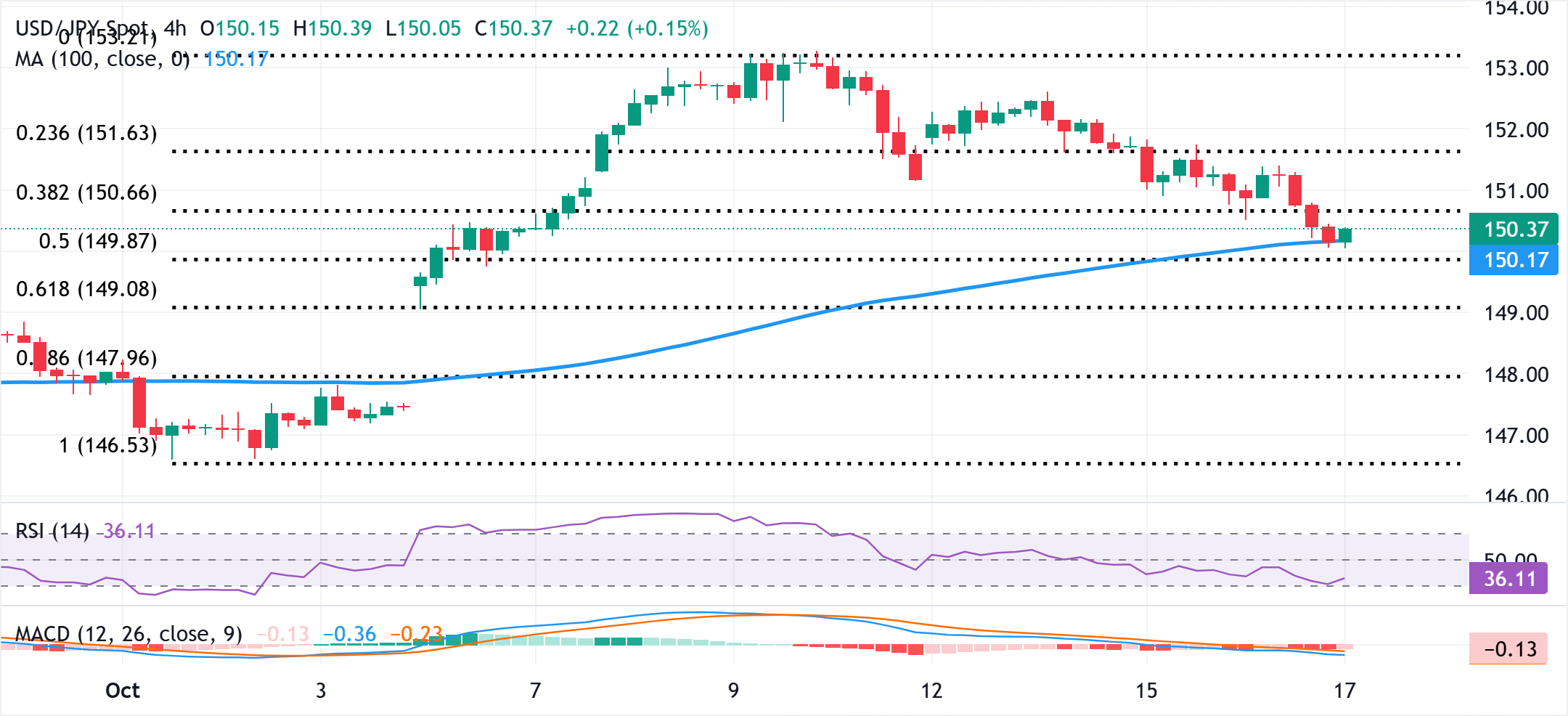
From a technical perspective, spot prices find support near the 150.00 mark, also representing the 50% retracement level of the upswing from the monthly low. A convincing break below could make the USD/JPY pair vulnerable to accelerate the fall towards the 149.15 region, or the 61.8% Fibo. level. Some follow-through selling will be seen as a fresh trigger for bearish traders and pave the way for an extension of the recent pullback from the 153.30-153.25 region, or the highest level since February, touched earlier this month.
On the flip side, any further recovery might confront an immediate hurdle near the 150.70 region (38.2% Fibo. retracement level). This is followed by the 151.00 mark, which, if cleared, could trigger a short-covering rally and lift the USD/JPY pair to the 151.65 intermediate barrier en route to the 152.00 round figure. The momentum could extend further towards the 152.25 supply zone before bulls aim to reclaim the 153.00 mark and retest a multi-month peak, around the 153.25-153.30 region.
Risk sentiment FAQs
In the world of financial jargon the two widely used terms “risk-on” and “risk off'' refer to the level of risk that investors are willing to stomach during the period referenced. In a “risk-on” market, investors are optimistic about the future and more willing to buy risky assets. In a “risk-off” market investors start to ‘play it safe’ because they are worried about the future, and therefore buy less risky assets that are more certain of bringing a return, even if it is relatively modest.
Typically, during periods of “risk-on”, stock markets will rise, most commodities – except Gold – will also gain in value, since they benefit from a positive growth outlook. The currencies of nations that are heavy commodity exporters strengthen because of increased demand, and Cryptocurrencies rise. In a “risk-off” market, Bonds go up – especially major government Bonds – Gold shines, and safe-haven currencies such as the Japanese Yen, Swiss Franc and US Dollar all benefit.
The Australian Dollar (AUD), the Canadian Dollar (CAD), the New Zealand Dollar (NZD) and minor FX like the Ruble (RUB) and the South African Rand (ZAR), all tend to rise in markets that are “risk-on”. This is because the economies of these currencies are heavily reliant on commodity exports for growth, and commodities tend to rise in price during risk-on periods. This is because investors foresee greater demand for raw materials in the future due to heightened economic activity.
The major currencies that tend to rise during periods of “risk-off” are the US Dollar (USD), the Japanese Yen (JPY) and the Swiss Franc (CHF). The US Dollar, because it is the world’s reserve currency, and because in times of crisis investors buy US government debt, which is seen as safe because the largest economy in the world is unlikely to default. The Yen, from increased demand for Japanese government bonds, because a high proportion are held by domestic investors who are unlikely to dump them – even in a crisis. The Swiss Franc, because strict Swiss banking laws offer investors enhanced capital protection.
Author

Haresh Menghani
FXStreet
Haresh Menghani is a detail-oriented professional with 10+ years of extensive experience in analysing the global financial markets.

















