Japanese Yen sticks to positive bias amid BoJ rate hike bets; US-China trade talks in focus
- The Japanese Yen attracts fresh buyers on Monday and snaps a two-day losing streak.
- An upward revision of Japan’s Q1 GDP reaffirms BoJ rate hike bets and boosts the JPY.
- The emergence of some USD selling exerts additional downward pressure on USD/JPY.

The Japanese Yen (JPY) sticks to its modest intraday gains through the early European session on Monday, which, along with a broadly weaker US Dollar (USD), drags the USD/JPY pair to the 144.20 area, or a fresh daily low in the last hour. An upward revision of Japan's Q1 GDP print comes on top of signs of broadening inflation in Japan and reaffirms market bets that the Bank of Japan (BoJ) will continue raising interest rates.
Moreover, persistent geopolitical risks lend additional support to the safe-haven JPY amid the prevalent cautious market mood. Meanwhile, Friday's stronger-than-expected US jobs data dampened hopes for imminent rate cuts by the Federal Reserve (Fed) this year. This might hold back the USD bears from placing aggressive bets and act as a tailwind for the USD/JPY pair ahead of the crucial US-China trade talks in London.
Japanese Yen bulls retain intraday control amid hawkish BoJ expectations
- Japan’s Cabinet Office reported earlier this Monday that the economy registered no growth during the first quarter of 2025, against the 0.2% contraction initially estimated. The revised data further revealed that Japan’s economy contracted at a slower pace, by 0.2% annualized during the reported month, compared to the 0.7% contraction initially reported.
- Additional details showed that private consumption, which accounts for more than half of the Japanese economy, inched up by 0.1% during the January-March period versus a flat preliminary reading. This gives the Bank of Japan headroom to hike interest rates further this year and provides a modest lift to the Japanese Yen at the start of a new week.
- Japan's Prime Minister Shigeru Ishiba said that Japan must be aware that rising interest rates would push up the government’s debt-financing costs and affect its spending plans. The government must ensure public, market trust in Japan's finances is maintained, Ishiba added further.
- The US Dollar, on the other hand, struggles to capitalize on Friday's move higher, led by the better-than-expected US Nonfarm Payrolls (NFP) report. The crucial US employment data showed that the economy added 139K new jobs in May, lower than the previous month's downwardly revised print of 147K, though it was better than the 130K forecasted.
- Other details of the report showed that the Unemployment Rate held steady at 4.2%, as anticipated. Adding to this, Average Hourly Earnings remained unchanged at 3.9%, surpassing consensus estimates of 3.7%. This reinforced expectations that the Federal Reserve would hold interest rates steady at its upcoming meeting and boosted the USD.
- Top US and Chinese officials will meet in London on Monday for negotiations aimed at defusing the high-stakes trade dispute between the world's two largest economies. US President Donald Trump said last week that a call with Chinese leader Xi Jinping was focused almost entirely on trade and resulted in a very positive conclusion.
- On the geopolitical front, Russian forces launched massive attacks on Ukraine's second-largest city of Kharkiv with drones, missiles, and guided bombs. Moreover, Russia claimed that a tank division has reached the western border of Donetsk and is continuing its advance, signaling a serious escalation in the conflict amid stalled peace talks.
USD/JPY could attract some buyers near the 144.00 pivotal support
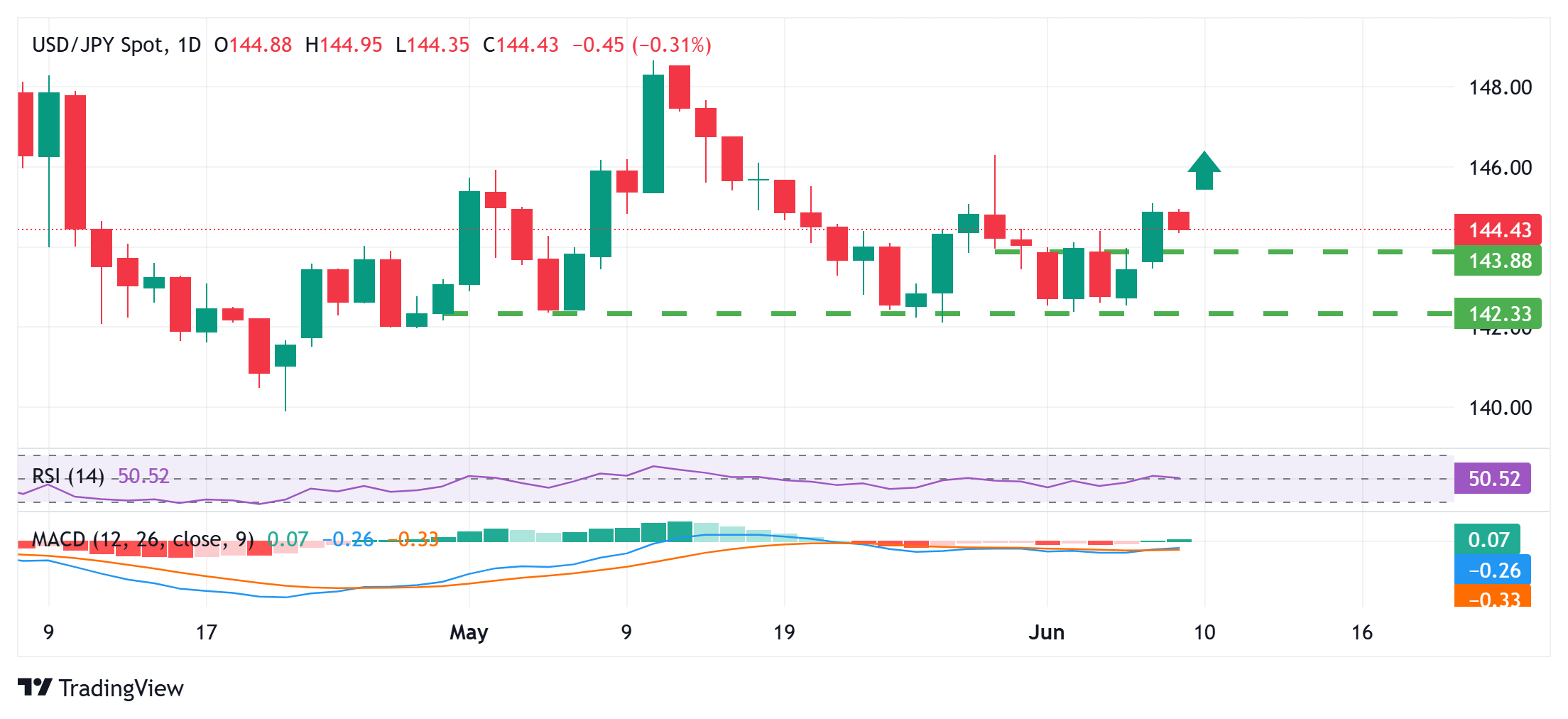
From a technical perspective, Friday's breakout through a multi-day-old trading range was seen as a key trigger for the USD/JPY bulls. However, neutral oscillators on the daily chart make it prudent to wait for some follow-through buying beyond the 145.00 psychological mark, or a one-week high touched last Friday, before positioning for further gains. Spot prices might then climb to the 145.55-145.60 horizontal barrier en route to the 146.00 round figure and the May 29 swing high, around the 146.25-146.30 region.
On the flip side, the trading range resistance breakpoint, around the 144.00 round figure, now seems to protect the immediate downside. A convincing break below, however, might prompt some technical selling and drag the USD/JPY pair back towards the 143.50-143.40 area en route to the 143.00 mark and the next relevant support near the 142.70-142.65 horizontal zone. The latter should act as a pivotal point, which, if broken decisively, will set the stage for the resumption of the recent downfall from the May monthly swing high.
US-China Trade War FAQs
Generally speaking, a trade war is an economic conflict between two or more countries due to extreme protectionism on one end. It implies the creation of trade barriers, such as tariffs, which result in counter-barriers, escalating import costs, and hence the cost of living.
An economic conflict between the United States (US) and China began early in 2018, when President Donald Trump set trade barriers on China, claiming unfair commercial practices and intellectual property theft from the Asian giant. China took retaliatory action, imposing tariffs on multiple US goods, such as automobiles and soybeans. Tensions escalated until the two countries signed the US-China Phase One trade deal in January 2020. The agreement required structural reforms and other changes to China’s economic and trade regime and pretended to restore stability and trust between the two nations. However, the Coronavirus pandemic took the focus out of the conflict. Yet, it is worth mentioning that President Joe Biden, who took office after Trump, kept tariffs in place and even added some additional levies.
The return of Donald Trump to the White House as the 47th US President has sparked a fresh wave of tensions between the two countries. During the 2024 election campaign, Trump pledged to impose 60% tariffs on China once he returned to office, which he did on January 20, 2025. With Trump back, the US-China trade war is meant to resume where it was left, with tit-for-tat policies affecting the global economic landscape amid disruptions in global supply chains, resulting in a reduction in spending, particularly investment, and directly feeding into the Consumer Price Index inflation.
Author

Haresh Menghani
FXStreet
Haresh Menghani is a detail-oriented professional with 10+ years of extensive experience in analysing the global financial markets.