Japanese Yen stands firm near YTD peak against USD amid US tariffs-inspired global meltdown
- The Japanese Yen continues to benefit from US tariffs-inspired global flight to safety.
- Hopes for a US-Japan trade deal further underpin the JPY amid sustained USD selling.
- The divergent BoJ-Fed expectations support prospects for deeper USD/JPY losses.

The Japanese Yen (JPY) sticks to strong intraday gains heading into the European session on Thursday and currently trades near the year-to-date peak against its American counterpart. Intensifying trade war and heightening global recession fears continue to weigh on investors' sentiment, which is evident from a sea of red across the equity markets and underpins the safe-haven JPY. Apart from this, bets that the Bank of Japan (BoJ) will raise interest rates again in 2025 amid broadening inflation in Japan, along with hopes for a US-Japan trade deal, turn out to be other factors lending support to the JPY.
Meanwhile, hawkish BoJ expectations mark a big divergence in comparison to expectations that the Federal Reserve (Fed) will resume its rate-cutting cycle soon amid growing worries about a tariffs-driven US economic slowdown. This, in turn, would result in a further narrowing of the rate differential between Japan and the US, which contributes to driving flows towards the lower-yielding JPY. Moreover, some follow-through US Dollar (USD) selling keeps the USD/JPY pair depressed below the 145.00 mark as traders now look forward to the FOMC meeting minutes for some meaningful opportunities.
Japanese Yen bulls retain control amid heightened recession fears, divergent BoJ-Fed expectations
- Mounting worries that US President Donald Trump’s sweeping tariffs would push the US, and possibly the global economy, into recession this year have led to an extended sell-off in equity markets worldwide. In fact, the S&P 500 registered its steepest four days of losses since the 1950s after Trump unveiled sweeping reciprocal tariffs late last Wednesday.
- Japan's Prime Minister Shigeru Ishiba and Trump agreed to keep dialogue open to address the pressing levy issues. Moreover, Trump told reporters that we have a great relationship with Japan and we're going to keep it that way. This fuels optimism about a possible US-Japan trade deal, which lends additional support to the safe-haven Japanese Yen.
- Japan's Ministry of Finance, Financial Services Agency, and the BoJ will hold meeting at 07:00 GMT to discuss international financial markets.
- Investors have pared their bets that the Bank of Japan will hike interest rates at a faster pace amid concerns about the potential economic fallout from Trump's trade tariffs. However, BoJ Deputy Governor Shinichi Uchida said last Friday the central bank will keep raising interest rates if the chance of underlying inflation achieving its 2% target heightens.
- Meanwhile, investors now seem convinced that a tariffs-driven US economic slowdown would put pressure on the Federal Reserve to resume its rate-cutting cycle. According to the CME Group's FedWatch Tool, the markets are currently pricing in over a 60% chance that the US central bank will lower borrowing costs at the next policy meeting in May.
- Moreover, the Fed is expected to deliver five interest rate cuts by the end of this year despite expectations that Trump's tariffs will boost inflation. This, in turn, weighs on the US Dollar for the second straight day and keeps the USD/JPY pair within striking distance of its lowest level since October 2024 touched last Friday.
- Traders now look forward to the release of FOMC meeting minutes, due later during the US session this Wednesday. Apart from this, the US Consumer Price Index (CPI) and the Producer Price Index (PPI) on Thursday and Friday, respectively, might provide cues about the Fed’s rate-cut path. This, in turn, will drive the buck and USD/JPY.
USD/JPY seems vulnerable to weaken further; YTD low around 144.55 is the last point of defense for bulls
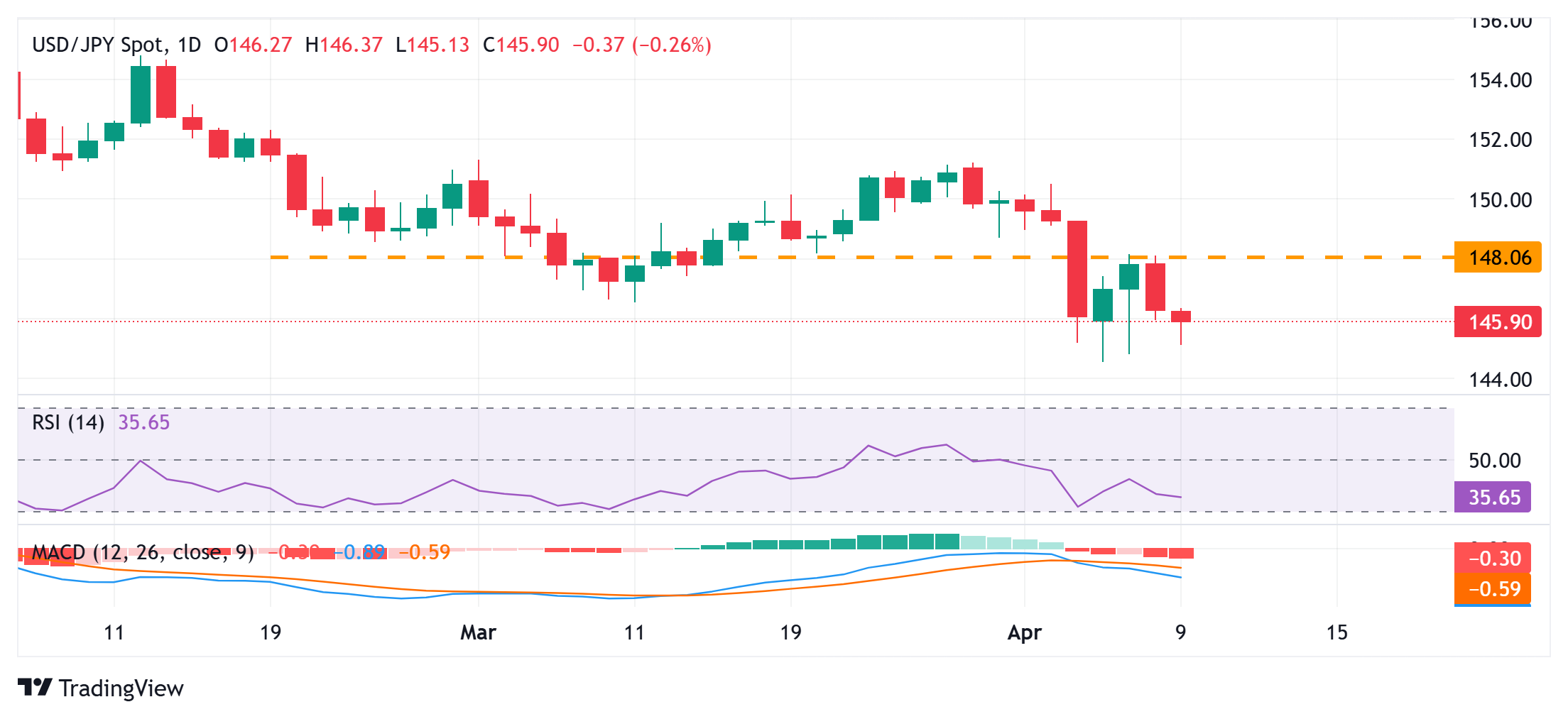
From a technical perspective, this week's failure to find acceptance above the 148.00 mark and the subsequent fall favors bearish traders. Moreover, oscillators on the daily chart are holding deep in negative territory and are still away from being in the oversold zone, suggesting that the path of least resistance for the USD/JPY pair is to the downside. Some follow-through selling below the year-to-date low, around the 144.55 region touched on Monday, will reaffirm the negative outlook and expose the 144.00 round figure.
On the flip side, the 146.00 mark now seems to keep a lid on any attempted recovery. This is followed by the Asian session high, around the 146.35 region, above which a bout of a short-covering could lift the USD/JPY pair to the 147.00 round figure en route to the 147.40-147.45 area. The subsequent move-up should allow bulls to reclaim the 148.00 mark and test the weekly top, around the 148.15 zone. A sustained strength beyond the latter might shift the near-term bias in favor of bullish traders and pave the way for some meaningful appreciating move.
Economic Indicator
FOMC Minutes
FOMC stands for The Federal Open Market Committee that organizes 8 meetings in a year and reviews economic and financial conditions, determines the appropriate stance of monetary policy and assesses the risks to its long-run goals of price stability and sustainable economic growth. FOMC Minutes are released by the Board of Governors of the Federal Reserve and are a clear guide to the future US interest rate policy.
Next release: Wed Apr 09, 2025 18:00
Frequency: Irregular
Consensus: -
Previous: -
Source: Federal Reserve
Minutes of the Federal Open Market Committee (FOMC) is usually published three weeks after the day of the policy decision. Investors look for clues regarding the policy outlook in this publication alongside the vote split. A bullish tone is likely to provide a boost to the greenback while a dovish stance is seen as USD-negative. It needs to be noted that the market reaction to FOMC Minutes could be delayed as news outlets don’t have access to the publication before the release, unlike the FOMC’s Policy Statement.
Author

Haresh Menghani
FXStreet
Haresh Menghani is a detail-oriented professional with 10+ years of extensive experience in analysing the global financial markets.