Japanese Yen moves further away from one-week low against USD; bears lack conviction
- The Japanese Yen retreats from an over one-week high touched against a weaker USD this Thursday.
- Rising US-China trade tensions and geopolitical risks could help limit losses for the safe-haven JPY.
- Dovish Fed expectations could undermine the USD and also contribute to capping the USD/JPY pair.

The Japanese Yen (JPY) extends its steady intraday descent through the European session and retreats further from an over one-week low touched against its American counterpart earlier this Thursday. Speculations that the Bank of Japan (BoJ) could delay raising interest rates further amid domestic political uncertainty, along with a generally positive risk tone, turned out to be key factors undermining the safe-haven JPY. Apart from this, a modest US Dollar (USD) bounce assists the USD/JPY pair to recover around 70-75 pips from the daily low and climb to the 152.25 region in the last hour.
Meanwhile, the ruling Liberal Democratic Party's (LDP) coalition split with the Komeito jeopardized Sanae Takaichi's bid to become the country's first woman Prime Minister and eased concerns about Japan's fiscal health. This, in turn, keeps hopes alive for an imminent BoJ rate hike this year, which, along with renewed US-China trade tensions and geopolitical risks, could help limit losses for the JPY. The US Dollar (USD), on the other hand, might struggle to lure buyers amid bets for more rate cuts by the Federal Reserve (Fed), which, in turn, should contribute to capping the USD/JPY pair.
Japanese Yen bulls losing grip as political jitters fuel BoJ uncertainty
- The long-standing Liberal Democratic Party (LDP)–Komeito coalition came to an abrupt end last week. The breakup, in turn, means the newly elected LDP leader, Sanae Takaichi, would need support from other parties to confirm her as Japan’s first female Prime Minister.
- Takaichi is a supporter of the former Premier Shinzo Abe's economic policies, who advocated heavy spending and monetary stimulus to support the economy. The developments, however, helped ease concerns about Japan’s fiscal health and underpinned the Japanese Yen.
- Meanwhile, Japan's parliament failed to set a date for its vote on the new Prime Minister as opposition parties are also holding talks to secure enough backing to form a new government. The uncertainty creates a challenge for the Bank of Japan to hike interest rates further.
- US-China trade tensions escalated in recent weeks after the US broadened tech restrictions and China outlined tighter export controls on rare earths. Moreover, both countries announced the tit-for-tat port fees on vessels linked to each other’s fleets, fueling trade war fears.
- In fact, US President Donald Trump said he saw the US as locked in an all-out trade war with China. However, US Treasury Secretary Scott Bessent proposed a longer pause on high tariffs on Chinese goods if China halts its plan for strict export controls on critical minerals.
- On the geopolitical front, US secretary of war Pete Hegseth warned Russia to stop fighting or risk a response only the US can give. This raises the risk of a further escalation of the protracted Russia-Ukraine war and benefits the JPY's safe-haven status amid BoJ rate hike bets.
- Meanwhile, BoJ board member Naoki Tamura said on Thursday that the economic growth rate in Japan is likely to rise and the slowdown in overseas economies will not be as significant as initially expected. Tamura added that the BoJ should push rates closer toward levels deemed neutral.
- This marks a significant divergence in comparison to firming expectations that the US Federal Reserve will deliver a 25-basis-point rate cut each in October and in December. Moreover, concerns that the US government closure would affect the economy weigh on the USD.
- A judge on Wednesday temporarily blocked the Trump administration from firing federal workers amid the ongoing shutdown, which started on October 1. This comes as the Senate fails to advance a House-passed GOP bill to fund the government for the ninth time.
- Traders now look to speeches from a slew of influential FOMC members, due later during the North American session, for more rate-cut cues. This, in turn, will play a key role in influencing the USD price dynamics and provide some impetus to the USD/JPY pair.
USD/JPY might struggle to move back above 151.65 confluence barrier
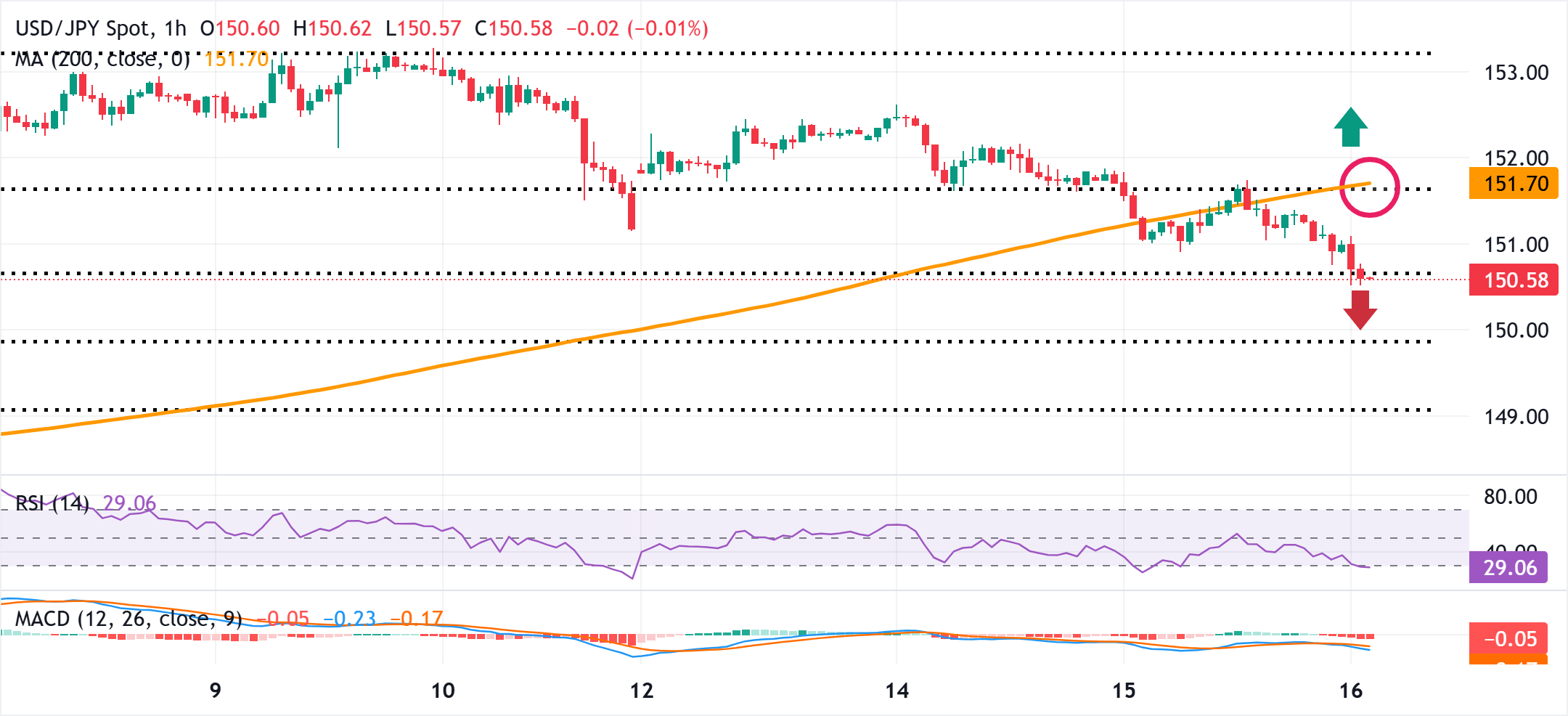
The overnight downfall dragged the USD/JPY pair below the 200-hour Simple Moving Average (SMA). The subsequent slide below the 150.70 area, or the 38.2% Fibonacci retracement level of the recent solid recovery from the October monthly swing low, could be seen as a key trigger for bearish traders. However, oscillators on the daily chart are still holding in positive territory, suggesting that spot prices could find some support near the 150.00 psychological mark. The said handle coincides with the 50% Fibo. retracement level, which, if broken decisively, might expose the 61.8% Fibo. retracement level, around the 149.15 region.
On the flip side, any recovery attempt might now confront an immediate barrier near the 151.00 mark. A sustained move beyond could lift the USD/JPY pair further, though it is more likely to remain capped near the 151.65 confluence hurdle. The said area comprises the 200-hour SMA breakpoint and the 23.6% Fibo. retracement level. However, some follow-through buying would negate any near-term negative bias and allow spot prices to reclaim the 152.00 round figure before climbing further towards the weekly swing high, around the 152.60 region.
Risk sentiment FAQs
In the world of financial jargon the two widely used terms “risk-on” and “risk off'' refer to the level of risk that investors are willing to stomach during the period referenced. In a “risk-on” market, investors are optimistic about the future and more willing to buy risky assets. In a “risk-off” market investors start to ‘play it safe’ because they are worried about the future, and therefore buy less risky assets that are more certain of bringing a return, even if it is relatively modest.
Typically, during periods of “risk-on”, stock markets will rise, most commodities – except Gold – will also gain in value, since they benefit from a positive growth outlook. The currencies of nations that are heavy commodity exporters strengthen because of increased demand, and Cryptocurrencies rise. In a “risk-off” market, Bonds go up – especially major government Bonds – Gold shines, and safe-haven currencies such as the Japanese Yen, Swiss Franc and US Dollar all benefit.
The Australian Dollar (AUD), the Canadian Dollar (CAD), the New Zealand Dollar (NZD) and minor FX like the Ruble (RUB) and the South African Rand (ZAR), all tend to rise in markets that are “risk-on”. This is because the economies of these currencies are heavily reliant on commodity exports for growth, and commodities tend to rise in price during risk-on periods. This is because investors foresee greater demand for raw materials in the future due to heightened economic activity.
The major currencies that tend to rise during periods of “risk-off” are the US Dollar (USD), the Japanese Yen (JPY) and the Swiss Franc (CHF). The US Dollar, because it is the world’s reserve currency, and because in times of crisis investors buy US government debt, which is seen as safe because the largest economy in the world is unlikely to default. The Yen, from increased demand for Japanese government bonds, because a high proportion are held by domestic investors who are unlikely to dump them – even in a crisis. The Swiss Franc, because strict Swiss banking laws offer investors enhanced capital protection.
Author

Haresh Menghani
FXStreet
Haresh Menghani is a detail-oriented professional with 10+ years of extensive experience in analysing the global financial markets.