Japanese Yen bulls seem non-committed amid BoJ uncertainty and fiscal concerns
- The Japanese Yen stalls the overnight pullback from the weekly low against USD.
- The BoJ rate hike uncertainty might hold back the JPY bulls from placing fresh bets.
- The Fed’s hawkish tilt could limit USD losses and offer support to the USD/JPY pair.

The Japanese Yen (JPY) remains on the front foot against a broadly softer US Dollar (USD) heading into the European session on Thursday, and for now, seems to have stalled the previous day's sharp retracement slide from the weekly low. Minutes of the Bank of Japan's (BoJ) September meeting, released on Wednesday, kept hopes alive for an imminent interest rate hike. This comes on top of speculations that Japanese authorities might intervene to stem further weakness in the domestic currency and offers some support to the JPY.
Meanwhile, investors remain uncertain about the likely timing of the next BoJ rate hike amid expectations that Japan's new Prime Minister Sanae Takaichi will pursue aggressive fiscal spending plans and resist policy tightening. This, along with a modest recovery in the global risk sentiment, could act as a headwind for the safe-haven JPY. The USD, on the other hand, holds steady near its highest level since late May on the back of the US Federal Reserve's (Fed) hawkish tilt and could help limit the downside for the USD/JPY pair.
Japanese Yen is underpinned by reviving BoJ rate hike bets but lacks bullish conviction
- Minutes of the Bank of Japan's September 18-19 meeting highlighted a cautious rate-hike path as policymakers weighed inflation dynamics and trade risks. Board members, however, said that the central bank may be able to return to a monetary policy stance of raising interest rates, as the BoJ's 2% price stability target has been more or less achieved.
- Japan’s Vice Finance Minister for International Affairs and top foreign exchange official, Atsushi Mimura, said on Wednesday that the recent JPY moves deviate from the fundamentals. Mimura added that JPY long positions have been shrinking as there is some speculation in the market about Japan's macroeconomic policies, especially fiscal policy.
- Meanwhile, Japan's new Prime Minister, Sanae Takaichi, has a pro-stimulus stance, advocating significant fiscal spending to tackle inflation and boost the economy. Moreover, the BoJ remains reluctant to commit to further rate hikes, which might hold back the Japanese Yen bulls from placing aggressive bets and positioning for strong gains.
- The US Dollar shot to its highest level since late May the previous day and remains well supported by reduced bets for another interest rate cut by the US Federal Reserve in December. Moreover, the upbeat US macro data provided an additional boost to the USD and contributed to the USD/JPY pair's intraday recovery from sub-153.00 levels.
- Automatic Data Processing (ADP) reported that private sector employment in the US rose by 42K in October, compared to 25K estimated and a 29K decrease recorded in the previous month. Adding to this, the Institute for Supply Management's (ISM) Non-Manufacturing Purchasing Managers' Index rose to an eight-month high in October.
- However, the longest US government shutdown in history has caused a blackout of official data, clouding the economic outlook. The US government closure enters its 36th day with no resolution in sight. Economists warn that the longer the impasse drags on, the higher the risk that the fragile economy could shift from bending to breaking.
- This, in turn, is holding back the USD bulls from placing fresh bets and exerting some downward pressure on the USD/JPY pair during the Asian session on Thursday. Traders now look forward to speeches from a slew of influential FOMC members for cues about the future rate-cut path, which should provide a short-term impetus later today.
USD/JPY technical setup backs case for eventual breakout through 154.40-154.45 pivotal resistance
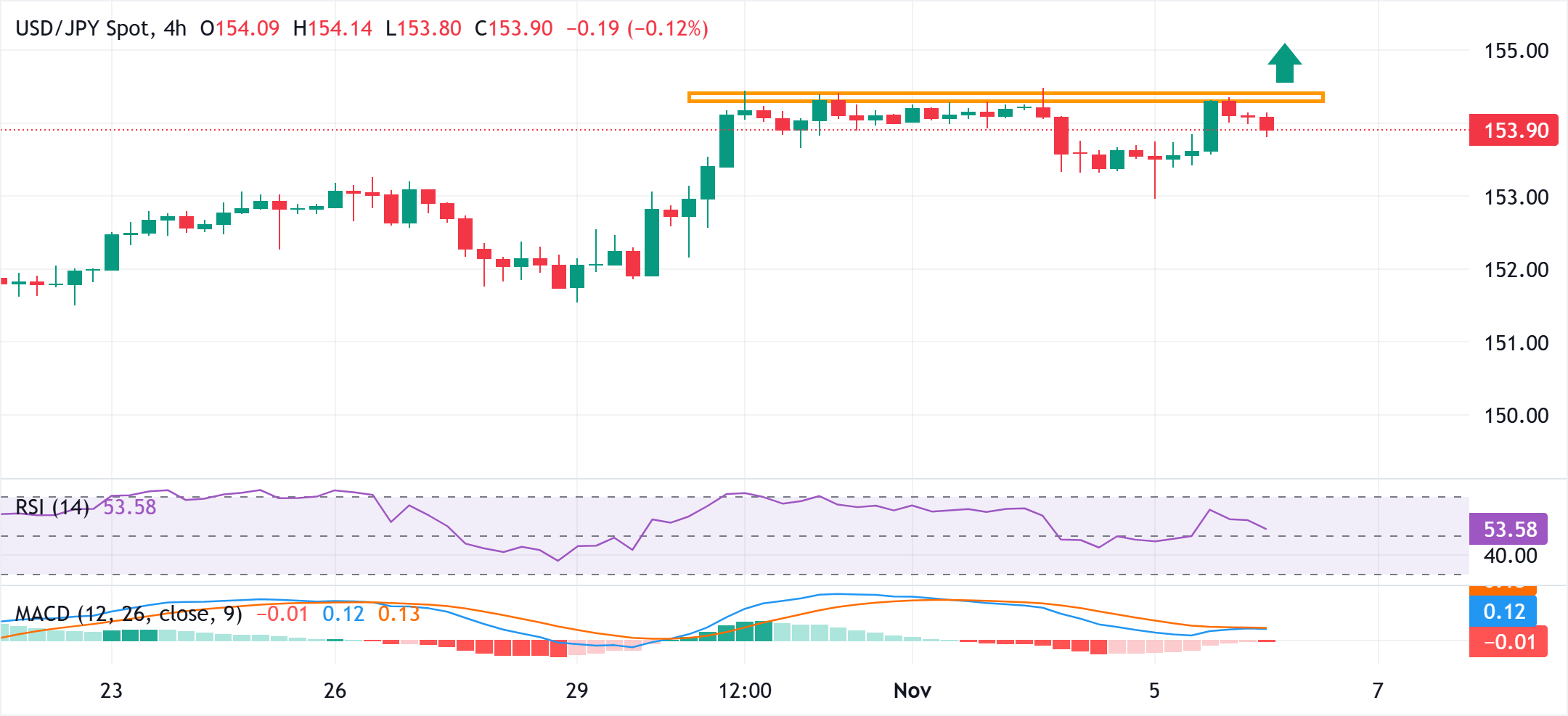
The USD/JPY pair has been facing stiff resistance near the 154.40-154.45 region over the past week or so. The said area should now act as a key pivotal point, above which spot prices could aim to reclaim the 155.00 psychological mark. Some follow-through buying should pave the way for a move towards the 155.60-155.65 hurdle before spot prices climb further towards the 156.00 round figure.
On the flip side, the 153.65 area could offer some support ahead of the overnight swing low, around the 153.00-152.95 region. Acceptance below the 153.00 mark might prompt some technical selling and make the USD/JPY pair vulnerable to accelerate the corrective fall towards the 152.55-152.50 intermediate support en route to the 152.00 round figure and last week's swing low, around the 151.55 zone.
Fed FAQs
Monetary policy in the US is shaped by the Federal Reserve (Fed). The Fed has two mandates: to achieve price stability and foster full employment. Its primary tool to achieve these goals is by adjusting interest rates. When prices are rising too quickly and inflation is above the Fed’s 2% target, it raises interest rates, increasing borrowing costs throughout the economy. This results in a stronger US Dollar (USD) as it makes the US a more attractive place for international investors to park their money. When inflation falls below 2% or the Unemployment Rate is too high, the Fed may lower interest rates to encourage borrowing, which weighs on the Greenback.
The Federal Reserve (Fed) holds eight policy meetings a year, where the Federal Open Market Committee (FOMC) assesses economic conditions and makes monetary policy decisions. The FOMC is attended by twelve Fed officials – the seven members of the Board of Governors, the president of the Federal Reserve Bank of New York, and four of the remaining eleven regional Reserve Bank presidents, who serve one-year terms on a rotating basis.
In extreme situations, the Federal Reserve may resort to a policy named Quantitative Easing (QE). QE is the process by which the Fed substantially increases the flow of credit in a stuck financial system. It is a non-standard policy measure used during crises or when inflation is extremely low. It was the Fed’s weapon of choice during the Great Financial Crisis in 2008. It involves the Fed printing more Dollars and using them to buy high grade bonds from financial institutions. QE usually weakens the US Dollar.
Quantitative tightening (QT) is the reverse process of QE, whereby the Federal Reserve stops buying bonds from financial institutions and does not reinvest the principal from the bonds it holds maturing, to purchase new bonds. It is usually positive for the value of the US Dollar.
Author

Haresh Menghani
FXStreet
Haresh Menghani is a detail-oriented professional with 10+ years of extensive experience in analysing the global financial markets.

















