Japanese Yen slides further; USD/JPY taps 148.00 amid modest USD recovery
- The Japanese Yen drifts lower for the third straight day amid the BoJ rate hike uncertainty.
- A modest USD rebound contributes to the USD/JPY pair’s positive move to a multi-day high.
- The divergent BoJ-Fed policy expectations might cap the pair ahead of key US macro data.

The Japanese Yen (JPY) selling bias remains unabated through the early European session on Tuesday, which, along with a modest US Dollar (USD) rebound, lifts the USD/JPY pair to the 148.00 neighborhood in the last hour. The uncertainty over the likely timing of the next interest rate hike by the Bank of Japan (BoJ), along with a positive tone around the Asian equity markets, is seen undermining the safe-haven JPY.
However, the growing acceptance that the BoJ will stick to its policy normalization path could offer some support to the JPY. Furthermore, firming expectations that the Federal Reserve (Fed) will cut interest rates this month might keep a lid on any meaningful USD appreciation and contribute to limiting losses for the lower-yielding JPY. This, in turn, warrants caution for the USD/JPY bulls ahead of key US macro releases.
Japanese Yen selling bias remains unabated amid BoJ uncertainty, receding safe-haven demand
- Asian stocks posted modest gains at the open on Tuesday amid a surge in China's CSI 300 Index, which contributes to the safe-haven Japanese Yen's underperformance against its American counterpart for the third straight day.
- Capital Spending data released from Japan on Monday indicated a pickup in business investments in the second quarter. This could bolster the labour market and demand-driven inflation, reaffirming Bank of Japan rate hike bets.
- In contrast, traders are pricing in a nearly 90% chance that the Federal Reserve will lower borrowing costs by 25 basis points in September, which marks a significant divergence in comparison to hawkish BoJ expectations.
- Moreover, market participants see a greater chance that the US central bank will cut interest rates twice by the end of this year. This, along with concerns about the Fed's independence, keeps the US Dollar bulls on the defensive.
- US Treasury Secretary Scott Bessent, speaking during a Reuters interview, defended President Donald Trump’s removal of Fed Governor Lisa Cook and argued that allegations of mortgage fraud against her warranted scrutiny.
- Cook, however, refused to step down and has filed a lawsuit. Meanwhile, Cook's departure would give Trump another appointment to the Fed's seven-member board and command a majority for the first time in decades.
- Moreover, Trump has repeatedly criticized Fed Chair Jerome Powell for not cutting rates more aggressively. Nevertheless, the development has raised concerns about the central bank's autonomy and could weigh on the USD.
- A busy week of important US macro releases scheduled at the start of a new month kicks off with the ISM Manufacturing PMI, which might influence the USD price dynamics and influence the USD/JPY pair later this Tuesday.
- Investors will also confront the release of the US JOLTS Job Openings on Wednesday, followed by the ADP report on private-sector employment and ISM Services PMI on Thursday, and the Nonfarm Payrolls (NFP) report on Friday.
USD/JPY bulls need to wait for move beyond multi-week-old trading range hurdle near 148.00
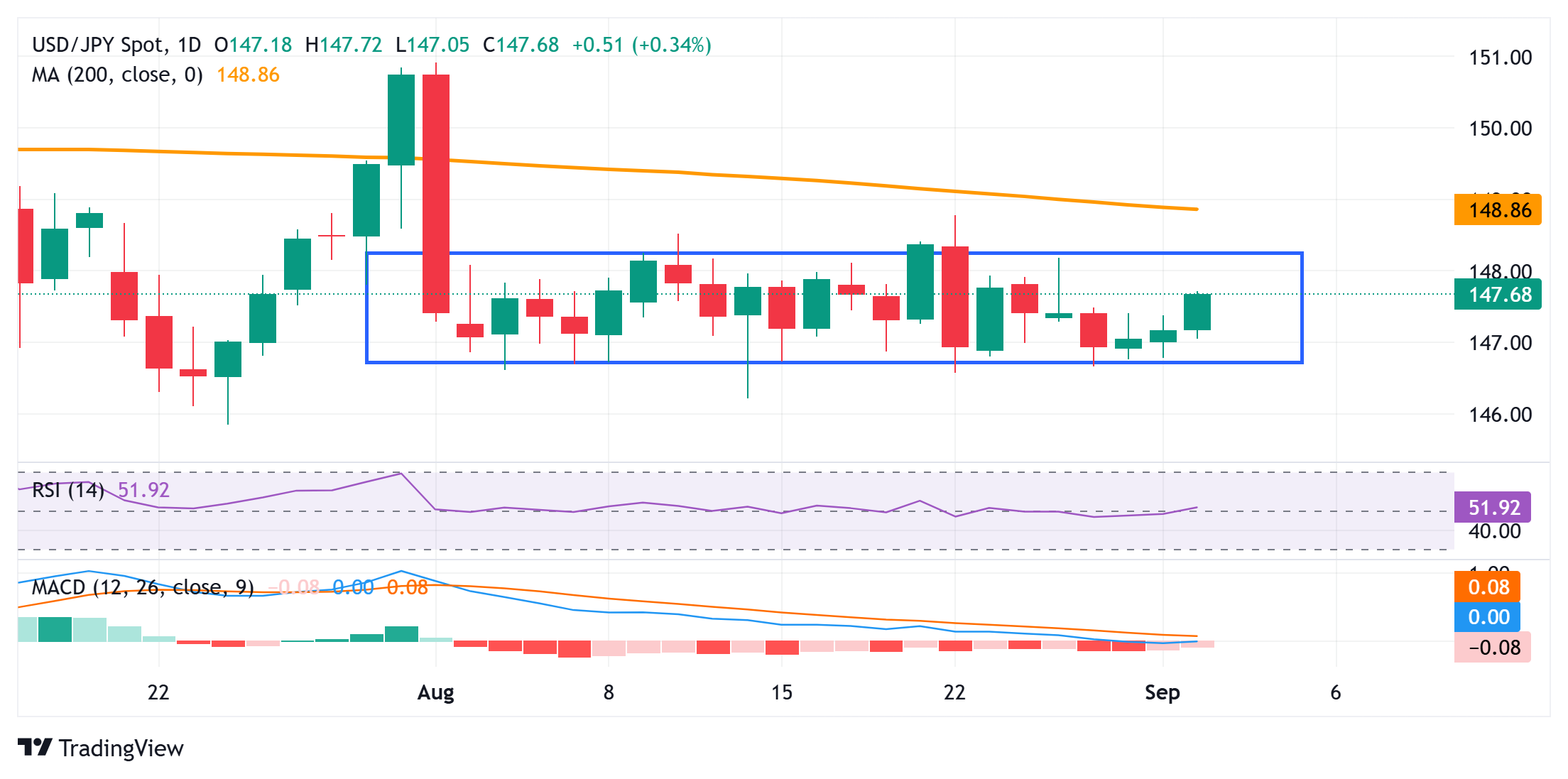
From a technical perspective, the USD/JPY pair's move up over the past three days validates a support marked by the lower boundary of a four-week-old trading range, around the 146.70 region. The said area should act as a key pivotal point, which, if broken decisively, could drag spot prices to the August swing low, around the 146.20 area, en route to the 146.00 mark. Some follow-through selling will be seen as a fresh trigger for bearish traders and pave the way for deeper losses.
On the flip side, any further move up could attract fresh sellers and remain capped ahead of the 148.00 round figure, which represents the top end of the multi-week-old trading band. A sustained strength beyond could prompt a short-covering rally towards the recent swing high, around the 148.75-148.80 region. The latter nears the 200-day Simple Moving Average (SMA). Hence, some follow-through buying might shift the near-term bias in favor of the USD/JPY bulls.
Economic Indicator
ISM Manufacturing PMI
The Institute for Supply Management (ISM) Manufacturing Purchasing Managers Index (PMI), released on a monthly basis, is a leading indicator gauging business activity in the US manufacturing sector. The indicator is obtained from a survey of manufacturing supply executives based on information they have collected within their respective organizations. Survey responses reflect the change, if any, in the current month compared to the previous month. A reading above 50 indicates that the manufacturing economy is generally expanding, a bullish sign for the US Dollar (USD). A reading below 50 signals that factory activity is generally declining, which is seen as bearish for USD.
Read more.Next release: Tue Sep 02, 2025 14:00
Frequency: Monthly
Consensus: 49
Previous: 48
Source: Institute for Supply Management
The Institute for Supply Management’s (ISM) Manufacturing Purchasing Managers Index (PMI) provides a reliable outlook on the state of the US manufacturing sector. A reading above 50 suggests that the business activity expanded during the survey period and vice versa. PMIs are considered to be leading indicators and could signal a shift in the economic cycle. Stronger-than-expected prints usually have a positive impact on the USD. In addition to the headline PMI, the Employment Index and the Prices Paid Index numbers are watched closely as they shine a light on the labour market and inflation.
Author

Haresh Menghani
FXStreet
Haresh Menghani is a detail-oriented professional with 10+ years of extensive experience in analysing the global financial markets.