Japanese Yen retains bullish bias; USD/JPY slides to 147.00 on weaker USD
- The Japanese Yen attracts fresh buyers following the release of Japan’s upbeat Q2 GDP print.
- The USD stalls Thursday’s strong US PPI-inspired recovery move and also weighs on USD/JPY.
- The divergent BoJ-Fed policy expectations back the case for a further depreciation of the pair.

The Japanese Yen (JPY) maintains its strong bid tone against a broadly weaker US Dollar (USD) and drags the USD/JPY pair to the 147.00 mark during the early European session on Friday. Data released earlier today showed that Japan's economy grew more than expected in the second quarter despite US tariff headwinds. This reaffirms expectations that the Bank of Japan (BoJ) will stick to the policy normalization path, which, in turn, provides a goodish lift to the JPY.
Meanwhile, the BoJ's relatively hawkish outlook marks a big divergence in comparison to other major central banks, including the Federal Reserve (Fed), which is expected to resume its rate-cutting cycle in September. This, in turn, fails to assist the USD to capitalize on Thursday's strong US Producer Price Index (PPI)-inspired recovery move and drives additional flows towards the lower-yielding JPY, which seems rather unaffected by the prevalent risk-on environment.
Japanese Yen buying interest remains unabated as strong GDP backs hawkish BoJ outlook
- The preliminary reading released by Japan’s Cabinet Office earlier this Friday showed that the Japanese economy grew 0.3% in the second quarter of 2025. On an annualized basis, Japan's Gross Domestic Product (GDP) expanded by 1.0% during the April-June period, compared to a contraction of 0.2% in the first quarter and consensus estimates for a 0.4% rise.
- Commenting on the report, Japan's Economy Minister Ryosei Akazawa said that the data confirmed the economy is recovering modestly. Akazawa, however, cautioned that risks from US trade policies could weigh on growth, while rising prices could dampen consumer sentiment and hurt private consumption.
- The data validates the Bank of Japan's hawkish forecast for the economy to grow 0.6% in the 2025 fiscal year. Furthermore, an upward revision of inflation forecasts by the BoJ keeps the door open for an imminent interest rate hike by the year-end. This, in turn, assists the Japanese Yen to stall the overnight pullback from a multi-week high against the US Dollar.
- The USD Index (DXY), which tracks the Greenback against a basket of currencies, witnessed an intraday short-covering move in reaction to the hotter-than-expected US Producer Price Index. In fact, the US Bureau of Labor Statistics reported that the headline PPI accelerated from the 2.4% YoY rate to 3.3% in July, surpassing expectations of a 2.5% by a wide margin.
- This overshadows the relatively cooler July Consumer Price Index (CPI) report released on Tuesday and suggests that a broad pickup in inflation is imminent. This, in turn, forced investors to temper bets for more aggressive interest rate cuts by the Federal Reserve, boosting the USD and triggering a sharp recovery of nearly 200 pips for the USD/JPY pair.
- Traders, however, are still pricing in around a 90% chance that the US central bank will lower borrowing costs by 25 basis points in September and the possibility of at least two rate cuts by the end of this year. This keeps a lid on any further recovery for the buck and further contributes to the USD/JPY pair's modest decline during the Asian session on Friday.
- US President Donald Trump and Russian President Vladimir Putin are set to meet in Alaska on Friday to discuss how to end the war in Ukraine. The incoming headlines from the high-stakes summit will influence the broader market risk sentiment and drive the safe-haven JPY. This, along with the US macro data, should provide impetus to the currency pair.
- Friday's US economic docket features the release of monthly Retail Sales figures, the Empire State Manufacturing Index, and the Preliminary University of Michigan Consumer Sentiment and Inflation Expectations Index. Apart from this, comments from FOMC members might contribute to producing short-term trading opportunities heading into the weekend.
USD/JPY could accelerate the intraday downfall once the 147.00 mark is broken decisively
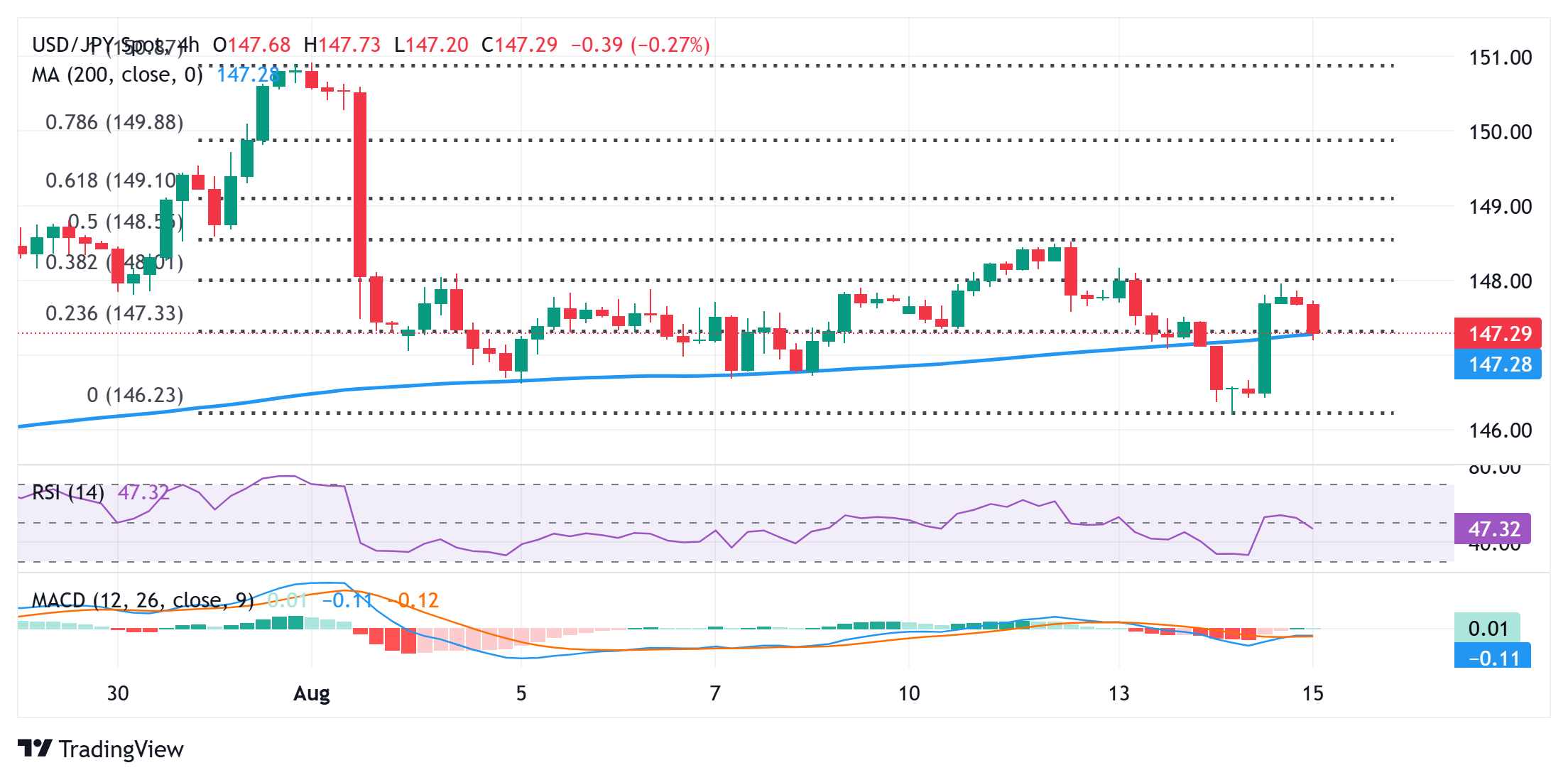
From a technical perspective, the USD/JPY pair's overnight solid recovery from the 146.20 area falters just ahead of the 148.00 round figure. The said handle represents the 38.2% Fibonacci retracement level of the downfall from the 151.00 neighborhood, or the monthly peak, and should now act as a key pivotal point. A sustained strength beyond has the potential to lift spot prices to the 148.55-148.60 region, or the 50% retracement level. Some follow-through buying might shift the near-term bias in favor of bullish traders and pave the way for additional gains towards reclaiming the 149.00 round figure.
On the flip side, the 147.10-147.00 area now seems to protect the immediate downside, below which the USD/JPY pair could retest the multi-week low, around the 146.20 zone, touched on Thursday. Some follow-through selling, leading to a subsequent fall below the 146.00 round figure, will be seen as a fresh trigger for bearish traders and make spot prices vulnerable. The downward trajectory might then extend towards the next relevant support near the 145.40-145.30 region en route to the 145.00 psychological mark.
US Dollar PRICE Today
The table below shows the percentage change of US Dollar (USD) against listed major currencies today. US Dollar was the strongest against the New Zealand Dollar.
| USD | EUR | GBP | JPY | CAD | AUD | NZD | CHF | |
|---|---|---|---|---|---|---|---|---|
| USD | -0.23% | -0.17% | -0.56% | -0.15% | -0.26% | -0.11% | -0.19% | |
| EUR | 0.23% | 0.05% | -0.21% | 0.07% | -0.06% | 0.10% | 0.04% | |
| GBP | 0.17% | -0.05% | -0.28% | 0.03% | -0.10% | 0.06% | -0.00% | |
| JPY | 0.56% | 0.21% | 0.28% | 0.30% | 0.20% | 0.39% | 0.25% | |
| CAD | 0.15% | -0.07% | -0.03% | -0.30% | -0.05% | 0.03% | -0.03% | |
| AUD | 0.26% | 0.06% | 0.10% | -0.20% | 0.05% | 0.09% | 0.09% | |
| NZD | 0.11% | -0.10% | -0.06% | -0.39% | -0.03% | -0.09% | -0.07% | |
| CHF | 0.19% | -0.04% | 0.00% | -0.25% | 0.03% | -0.09% | 0.07% |
The heat map shows percentage changes of major currencies against each other. The base currency is picked from the left column, while the quote currency is picked from the top row. For example, if you pick the US Dollar from the left column and move along the horizontal line to the Japanese Yen, the percentage change displayed in the box will represent USD (base)/JPY (quote).
Author

Haresh Menghani
FXStreet
Haresh Menghani is a detail-oriented professional with 10+ years of extensive experience in analysing the global financial markets.