Japanese Yen ticks higher against a bearish USD; US PCE inflation eyed for fresh impetus
- The Japanese Yen reverses modest intraday downtick led by a softer Tokyo CPI on Friday.
- Bets that the BoJ will hike interest rates further and continue to act as a tailwind for the JPY.
- The USD languishes near a multi-year low and weighs on USD/JPY ahead of US PCE data.

The Japanese Yen (JPY) attracts some dip-buying on Friday and remains close to a one-and-half-week high touched against its American counterpart the previous day. The initial market reaction to the softer Tokyo Consumer Price Index (CPI) and rather unimpressive Japan's Retail Sales turned out to be short-lived amid bets that the Bank of Japan will raise interest rates further amid the broadening inflationary pressures. This, in turn, acts as a tailwind for the JPY, which, along with a bearish sentiment surrounding the US Dollar (USD), suggests that the path of least resistance for the USD/JPY pair is to the downside.
Traders, however, seem reluctant and opt to wait for the release of the US Personal Consumption Expenditure (PCE) Price Index before placing fresh directional bets. Heading into the key data risk, the growing acceptance that the Federal Reserve (Fed) will lower borrowing costs further this year keeps the USD depressed near its lowest level since March 2022 and exerts some pressure on the USD/JPY pair. That said, a positive risk tone and worries about the economic fallout from US tariffs warrant caution before placing aggressive bets around the safe-haven JPY and positioning for deeper losses for the pair.
Japanese Yen bulls have the upper hand amid divergent BoJ-Fed policy expectations
- The Statistics Bureau of Japan reported this Friday that the headline Tokyo Consumer Price Index (CPI) rose 3.1% YoY in June as compared to 3.4% in the previous month. Adding to this, the core gauge, which excludes Fresh Food, decelerated from the 3.6% YoY rate in May to 3.1% against the 3.3% expected. Moreover, the Tokyo CPI that strips out both Fresh Food and Energy rose 3.1% from a year earlier after a 3.3% gain in May.
- A separate government report showed that Retail Sales in Japan fell 0.2% MoM in May as compared to the previous month's upwardly revised growth of 0.7%. On a yearly basis, Retail Sales increased by 2.2% during the reported month, down from an upwardly revised 3.5% rise in April and below market expectations of 2.7% growth. The data reaffirms expectations that the Bank of Japan could forgo raising interest rates in 2025.
- However, inflation in Japan's capital city remains well above the central bank's 2% annual target. Adding to this, signs of a consistent rise in domestic inflationary pressures keep hopes alive for more rate hikes by the BoJ. In contrast, traders have been betting that the Federal Reserve (Fed) would lower borrowing costs by at least 50 basis points before the end of the year and pricing in a 20% chance of a rate reduction in July.
- That said, Fed Chair Jerome Powell maintained a wait-and-see approach to future interest rate decisions this week, prompting criticism from US President Donald Trump, who has been calling for lower interest rates. Moreover, reports suggest that Trump was considering naming Powell's successor by September or October, stoking concerns over the potential erosion of the Fed's independence and undermining the US Dollar.
- Apart from this, the Commerce Department’s final estimate released on Thursday showed that the US economy contracted by a 0.5% annual pace from January through March. This represents a steeper decline than the -0.2% reported in the second estimate and was driven by softer consumer spending, which rose by just 0.5%, or the slowest pace since 2020, down sharply from the previously reported 1.2% growth.
- Meanwhile, the US Weekly Jobless Claims fell by 10K to a seasonally adjusted 236K during the week ended June 21. However, Continuing Jobless Claims increased by 37K to reach 1.974 million, or the highest since November 2021, for the week ending June 14. This overshadowed the largest increase in Durable Goods Orders since July 2014 and kept the USD depressed near its lowest level since March 2022.
- Investors now look forward to the release of the US Personal Consumption Expenditure (PCE) Price Index – the Fed's preferred inflation gauge. The key data will be looked upon for cues about the Fed's rate-cut path, which, in turn, will play a key role in influencing the near-term USD price dynamics and provide some meaningful impetus to the USD/JPY pair.
USD/JPY could accelerate the downtrend below the overnight low, around 143.70
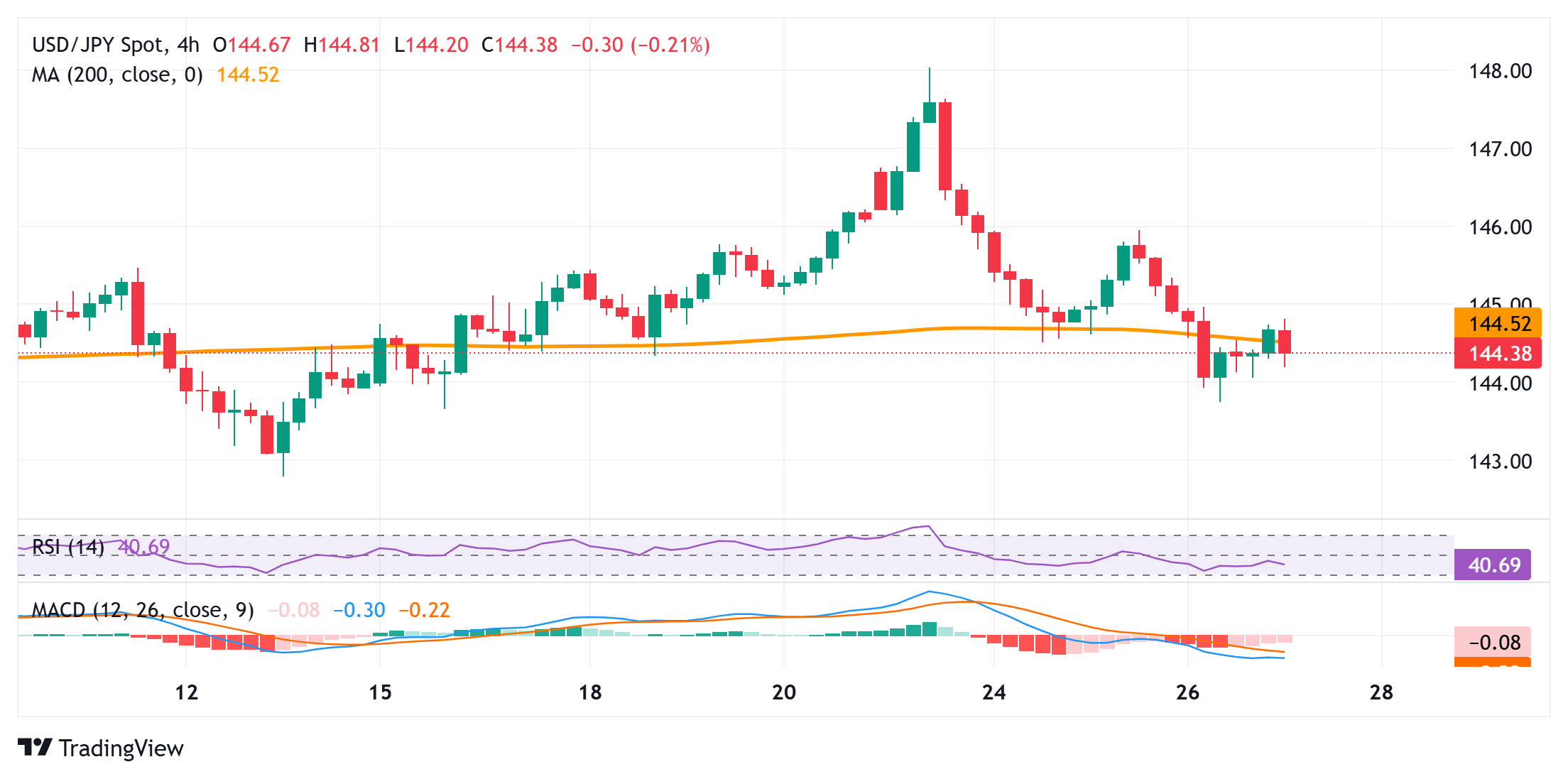
From a technical perspective, the USD/JPY pair's move higher on Friday struggles to find acceptance above a support-turned-hurdle marked by the 200-period Simple Moving Average (SMA) on the 4-hour chart and falters near the 144.80 region. Given that oscillators on 4-hour/daily charts have just started gaining negative traction, some follow-through weakness back below the 144.00 mark could make spot prices vulnerable to sliding further below the 143.75 area, or the overnight swing low. The downward trajectory could eventually drag spot prices towards testing sub-143.00 levels.
On the flip side, a sustained strength beyond the 200-SMA, leading to a subsequent strength above the 145.00 psychological mark and the 145.25-145.35 static barrier, might negate the bearish outlook. The USD/JPY pair might then make a fresh attempt to conquer the 146.00 mark, which if cleared decisively should pave the way for additional near-term gains towards the 146.70-146.75 region and the 147.00 round figure.
Economic Indicator
Core Personal Consumption Expenditures - Price Index (YoY)
The Core Personal Consumption Expenditures (PCE), released by the US Bureau of Economic Analysis on a monthly basis, measures the changes in the prices of goods and services purchased by consumers in the United States (US). The PCE Price Index is also the Federal Reserve’s (Fed) preferred gauge of inflation. The YoY reading compares the prices of goods in the reference month to the same month a year earlier. The core reading excludes the so-called more volatile food and energy components to give a more accurate measurement of price pressures." Generally, a high reading is bullish for the US Dollar (USD), while a low reading is bearish.
Read more.Next release: Fri Jun 27, 2025 12:30
Frequency: Monthly
Consensus: 2.6%
Previous: 2.5%
Source: US Bureau of Economic Analysis
After publishing the GDP report, the US Bureau of Economic Analysis releases the Personal Consumption Expenditures (PCE) Price Index data alongside the monthly changes in Personal Spending and Personal Income. FOMC policymakers use the annual Core PCE Price Index, which excludes volatile food and energy prices, as their primary gauge of inflation. A stronger-than-expected reading could help the USD outperform its rivals as it would hint at a possible hawkish shift in the Fed’s forward guidance and vice versa.
Author

Haresh Menghani
FXStreet
Haresh Menghani is a detail-oriented professional with 10+ years of extensive experience in analysing the global financial markets.