Japanese Yen sticks to intraday losses against recovering USD; lacks bearish conviction
- The Japanese Yen drifts lower against the USD for the second consecutive day on Wednesday.
- Concerns about Trump’s trade tariffs and a positive risk tone undermine the safe-haven JPY.
- The divergent BoJ-Fed policy expectations should limit any meaningful downside for the JPY.

The Japanese Yen (JPY) remains on the back foot against the recovering US Dollar (USD) through the early European session on Wednesday, though it lacks follow-through amid hawkish Bank of Japan (BoJ) expectations. Data released earlier today showed that Japan's annual wholesale inflation – Producer Price Index (PPI) – rose 4.0% in February, underscoring broadening inflationary pressure. Adding to this hopes that bumper wage hikes seen last year will continue this year remain supportive of the growing market acceptance that the BoJ will hike interest rates further.
This, along with the recent sharp narrowing of rate differential between Japan and other countries should act as a tailwind for the lower-yielding JPY and help limit losses. Furthermore, any meaningful USD appreciation seems elusive in the wake of bets that the Federal Reserve (Fed) will cut interest rates several times this year amid concerns about a tariff-drive slowdown in the US economic activity and signs of a cooling US labor market. This might hold back the USD bulls from placing aggressive bets ahead of the US consumer inflation figures and cap the USD/JPY pair.
Japanese Yen struggles to lure buyers amid trade jitters, upbeat market mood
- US President Donald Trump on Tuesday threatened a 50% tariff on steel and aluminum from Canada, though he reversed course after Ontario paused surcharges on electricity to US customers. Earlier, Japan’s Trade Minister Yoji Muto said that he has failed to win assurances from US officials that Japan will be exempt from steel tariffs, which take effect on Wednesday.
- The lower house of Congress narrowly passed a Republican spending bill that would avoid a government shutdown on March 14 and keep the US government open until September. The bill now heads to the Senate and will need the support of at least seven Democrats to overcome the 60-vote filibuster threshold before being sent to Trump for his signature.
- Data published by the Bank of Japan this Wednesday showed that the Producer Price Index (PPI) slowed to a 4.0% year-on-year rate in February from 4.2% in the previous month. Given that consumer inflation in Japan has exceeded the central bank's target for nearly three years, the latest PPI supports prospects for further monetary policy tightening by the BoJ.
- BoJ Governor Kazuo Ueda, when asked about the recent rise in long-term rate, said that we don't see a big divergence between our view and that of the markets. It is natural for long-term rates to move in a way that reflects the market's outlook for the short-term policy rate. Ueda added that the underlying inflation still remains below 2%.
- Japan’s largest companies are expected to offer substantial wage hikes for a third consecutive year, helping workers cope with inflation and retain staff amid labour shortages. Higher wages are crucial for BoJ policy decisions, as well as Prime Minister Shigeru Ishiba’s efforts to boost consumer spending amid stagnant real wage growth.
- The yield on the benchmark 10-year Japanese government bond remains close to its highest level since October 2008 touched on Monday. In contrast, the 10-year US Treasury bond yield remains close to a multi-month low touched earlier this March amid concerns about a tariff-driven US economic slowdown and bets for more rate cuts by the Federal Reserve.
- In fact, market participants are now pricing in about three rate cuts of 25 basis points each by the Fed by the end of this year. The bets were lifted by Friday's weaker US Nonfarm Payrolls report, which pointed to signs of a cooling US labor market. This keeps the US Dollar depressed near its lowest level since mid-October and caps the upside for the USD/JPY pair.
- Traders also seem reluctant and opt to wait for the release of the US consumer inflation figures before positioning for the next leg of a directional move. The crucial Consumer Price Index (CPI) report will play a key role in influencing expectations about the Fed's rate-cut path, which, in turn, will drive USD demand and provide a fresh impetus to the currency pair.
USD/JPY seems vulnerable while below the 148.60-148.70 support breakpiont
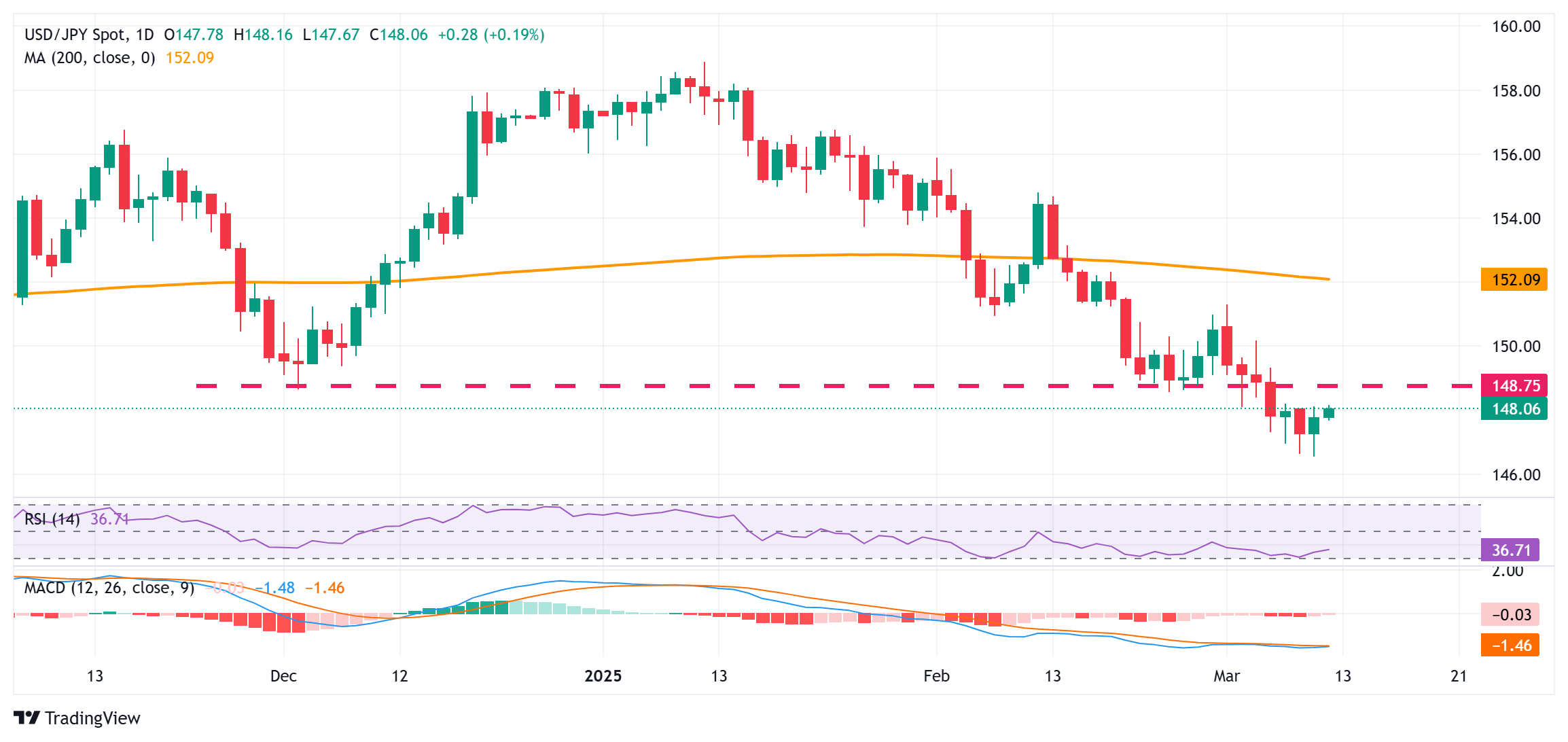
From a technical perspective, oscillators on the daily chart are holding deep in negative territory and are still away from being in the oversold zone. This, in turn, suggests that the path of least resistance for the USD/JPY pair is to the downside and any further move up is likely to remain capped near the 148.60-148.70 horizontal support breakpoint. However, some follow-through buying, leading to a subsequent strength beyond the 149.00 mark, might trigger a short-covering rally towards the 149.70-149.75 intermediate resistance en route to the 150.00 psychological mark.
On the flip side, the 147.25 area now seems to act as immediate support ahead of the 147.00 round figure and the 146.55-146.50 zone, or a multi-month trough touched on Tuesday. A break below the latter might turn the USD/JPY pair vulnerable to accelerate the fall toward the 146.00 round figure. The downward trajectory could eventually drag spot prices to the 145.00 psychological mark with some intermediate support near the 145.40-145.35 zone.
US Dollar PRICE Today
The table below shows the percentage change of US Dollar (USD) against listed major currencies today. US Dollar was the strongest against the Japanese Yen.
| USD | EUR | GBP | JPY | CAD | AUD | NZD | CHF | |
|---|---|---|---|---|---|---|---|---|
| USD | 0.21% | 0.23% | 0.28% | 0.16% | 0.25% | 0.22% | 0.05% | |
| EUR | -0.21% | 0.00% | 0.06% | -0.06% | 0.03% | 0.00% | -0.16% | |
| GBP | -0.23% | -0.01% | 0.06% | -0.06% | 0.02% | -0.00% | -0.16% | |
| JPY | -0.28% | -0.06% | -0.06% | -0.12% | -0.02% | -0.06% | -0.20% | |
| CAD | -0.16% | 0.06% | 0.06% | 0.12% | 0.09% | 0.06% | -0.09% | |
| AUD | -0.25% | -0.03% | -0.02% | 0.02% | -0.09% | -0.02% | -0.17% | |
| NZD | -0.22% | -0.01% | 0.00% | 0.06% | -0.06% | 0.02% | -0.16% | |
| CHF | -0.05% | 0.16% | 0.16% | 0.20% | 0.09% | 0.17% | 0.16% |
The heat map shows percentage changes of major currencies against each other. The base currency is picked from the left column, while the quote currency is picked from the top row. For example, if you pick the US Dollar from the left column and move along the horizontal line to the Japanese Yen, the percentage change displayed in the box will represent USD (base)/JPY (quote).
Author

Haresh Menghani
FXStreet
Haresh Menghani is a detail-oriented professional with 10+ years of extensive experience in analysing the global financial markets.















