Japanese Yen trims a part of intraday losses against USD amid BoJ rate hike bets
- The Japanese Yen is pressured by renewed worries about Trump’s trade tariffs.
- A modest USD strength provides a goodish lift to the USD/JPY pair on Monday.
- Rising bets that the BoJ will hike rates again help limit deeper losses for the JPY.

The Japanese Yen (JPY) retains negative bias heading into the European session amid worries that would be an eventual target of US President Donald Trump's trade tariffs. This, along with a modest US Dollar (USD) strength, assists the USD/JPY pair to stick to its intraday gains. That said, hawkish Bank of Japan (BoJ) expectations help limit deeper losses for the JPY and cap gains for the currency pair.
Investors seem convinced that the BoJ will hike interest rates again this year, which, in turn, continues to push the Japanese government bond (JGB) yields higher. The resultant narrowing of the rate differential between Japan and the US further lends support to the lower-yielding JPY. This makes it prudent to wait for strong follow-through buying before confirming a near-term bottom for the USD/JPY pair.
Japanese Yen bulls have the upper hand amid hawkish BoJ expectations
- US President Donald Trump said on Sunday that he will announce an additional 25% tariffs on all steel and aluminum imports into the US, and will also announce reciprocal duties over what he sees as unfair trading practices.
- Worries that Trump's protectionist policies would put upward pressure on inflation, along with Friday's upbeat US job data, should allow the Federal Reserve to keep rates on hold, which, in turn, boosts the US Dollar.
- The closely-watched US Nonfarm Payrolls (NFP) report showed that the Unemployment Rate declined to 4% from 4.1% and Average Hourly Earnings rose more than expected by 4.1% during the reported month.
- Other details of the publication revealed that the number of employed people rose by 143,000 in January compared to the 170,000 expected and the 307,000 increase (revised from 256,000) recorded in the previous month.
- The International Monetary Fund (IMF) warned last week that Japan should remain alert to potential spillover effects from rising volatility in global markets that could affect liquidity conditions for its financial institutions.
- The IMF added that Japan needs to be vigilant about monitoring any fallout from the Bank of Japan's rate hikes, such as an increase in the government's debt-servicing costs and a possible jump in corporate bankruptcies.
- Kazuhiro Masaki, Director General of the BoJ's monetary affairs department, said last Thursday that the central bank will continue to raise interest rates if underlying inflation accelerates toward its 2% target as projected.
- This comes on top of data showing that Japan’s inflation-adjusted real wages rose 0.6% year-on-year in December – marking the second consecutive monthly gain – and backs the case for further tightening by the BoJ.
- The view was echoed in the Summary of Opinions from the BoJ's January meeting, which revealed that board members had discussed the likelihood of raising interest rates further and should support the Japanese Yen.
USD/JPY seems vulnerable while below 152.50-152.45 confluence breakpoint
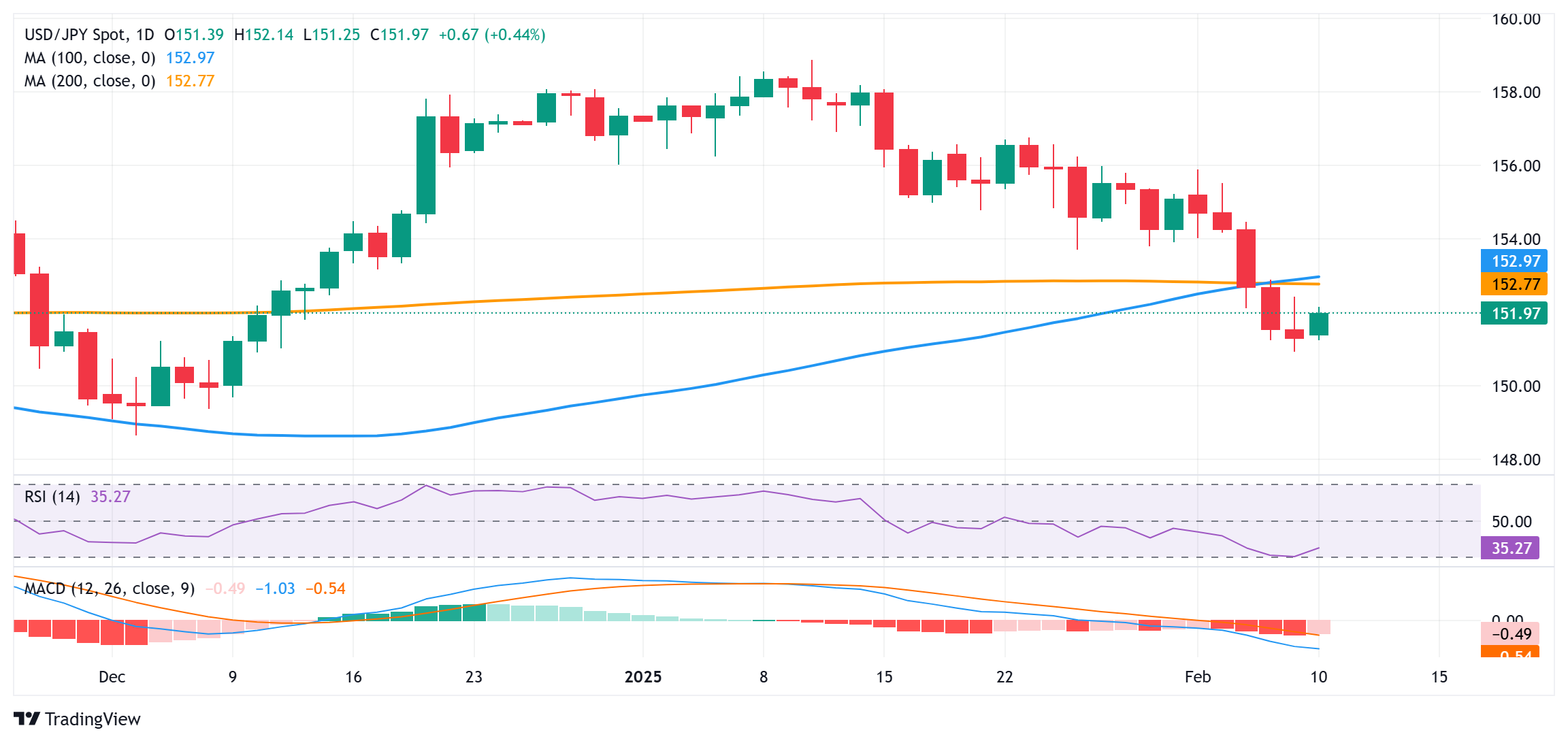
Technical indicators on the daily chart are holding deep in negative territory and are still away from being in the oversold zone. Apart from this, last week's breakdown below the 152.50-152.45 confluence – comprising the 100- and the 200-day Simple Moving Averages (SMAs) – favors bearish traders. Hence, any subsequent move-up is more likely to attract fresh sellers and remain capped near the said confluence support breakpoint. Some follow-through buying, however, might trigger a short-covering move and allow the USD/JPY pair to reclaim the 153.00 round figure.
On the flip side, the Asian session low, around the 151.25 area, now seems to protect the immediate downside ahead of the 151.00-150.95 area, or the lowest level since December 10 touched on Friday. Acceptance below the latter could drag the USD/JPY pair below the 150.55-150.50 intermediate support, toward the 150.00 psychological mark. The downward trajectory could extend further towards the 149.60 horizontal support en route to the 149.00 mark and the December swing low, around the 148.65 region.
Bank of Japan FAQs
The Bank of Japan (BoJ) is the Japanese central bank, which sets monetary policy in the country. Its mandate is to issue banknotes and carry out currency and monetary control to ensure price stability, which means an inflation target of around 2%.
The Bank of Japan embarked in an ultra-loose monetary policy in 2013 in order to stimulate the economy and fuel inflation amid a low-inflationary environment. The bank’s policy is based on Quantitative and Qualitative Easing (QQE), or printing notes to buy assets such as government or corporate bonds to provide liquidity. In 2016, the bank doubled down on its strategy and further loosened policy by first introducing negative interest rates and then directly controlling the yield of its 10-year government bonds. In March 2024, the BoJ lifted interest rates, effectively retreating from the ultra-loose monetary policy stance.
The Bank’s massive stimulus caused the Yen to depreciate against its main currency peers. This process exacerbated in 2022 and 2023 due to an increasing policy divergence between the Bank of Japan and other main central banks, which opted to increase interest rates sharply to fight decades-high levels of inflation. The BoJ’s policy led to a widening differential with other currencies, dragging down the value of the Yen. This trend partly reversed in 2024, when the BoJ decided to abandon its ultra-loose policy stance.
A weaker Yen and the spike in global energy prices led to an increase in Japanese inflation, which exceeded the BoJ’s 2% target. The prospect of rising salaries in the country – a key element fuelling inflation – also contributed to the move.
Tariffs FAQs
Tariffs are customs duties levied on certain merchandise imports or a category of products. Tariffs are designed to help local producers and manufacturers be more competitive in the market by providing a price advantage over similar goods that can be imported. Tariffs are widely used as tools of protectionism, along with trade barriers and import quotas.
Although tariffs and taxes both generate government revenue to fund public goods and services, they have several distinctions. Tariffs are prepaid at the port of entry, while taxes are paid at the time of purchase. Taxes are imposed on individual taxpayers and businesses, while tariffs are paid by importers.
There are two schools of thought among economists regarding the usage of tariffs. While some argue that tariffs are necessary to protect domestic industries and address trade imbalances, others see them as a harmful tool that could potentially drive prices higher over the long term and lead to a damaging trade war by encouraging tit-for-tat tariffs.
During the run-up to the presidential election in November 2024, Donald Trump made it clear that he intends to use tariffs to support the US economy and American producers. In 2024, Mexico, China and Canada accounted for 42% of total US imports. In this period, Mexico stood out as the top exporter with $466.6 billion, according to the US Census Bureau. Hence, Trump wants to focus on these three nations when imposing tariffs. He also plans to use the revenue generated through tariffs to lower personal income taxes.
Author

Haresh Menghani
FXStreet
Haresh Menghani is a detail-oriented professional with 10+ years of extensive experience in analysing the global financial markets.