Japanese Yen bulls turn cautious amid retreating JGB yields; USD/JPY remains below 150.00
- The Japanese Yen climbs to a two-month high against the USD amid BoJ rate hike bets.
- Retreating JGB yields caps the JPY and assists USD/JPY to bounce off sub-149.00 levels.
- The emergence of fresh USD selling keeps a lid on any meaningful recovery for the pair.


The Japanese Yen (JPY) remains on the back foot against its American counterpart through the early European session, though it remains close to the highest level since early December touched earlier this Monday. Bank of Japan (BoJ) Governor Kazuo Ueda showed readiness to ramp up government bond buying if long-term interest rates rise sharply. This leads to a further pullback in the Japanese government bond (JGB) yields, which prompts some intraday JPY selling and assists the USD/JPY pair to reverse an intraday dip to sub-149.00 levels.
Meanwhile, investors seem convinced that the BoJ will hike interest rates more aggressively than initially thought amid signs of broadening inflation in Japan and expectations that sustained wage gains would spur consumer spending. This holds back the JPY bears from placing aggressive bets. Moreover, renewed US Dollar (USD) selling, despite the Federal Reserve's (Fed) hawkish stance, caps the USD/JPY pair's attempted recovery. Hence, it will be prudent to wait for strong follow-through buying before confirming that spot prices have bottomed out.
Japanese Yen remains depressed as policymakers talk down JGB yields; BoJ rate hike bets limit losses
- Data released on Friday showed that Japan's core inflation touched a 19-month high in January and reinforced expectations that the Bank of Japan will keep raising interest rates.
- BoJ Governor Kazuo Ueda warned on Friday that the central bank could increase bond buying if abnormal market moves trigger a sharp rise in the government bond yields.
- The yield on the benchmark Japanese government bond (JGB) retreats further from its highest level since November 2009 set last week and caps gains for the Japanese Yen.
- A disappointing sales forecast from Walmart raised doubts about US consumer health and drags the US Dollar to over a two-month low during the Asian session on Monday.
- The flash S&P Global US Composite PMI dropped to 50.4 in February, from 52.7 in January, pointing to a weaker expansion in overall business activity across the private sector.
- Separately, the University of Michigan reported that its US Consumer Sentiment Index dropped more than expected, from 71.7 previous to 64.7 in February, or a 15-month low.
- Moreover, households saw inflation over the next year surging to 4.3% — the highest since November 2023 — and running at 3.5% — the highest since 1995 – over the next five years.
- Federal Reserve officials remain wary of future interest rate cuts amid sticky inflation and the uncertainty over US President Donald Trump's tariff plans and protectionist policies.
USD/JPY technical setup remains tilted in favor of bearish traders; 150.90-151.00 holds the key
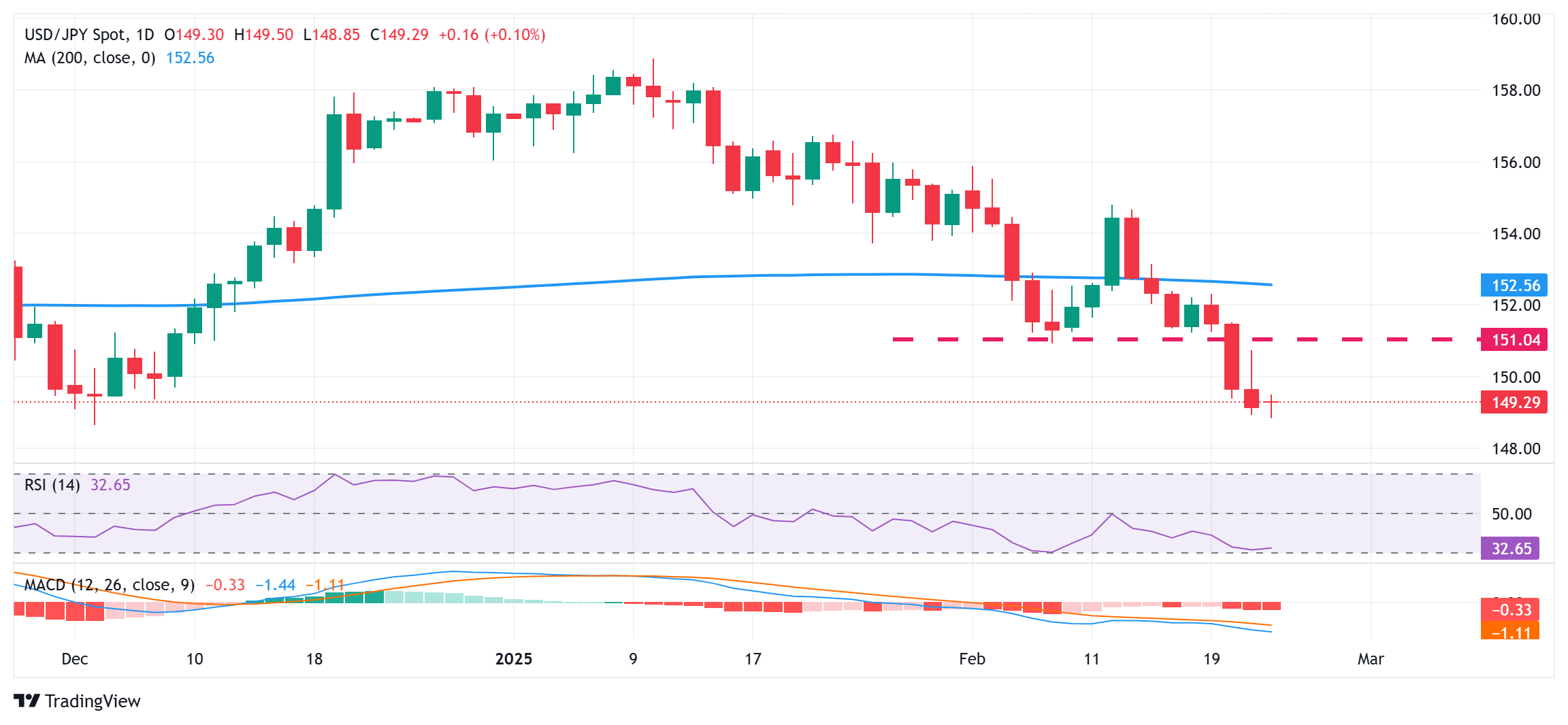
From a technical perspective, any subsequent move up is likely to confront stiff resistance near the 150.00 psychological mark. Some follow-through buying could lift the USD/JPY pair to last Friday's swing high, around the 150.70-150.75 region, en route to the 150.90-151.00 horizontal support breakpoint. The latter should act as a key pivotal point, which if cleared decisively might trigger a short-covering rally and lift spot prices beyond the 151.40 intermediate hurdle, towards the 152.00 mark. The momentum, however, runs the risk of fizzling out rather quickly near the 152.65 area, representing the very important 200-day Simple Moving Average (SMA).
On the flip side, the 149.00 mark, followed by the Asian session low around the 148.85 region, now seems to act as an immediate hurdle ahead of the 148.65 area, or the December 2024 trough. Failure to defend the said support levels would make the USD/JPY pair vulnerable to accelerate the fall further toward the 148.00 round figure. The downward trajectory could extend further towards the next relevant support near the 147.45 region before spot prices eventually drop to the 147.00 mark.
Economic Indicator
Personal Consumption Expenditures - Price Index (YoY)
The Personal Consumption Expenditures (PCE), released by the US Bureau of Economic Analysis on a monthly basis, measures the changes in the prices of goods and services purchased by consumers in the United States (US). The YoY reading compares prices in the reference month to a year earlier. Price changes may cause consumers to switch from buying one good to another and the PCE Deflator can account for such substitutions. This makes it the preferred measure of inflation for the Federal Reserve. Generally, a high reading is bullish for the US Dollar (USD), while a low reading is bearish.
Read more.Next release: Fri Feb 28, 2025 13:30
Frequency: Monthly
Consensus: -
Previous: 2.6%
Source: US Bureau of Economic Analysis
Author
Haresh Menghani
FXStreet
Haresh Menghani is a detail-oriented professional with 10+ years of extensive experience in analysing the global financial markets.

















