Japanese Yen rebounds from multi-month low against USD; upside potential seems limited
- The Japanese Yen attracts some safe-haven flows on Wednesday amid a weaker risk tone.
- Domestic political uncertainty and reduced BoJ rate cut bets might cap gains for the JPY.
- Expectations that the Fed will keep rates elevated should support the USD and USD/JPY.

The Japanese Yen (JPY) recovers a few pips from the lowest level since early April touched against its American counterpart earlier this Wednesday, though any further move up seems elusive. Against the backdrop of trade-related uncertainties, diminishing odds for an immediate rate cut by the Federal Reserve (Fed) weigh on investors' sentiment. This, in turn, drives some safe-haven flows towards the JPY, which, along with a modest US Dollar (USD) downtick, fails to assist the USD/JPY pair to build on its intraday strength beyond the 149.00 mark.
Meanwhile, investors now seem convinced that the Bank of Japan (BoJ) will forgo raising interest rates this year amid concerns about the economic fallout from higher US tariffs. Moreover, domestic political uncertainty ahead of the House of Councillors election on July 20 might hold back the JPY bulls from placing aggressive bets. Furthermore, expectations that the Fed would delay cutting interest rates on the back of a slight pickup in US inflation favor the USD bulls and support prospects for the emergence of some dip-buying around the USD/JPY pair.
Japanese Yen bulls turn cautious amid reviving safe-haven demand
- Recent polls indicate that Japan’s ruling coalition – the ruling coalition of the Liberal Democratic Party (LDP) and Komeito – might lose its majority in the Upper House election scheduled for July 20. This could heighten both fiscal and political risks in Japan and complicate trade negotiations amid the looming US tariffs on Japanese exports.
- US President Donald Trump reignited trade war concerns last week and issued notices to key trading partners, including Japan, outlining individual tariff rates starting August 1. Japan faces a punishing 25% tariff on all exports to America amid stalled US-Japan trade negotiations, particularly over Japan’s protection of its rice market.
- This comes at a time when economic growth in Japan has been slowing. Adding to this, declining real wages and signs of cooling inflationary pressures might further complicate the Bank of Japan's monetary policy normalization schedule, which turns out to be a key factor behind the Japanese Yen's underperformance against the US Dollar.
- Traders pared their bets for a rate cut by the Federal Reserve later this month following the release of the upbeat US June jobs report. Moreover, data released on Tuesday showed that US consumer prices increased by the most in five months, reaffirming market expectations that the Federal Reserve would remain on the sidelines until September.
- The US Bureau of Labor Statistics reported that the headline Consumer Price Index (CPI) rose 0.3% in June and the yearly rate accelerated to 2.7% from 2.4% in May. Meanwhile, the core gauge, which excludes fluctuating food and energy costs, increased by 2.9% from 2.8% prior, lifting US Treasury bond yields to their highest levels in several weeks.
- Boston Fed President Susan Collins noted that it is challenging to set monetary policy right now amid uncertainty, and a solid economy gives the US central bank time to decide its next interest rate move. Tariffs could boost inflation over the second half of 2025 and push core inflation to around 3% by year's end, Boston added further.
- Separately, Dallas Fed President Lorie Logan said the base case is that monetary policy needs to hold tight for a while longer to bring inflation down. Logan added that tariff increases appear likely to create additional inflationary pressure for some time, and an early rate cut by the Fed risks deeper economic scars on a longer road to price stability.
- Traders now look forward to the release of the US Producer Price Index due later during the North American session. Apart from this, comments from influential FOMC members will drive the USD and the USD/JPY pair. The fundamental backdrop, meanwhile, suggests that the path of least resistance for the pair is to the upside.
USD/JPY constructive technical setup backs the case for dip-buying
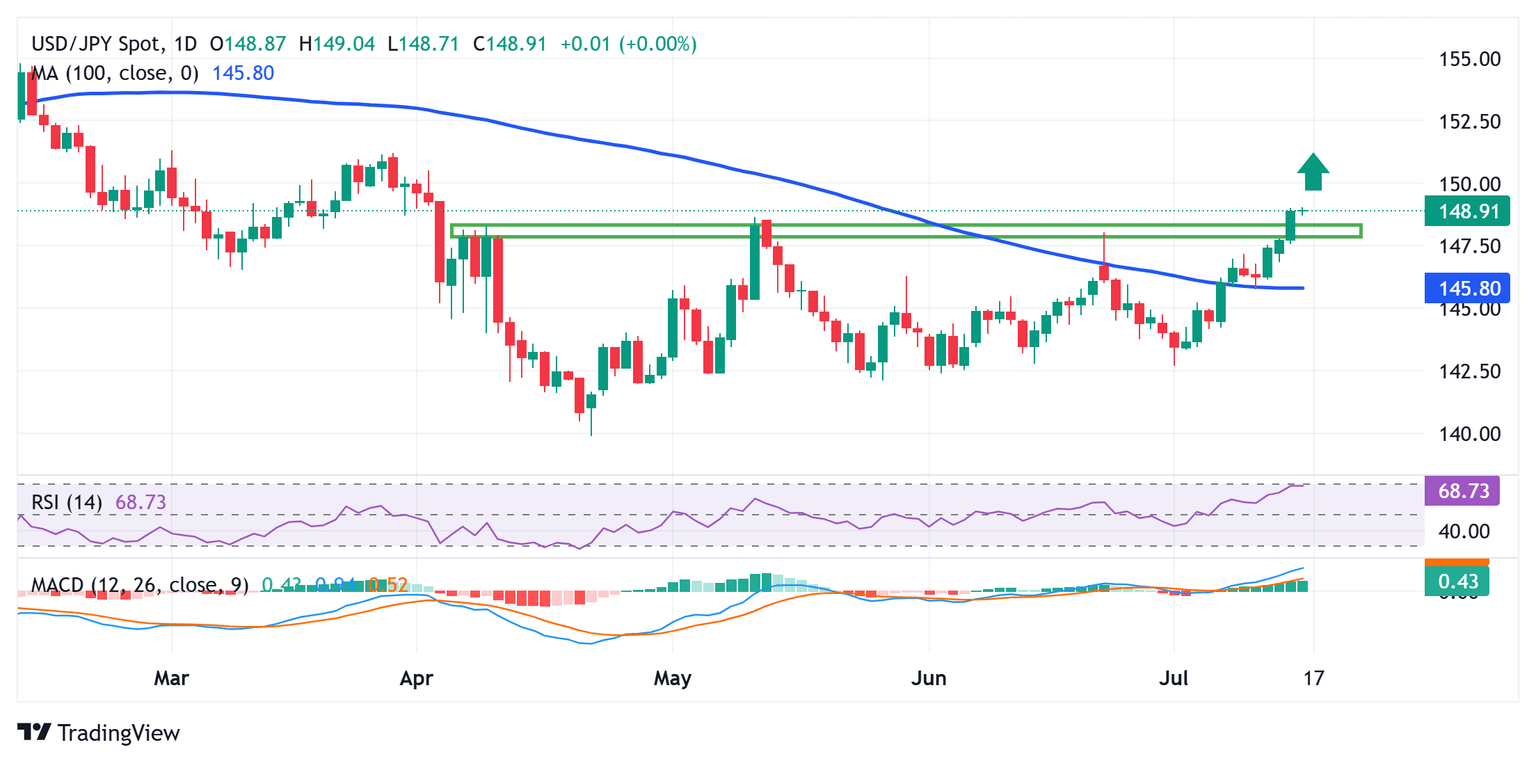
From a technical perspective, the overnight breakout through the 148.00 mark (June peak) and a subsequent move beyond the May swing high, around the 148.65 area, could be seen as a fresh trigger for the USD/JPY bulls. That said, the Relative Strength Index (RSI) has moved closer to the 70 mark on the daily chart. Hence, it will be prudent to wait for some near-term consolidation or a modest pullback before positioning for any further appreciating move.
In the meantime, corrective slide now seems to find some support near the 148.65 region, below which the USD/JPY pair could slide to the 148.00 round figure. Any further decline could be seen as a buying opportunity and remain cushioned near the 147.60-147.55 horizontal zone. The latter should act as a key pivotal point, which, if broken, might prompt some technical selling and drag spot prices to the 147.00 mark en route to the 146.30-146.25 support.
On the flip side, a sustained strength and acceptance above the 149.00 round figure could lift the USD/JPY pair to the next relevant hurdle near the 149.35-149.40 region. The momentum could extend further, though it is more likely to face stiff resistance near the 150.00 psychological mark.
Tariffs FAQs
Tariffs are customs duties levied on certain merchandise imports or a category of products. Tariffs are designed to help local producers and manufacturers be more competitive in the market by providing a price advantage over similar goods that can be imported. Tariffs are widely used as tools of protectionism, along with trade barriers and import quotas.
Although tariffs and taxes both generate government revenue to fund public goods and services, they have several distinctions. Tariffs are prepaid at the port of entry, while taxes are paid at the time of purchase. Taxes are imposed on individual taxpayers and businesses, while tariffs are paid by importers.
There are two schools of thought among economists regarding the usage of tariffs. While some argue that tariffs are necessary to protect domestic industries and address trade imbalances, others see them as a harmful tool that could potentially drive prices higher over the long term and lead to a damaging trade war by encouraging tit-for-tat tariffs.
During the run-up to the presidential election in November 2024, Donald Trump made it clear that he intends to use tariffs to support the US economy and American producers. In 2024, Mexico, China and Canada accounted for 42% of total US imports. In this period, Mexico stood out as the top exporter with $466.6 billion, according to the US Census Bureau. Hence, Trump wants to focus on these three nations when imposing tariffs. He also plans to use the revenue generated through tariffs to lower personal income taxes.
Author
Haresh Menghani
FXStreet
Haresh Menghani is a detail-oriented professional with 10+ years of extensive experience in analysing the global financial markets.