Japanese Yen bears have the upper hand amid BoJ rate hike ambiguity
- The Japanese Yen struggles to lure buyers and languishes around a multi-month trough.
- The BoJ’s dovish stance and a positive risk tone seem to undermine the safe-haven JPY.
- The Fed’s hawkish view supports to USD/JPY, though intervention fears cap the upside.

The Japanese Yen (JPY) oscillates in a range against its American counterpart through the early European session on Tuesday and remains close to a multi-month low touched last week. Investors seem sceptical about the Bank of Japan's (BoJ) plan to hike interest rates further. Furthermore, the Federal Reserve's (Fed) hawkish shift dampens hopes for a narrowing in the US-Japan rate differential and continues to undermine the lower-yielding JPY.
Apart from this, a generally positive risk tone turns out to be another factor acting as a headwind for the safe-haven JPY. That said, the recent strong inflation data from Japan keeps the door open for a potential BoJ rate hike in January or March. Apart from this, geopolitical risks, trade war fears and speculations that Japanese authorities might intervene to prop up the domestic currency hold back the JPY bears from placing aggressive bets.
Japanese Yen bulls seem unimpressed by intervention warning amid BoJ rate-hike uncertainty
- The Bank of Japan October meeting Minutes released this Tuesday reiterated the possibility of gradual rate hikes if inflation trends align with expectations, with a potential path to 1.0% by late fiscal 2025.
- The BoJ Minutes also emphasized a cautious approach to monetary policy, wage-driven economic growth amid domestic and global uncertainties and fiscal measures to counter deflationary pressures.
- BoJ Governor Kazuo Ueda said last week that the central bank preferred to await data on whether wages would retain their upward momentum next year and to gain clarity on Trump's economic policies.
- Investors now seem convinced that the BoJ will not hike interest rates at its next monetary policy meeting in January and wait until March, which, in turn, continues to undermine the Japanese Yen on Tuesday.
- Japan Finance Minister Katsunobu Kato raised concerns about recent FX moves and reiterated this Tuesday that the government will take appropriate action against excessive JPY selling.
- As the market continues to adjust to the Federal Reserve's (Fed) less dovish outlook for 2025, the yield on the benchmark 10-year US government bond shot to its highest level since May the previous day.
- The US Dollar remains close to a two-year peak and seems unaffected by a slight disappointment from the Conference Board's US Consumer Confidence index, which fell to 104.7 from 111.7 previously.
- Investors now look to the release of the Richmond Manufacturing Index from the US for some impetus amid relatively thin trading volumes on Christmas Eve.
USD/JPY technical setup favors bulls and supports prospects for extension of the recent move up
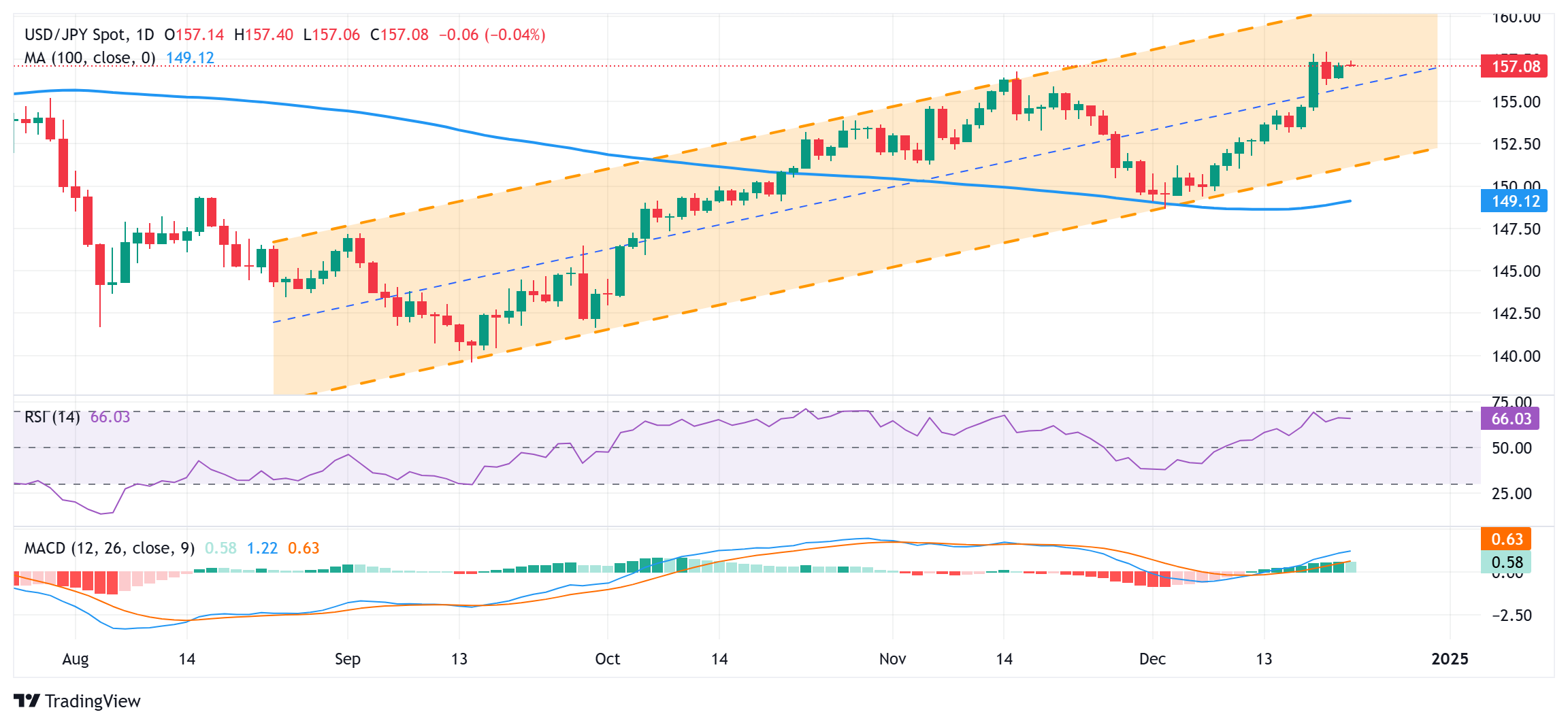
From a technical perspective, the multi-month top, around the 158.00 neighborhood touched last Friday, could act as an immediate hurdle. A sustained strength beyond the said handle will be seen as a fresh trigger for bulls and lift the USD/JPY pair to the 158.45 intermediate resistance en route to the 159.00 mark amid positive oscillators on the daily chart.
On the flip side, weakness below the 157.00 round figure now seems to find decent support near the 156.65 horizontal zone, below which the USD/JPY pair could slide to the 156.00 mark. Any further decline could be seen as a buying opportunity near the 155.50 region and seems limited near the 155.00 psychological mark. The latter should act as a strong base for spot prices.
Fed FAQs
Monetary policy in the US is shaped by the Federal Reserve (Fed). The Fed has two mandates: to achieve price stability and foster full employment. Its primary tool to achieve these goals is by adjusting interest rates. When prices are rising too quickly and inflation is above the Fed’s 2% target, it raises interest rates, increasing borrowing costs throughout the economy. This results in a stronger US Dollar (USD) as it makes the US a more attractive place for international investors to park their money. When inflation falls below 2% or the Unemployment Rate is too high, the Fed may lower interest rates to encourage borrowing, which weighs on the Greenback.
The Federal Reserve (Fed) holds eight policy meetings a year, where the Federal Open Market Committee (FOMC) assesses economic conditions and makes monetary policy decisions. The FOMC is attended by twelve Fed officials – the seven members of the Board of Governors, the president of the Federal Reserve Bank of New York, and four of the remaining eleven regional Reserve Bank presidents, who serve one-year terms on a rotating basis.
In extreme situations, the Federal Reserve may resort to a policy named Quantitative Easing (QE). QE is the process by which the Fed substantially increases the flow of credit in a stuck financial system. It is a non-standard policy measure used during crises or when inflation is extremely low. It was the Fed’s weapon of choice during the Great Financial Crisis in 2008. It involves the Fed printing more Dollars and using them to buy high grade bonds from financial institutions. QE usually weakens the US Dollar.
Quantitative tightening (QT) is the reverse process of QE, whereby the Federal Reserve stops buying bonds from financial institutions and does not reinvest the principal from the bonds it holds maturing, to purchase new bonds. It is usually positive for the value of the US Dollar.
Author

Haresh Menghani
FXStreet
Haresh Menghani is a detail-oriented professional with 10+ years of extensive experience in analysing the global financial markets.

















