Japanese Yen trades with mild negative bias against USD; bullish potential seems intact
- The Japanese Yen ticks lower amid receding safe-haven demand, though the downside seems limited.
- The BoJ’s hawkish outlook marks a ig divergence in comparison to Fed rate cut bets and supports the JPY.
- The lack of any meaningful USD buying might further contribute to keeping a lid on the USD/JPY pair.

The Japanese Yen (JPY) remains on the defensive against its American counterpart heading into the European session, though the downside remains cushioned amid hawkish Bank of Japan (BoJ) expectations. Investors seem convinced that the BoJ will stick to its policy normalization path and hike interest rates in October. This marks a significant divergence in comparison to bets that the US Federal Reserve (Fed) will lower borrowing costs two more times by the end of this year. The resultant narrowing of the US-Japan rate differential continues to act as a tailwind for the lower-yielding JPY.
Meanwhile, the global financial markets seem unfazed by the US government shutdown amid expectations of a limited impact on the economic performance. This remains supportive of a generally positive risk tone, which, in turn, is seen undermining the JPY's safe-haven status. The US Dollar (USD), on the other hand, struggles to capitalize on the overnight bounce from a one-week low amid rising Fed rate cut bets. This further contributes to capping the USD/JPY pair, warranting some caution before confirming that the recent pullback from a nearly two-month high has run its course.
Japanese Yen bulls remain on the sidelines amid positive risk tone; not ready to give up yet
- US government agencies began shutting down after President Donald Trump's Republican Party failed to agree with opposition Democrats on a way forward on a spending bill. Investors, however, seem relatively unfazed, as shutdowns have historically had a limited impact on the economic performance.
- Wall Street's three major indices registered gains for the fourth consecutive day, and the spillover effect is evident from a generally positive tone across the Asian equity markets. This turns out to be a key factor undermining the safe-haven Japanese Yen during the Asian session on Thursday.
- The main event risk from Japan this week will be the Liberal Democratic Party leadership election on Saturday, 4th October. The new Prime Minister will influence the trajectory of Japan's fiscal policy, which could further determine the Bank of Japan's policy stance and drive the JPY in the near term.
- Meanwhile, the Summary of Opinions from the September BoJ meeting, released on Tuesday, revealed that board members debated the feasibility of raising interest rates. Moreover, traders are pricing in the possibility of a 25-basis-point BoJ rate hike later this month, which should limit JPY losses.
- In contrast, the CME Group's FedWatch Tool indicates that traders have fully priced in a rate cut by the Federal Reserve in October and see around a 90% probability of another rate reduction in December. The bets were lifted by the disappointing US private-sector employment details.
- Automatic Data Processing reported on Wednesday that private companies shed 32,000 jobs in September, marking the biggest drop since March 2023. Moreover, the August payrolls number was also revised to show a loss of 3,000 compared to an increase of 54,000 reported initially.
- Separately, the Institute for Supply Management's (ISM) Purchasing Managers' Index (PMI) came in slightly above consensus estimates and improved from 48.7 to 49.1 in September. This, however, still pointed to a contraction in the manufacturing business activity for the seventh straight month.
- The immediate effect of a partial US government shutdown is likely to be a delay in key US macro releases, including the usual Weekly Initial Jobless Claims on Thursday and the US Nonfarm Payrolls (NFP) report on Friday. This leaves the US Dollar at the mercy of speeches from FOMC members.
USD/JPY technical setup backs the case for the emergence of fresh sellers at higher levels
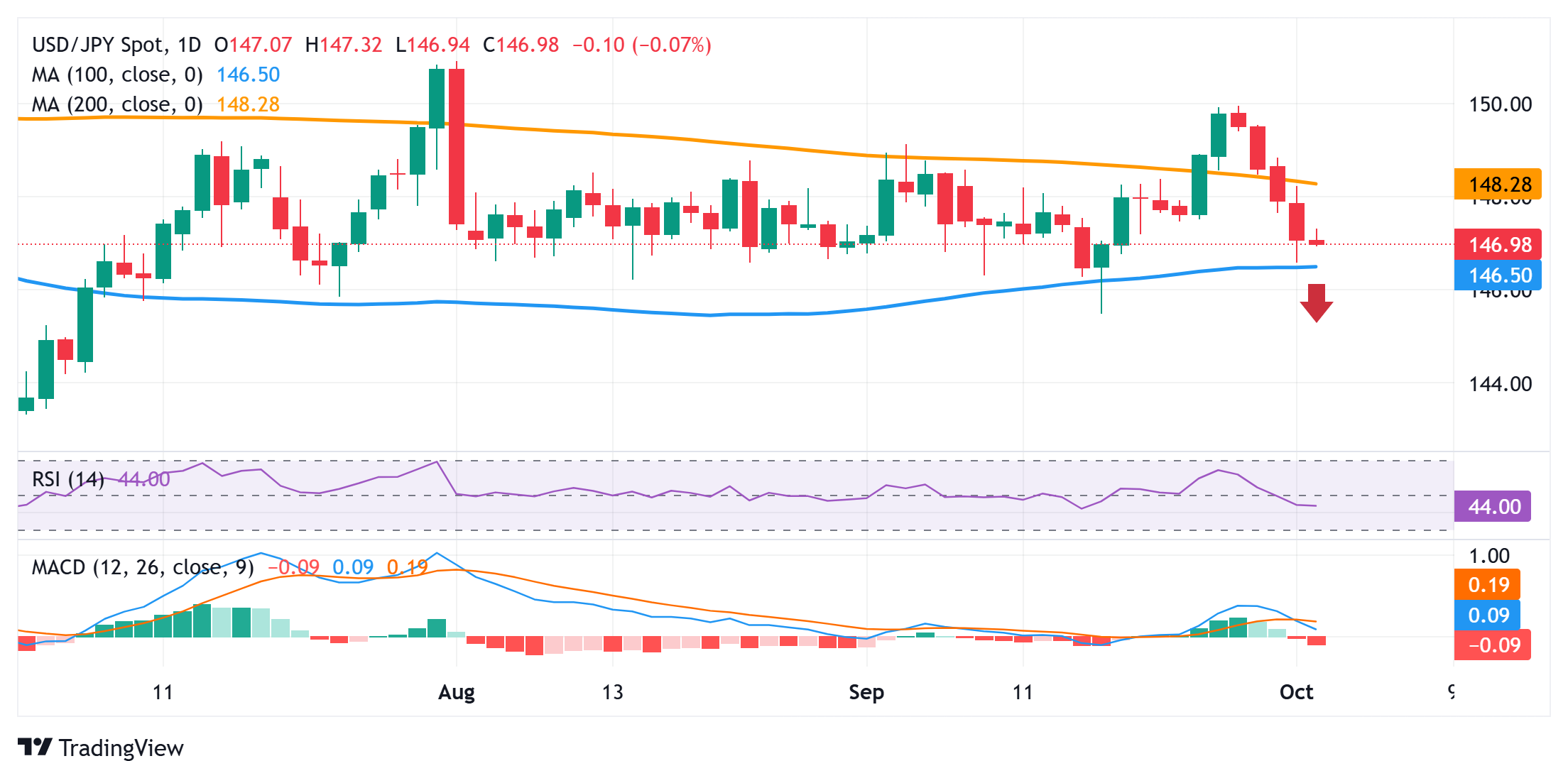
From a technical perspective, the overnight breakdown below the 147.00 mark could be seen as a key trigger for the USD/JPY bears. Moreover, oscillators on the daily chart have again started gaining negative traction, suggesting that the path of least resistance for spot prices remains to the downside. However, it will still be prudent to wait for some follow-through selling below the 100-day Simple Moving Average (SMA), currently pegged near mid-146.00s, before positioning for further losses. Spot prices might then slide to the 146.00 mark, below which the downward trajectory could extend towards the September swing low, around the 145.50-145.45 region, en route to the 145.00 psychological mark.
On the flip side, the Asian session swing high, around the 147.30 area, now seems to act as an immediate hurdle. Any further move up could be seen as a selling opportunity near the 148.00 mark and remain capped near the 200-day SMA, currently pegged near the 148.35 region. A sustained strength beyond the latter, however, might trigger a short-covering move and lift the USD/JPY pair to the 149.00 round figure. The momentum could extend further towards the 149.35-149.40 region before spot prices make a fresh attempt to conquer the 150.00 psychological mark.
Fed FAQs
Monetary policy in the US is shaped by the Federal Reserve (Fed). The Fed has two mandates: to achieve price stability and foster full employment. Its primary tool to achieve these goals is by adjusting interest rates. When prices are rising too quickly and inflation is above the Fed’s 2% target, it raises interest rates, increasing borrowing costs throughout the economy. This results in a stronger US Dollar (USD) as it makes the US a more attractive place for international investors to park their money. When inflation falls below 2% or the Unemployment Rate is too high, the Fed may lower interest rates to encourage borrowing, which weighs on the Greenback.
The Federal Reserve (Fed) holds eight policy meetings a year, where the Federal Open Market Committee (FOMC) assesses economic conditions and makes monetary policy decisions. The FOMC is attended by twelve Fed officials – the seven members of the Board of Governors, the president of the Federal Reserve Bank of New York, and four of the remaining eleven regional Reserve Bank presidents, who serve one-year terms on a rotating basis.
In extreme situations, the Federal Reserve may resort to a policy named Quantitative Easing (QE). QE is the process by which the Fed substantially increases the flow of credit in a stuck financial system. It is a non-standard policy measure used during crises or when inflation is extremely low. It was the Fed’s weapon of choice during the Great Financial Crisis in 2008. It involves the Fed printing more Dollars and using them to buy high grade bonds from financial institutions. QE usually weakens the US Dollar.
Quantitative tightening (QT) is the reverse process of QE, whereby the Federal Reserve stops buying bonds from financial institutions and does not reinvest the principal from the bonds it holds maturing, to purchase new bonds. It is usually positive for the value of the US Dollar.
Author

Haresh Menghani
FXStreet
Haresh Menghani is a detail-oriented professional with 10+ years of extensive experience in analysing the global financial markets.

















