Japanese Yen retests multi-month high against USD; bulls retain control amid rising trade tensions
- The Japanese Yen attracts fresh buying as trade jitters boost safe-haven demand.
- Hopes for a US-Japan trade deal and BoJ rate hike bets further underpin the JPY.
- Dovish Fed expectations continue to undermine the USD and the USD/JPY pair.

The Japanese Yen (JPY) jumps back closer to a multi-month high against its American counterpart heading into the European session on Wednesday and seems poised to appreciate further. Investors remain concerned about the escalating US-China trade war and the potential fallout from US President Donald Trump's trade tariffs, which could hinder global economic growth. This, in turn, continues to boost demand for traditional safe-haven assets, including the JPY, which draws additional support from hopes for a US-Japan trade deal.
Meanwhile, data released earlier this Wednesday showed that Japan’s core machinery orders rebounded sharply in February and surpassed market expectations. This, along with the bets that the Bank of Japan (BoJ) will continue raising interest rates in 2025, turns out to be another factor underpinning the JPY. Moreover, the prospects for a more aggressive easing by the Federal Reserve (Fed), which keeps the US Dollar (USD) depressed, marks a big divergence in comparison to hawkish BoJ expectations and further benefits the lower-yielding JPY.
Japanese Yen seems poised to appreciate further amid a combination of supporting factors
- US President Donald Trump's rapidly shifting stance on trade tariffs continues to fuel uncertainty and support traditional safe-haven assets, including the Japanese Yen. Over the weekend, the Trump administration granted exclusions from steep tariffs on smartphones, computers, and other electronics imported largely from China.
- Adding to this, Trump suggested on Monday that he was looking into possible exemptions for the auto industry from the 25% tariffs already in place. Trump, however, promised more tariffs on other key sectors like semiconductors as soon as next week and threatened that he would impose tariffs on pharmaceuticals in the near future.
- Data released this Wednesday showed that Japan’s Core Machinery Orders rose more than expected, by 4.3% in February, marking the highest level in a year and a strong recovery from January’s 3.5% decline. Additional details of the report revealed that manufacturing Orders rose 3%, while non-manufacturing orders jumped 11.4%.
- This points to improving business sentiment, which should support capital investment and boost employment. Adding to this higher wages may fuel demand-driven inflation. This keeps the door open for another Bank of Japan interest rate hike during the first half of 2025 and turns out to be another factor lending support to the JPY.
- Investors remain optimistic about a positive outcome from US-Japan trade talks. In fact, Trump said last week that tough but fair parameters are being set for a negotiation. Adding to this, US Treasury Secretary Scott Bessent said that Japan may be a priority in tariff negotiations, fueling hopes for a possible US-Japan trade deal.
- Meanwhile, the recent unusual sell-off in the US Treasuries suggests that investors are losing faith in the US economy, which continues to dent the appeal for the US Dollar. Moreover, traders have been pricing in the possibility that the Federal Reserve will resume cutting rates in June and reduce its policy rate by 100 basis points this year.
- Hence, Fed Chair Jerome Powell's speech later this Wednesday will be scrutinized closely for cues about the future rate-cut path and determining the near-term USD trajectory. In the meantime, the US Retail Sales should allow traders to grab short-term opportunities around the USD/JPY pair later during the North American session.
USD/JPY could accelerate the downward trajectory once the 142.00 pivotal support is broken
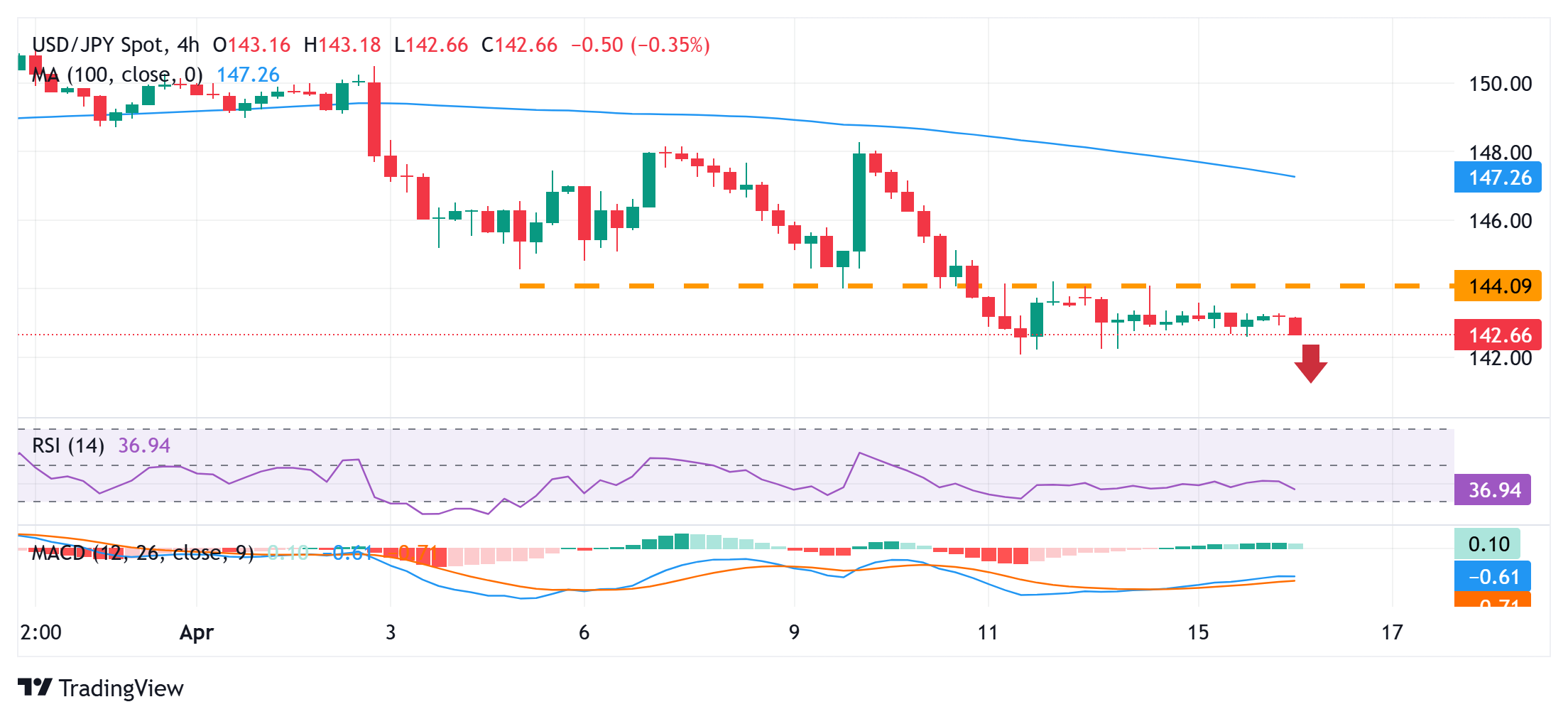
From a technical perspective, the USD/JPY pair's inability to attract any meaningful buyers suggests that a multi-month-old downtrend is still far from being over. Moreover, oscillators on the daily chart are holding deep in negative territory, which further suggests that the path of least resistance for spot prices remains to the downside. In the meantime, any further decline is likely to find some support near the 142.25-142.20 region, or the weekly trough, ahead of the 142.00 mark, or the multi-month low touched last Friday. A convincing break below the latter will reaffirm the negative bias and pave the way for a further near-term depreciating move for the currency pair.
On the flip side, attempted recovery back above the 143.00 mark might now confront stiff resistance near the overnight swing high, around the 143.60 region. Any further move up could be seen as a selling opportunity and remain capped near the 144.00 round figure. The latter should act as a key pivotal point, which if cleared decisively might trigger a short-covering rally and lift the USD/JPY pair to the 144.45-144.50 horizontal barrier en route to the 145.00 psychological mark. The momentum could extend further towards the 145.50 zone and the 146.00 round figure.
US Dollar PRICE Today
The table below shows the percentage change of US Dollar (USD) against listed major currencies today. US Dollar was the strongest against the Canadian Dollar.
| USD | EUR | GBP | JPY | CAD | AUD | NZD | CHF | |
|---|---|---|---|---|---|---|---|---|
| USD | -0.76% | -0.25% | -0.58% | -0.20% | -0.36% | -0.34% | -1.10% | |
| EUR | 0.76% | 0.53% | 0.18% | 0.55% | 0.62% | 0.43% | -0.34% | |
| GBP | 0.25% | -0.53% | -0.36% | 0.03% | 0.11% | -0.10% | -0.82% | |
| JPY | 0.58% | -0.18% | 0.36% | 0.41% | 0.54% | 0.31% | -0.54% | |
| CAD | 0.20% | -0.55% | -0.03% | -0.41% | 0.11% | -0.11% | -0.83% | |
| AUD | 0.36% | -0.62% | -0.11% | -0.54% | -0.11% | -0.23% | -0.94% | |
| NZD | 0.34% | -0.43% | 0.10% | -0.31% | 0.11% | 0.23% | -0.72% | |
| CHF | 1.10% | 0.34% | 0.82% | 0.54% | 0.83% | 0.94% | 0.72% |
The heat map shows percentage changes of major currencies against each other. The base currency is picked from the left column, while the quote currency is picked from the top row. For example, if you pick the US Dollar from the left column and move along the horizontal line to the Japanese Yen, the percentage change displayed in the box will represent USD (base)/JPY (quote).
Author

Haresh Menghani
FXStreet
Haresh Menghani is a detail-oriented professional with 10+ years of extensive experience in analysing the global financial markets.