Japanese Yen rebounds from 38-year highs amid intervention threat
- The USD/JPY retreats from a 38-year high of 161.95.
- Rabobank FX strategists suggest that FX intervention could be imminent due to the weakness of the Japanese Yen.
- The US Dollar struggles as lackluster economic data raise expectations of Fed rate cuts in 2024.

The Japanese Yen (JPY) appreciates against the US Dollar (USD) on Thursday. The USD/JPY pair retreated from its peak at 161.95, a level not seen since 1986. Traders remain watchful for significant movements in the JPY and potential intervention by Japanese authorities to prevent excessive depreciation.
Rabobank FX strategists pointed out on Wednesday that yield differentials appear crucial to the USD/JPY outlook. They suggested that FX intervention could be imminent due to the weakness of the Japanese Yen, which is exerting downward pressure on consumer confidence.
The Nikkei 225 Index increases to near 40,700 on Thursday, following gains on Wall Street overnight. The weaker Yen also bolstered equities by enhancing the profit outlook for Japan's export-driven industries.
The US Dollar (USD) faced challenges amid declining US Treasury yields, fueled by lackluster economic data that reinforced expectations of Federal Reserve (Fed) interest rate cuts in 2024. US markets will be closed on Thursday in observance of the Independence Day holiday.
Daily Digest Market Movers: Japanese Yen improves as rising odds of Fed rate cuts
- OCBC strategists Frances Cheung and Christopher Wong observe that the persistent strength of USD/JPY is raising intervention expectations. However, there is speculation that authorities may monitor to what extent they allow for further depreciation before intervening.
- US ISM Services PMI fell sharply to 48.8 in June, marking the steepest decline since April 2020. This figure was well below market expectations of 52.5, following a reading of 53.8 in May.
- The ADP Employment report showed that US private businesses added 150,000 workers to their payrolls in June, the lowest increase in five months. This figure fell short of the expected 160,000 and was below the downwardly revised 157,000 in May.
- Federal Reserve Bank of Chicago President Austan Goolsbee stated on BBC Radio on Wednesday that bringing inflation back to 2% will take time and that more economic data are needed. However, on Tuesday, Fed Chair Jerome Powell said that the central bank is getting back on the disinflationary path, per Reuters.
- The Minutes from the Federal Reserve's June 11-12 monetary policy meeting, released on Wednesday, suggested that Fed officials were in a wait-and-see mode. "Some participants emphasized the Committee’s data-dependent approach, with monetary policy decisions being conditional on the evolution of the economy rather than being on a preset path."
- Reuters, citing two government sources on Wednesday, reported that the Japan Ministry of Finance may introduce a new type of floating-rate bond to help investors mitigate the risks from rising bond yields. This move comes as Japanese officials prepare for more rate hikes by the Bank of Japan.
- The Federal Reserve (Fed) Chair Jerome Powell turned slightly dovish on Tuesday. Powell said that the Fed is getting back on the disinflationary path. However, Powell wants to see further evidence before cutting interest rates as the US economy and the labor market remain strong, per Reuters.
Technical Analysis: USD/JPY hovers around 161.50
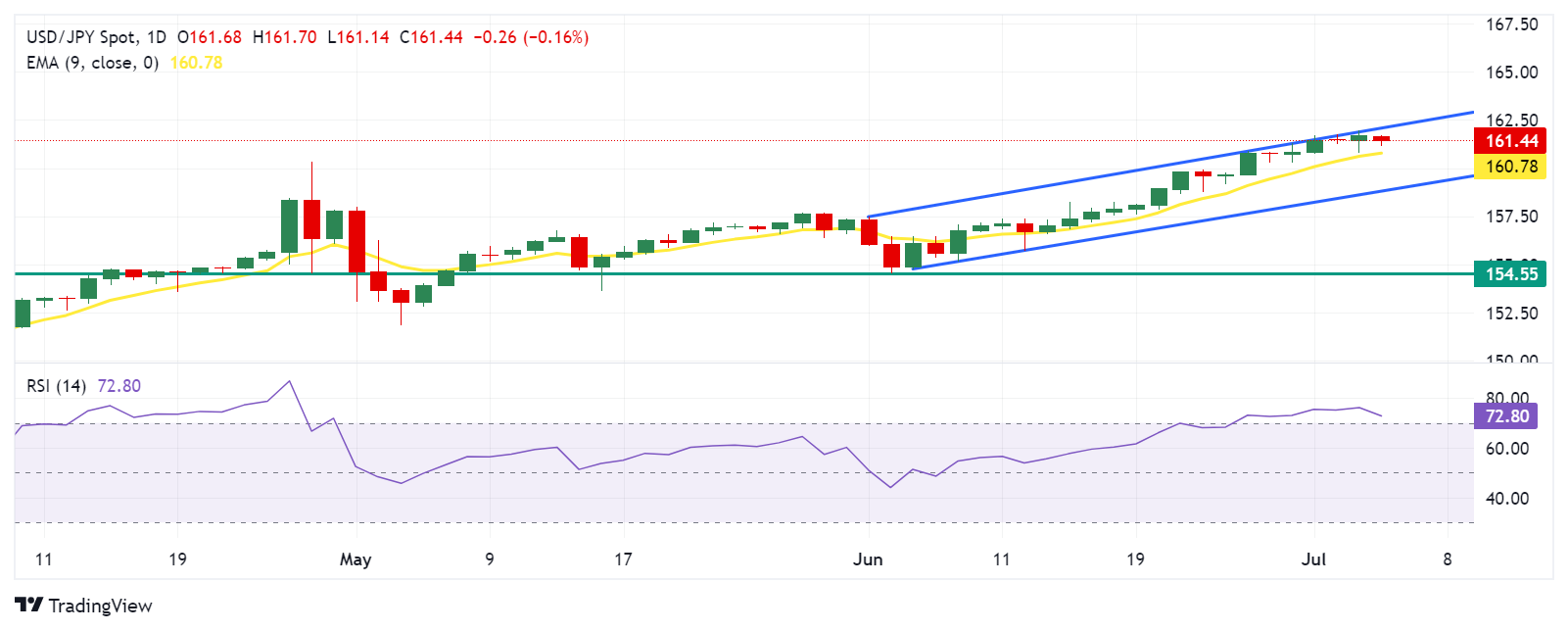
USD/JPY trades around 161.40 on Thursday, showing a bullish bias according to daily chart analysis. The pair holds near the upper boundary of an ascending channel pattern. However, caution is advised as the 14-day Relative Strength Index (RSI) is above 70, indicating overbought conditions and suggesting a possible correction.
In the near term, USD/JPY may test resistance near 162.10, the upper boundary of the ascending channel. A breakout above this level could strengthen bullish sentiment, potentially pushing the pair toward psychological resistance at 162.50.
On the downside, immediate support is observed around the nine-day Exponential Moving Average (EMA) at 160.68. A break below this level could weaken the bullish outlook, potentially guiding USD/JPY toward the lower boundary of the ascending channel near 158.80. A further decline below this channel support could see the pair navigating the area around June's low at 154.55.
USD/JPY: Daily Chart
Japanese Yen PRICE Today
The table below shows the percentage change of Japanese Yen (JPY) against listed major currencies today. Japanese Yen was the strongest against the US Dollar.
| USD | EUR | GBP | JPY | CAD | AUD | NZD | CHF | |
|---|---|---|---|---|---|---|---|---|
| USD | -0.06% | -0.11% | -0.29% | -0.12% | -0.24% | -0.20% | -0.03% | |
| EUR | 0.06% | -0.05% | -0.23% | -0.06% | -0.16% | -0.16% | 0.07% | |
| GBP | 0.11% | 0.05% | -0.19% | -0.00% | -0.12% | -0.12% | 0.10% | |
| JPY | 0.29% | 0.23% | 0.19% | 0.16% | 0.03% | 0.05% | 0.27% | |
| CAD | 0.12% | 0.06% | 0.00% | -0.16% | -0.12% | -0.09% | 0.10% | |
| AUD | 0.24% | 0.16% | 0.12% | -0.03% | 0.12% | 0.04% | 0.24% | |
| NZD | 0.20% | 0.16% | 0.12% | -0.05% | 0.09% | -0.04% | 0.20% | |
| CHF | 0.03% | -0.07% | -0.10% | -0.27% | -0.10% | -0.24% | -0.20% |
The heat map shows percentage changes of major currencies against each other. The base currency is picked from the left column, while the quote currency is picked from the top row. For example, if you pick the Japanese Yen from the left column and move along the horizontal line to the US Dollar, the percentage change displayed in the box will represent JPY (base)/USD (quote).
Japanese Yen FAQs
The Japanese Yen (JPY) is one of the world’s most traded currencies. Its value is broadly determined by the performance of the Japanese economy, but more specifically by the Bank of Japan’s policy, the differential between Japanese and US bond yields, or risk sentiment among traders, among other factors.
One of the Bank of Japan’s mandates is currency control, so its moves are key for the Yen. The BoJ has directly intervened in currency markets sometimes, generally to lower the value of the Yen, although it refrains from doing it often due to political concerns of its main trading partners. The current BoJ ultra-loose monetary policy, based on massive stimulus to the economy, has caused the Yen to depreciate against its main currency peers. This process has exacerbated more recently due to an increasing policy divergence between the Bank of Japan and other main central banks, which have opted to increase interest rates sharply to fight decades-high levels of inflation.
The BoJ’s stance of sticking to ultra-loose monetary policy has led to a widening policy divergence with other central banks, particularly with the US Federal Reserve. This supports a widening of the differential between the 10-year US and Japanese bonds, which favors the US Dollar against the Japanese Yen.
The Japanese Yen is often seen as a safe-haven investment. This means that in times of market stress, investors are more likely to put their money in the Japanese currency due to its supposed reliability and stability. Turbulent times are likely to strengthen the Yen’s value against other currencies seen as more risky to invest in.
Author

Akhtar Faruqui
FXStreet
Akhtar Faruqui is a Forex Analyst based in New Delhi, India. With a keen eye for market trends and a passion for dissecting complex financial dynamics, he is dedicated to delivering accurate and insightful Forex news and analysis.

















