Japanese Yen seems poised to appreciate further against weaker USD amid trade woes
- The Japanese Yen continues to attract safe-haven flows amid trade-related uncertainties.
- The divergent BoJ-Fed policy expectations also contribute to the USD/JPY pair’s decline.
- Slightly overstretched conditions on the daily chart warrant some caution for the JPY bulls.

The Japanese Yen (JPY) retains its bullish bias against a broadly weaker US Dollar (USD) heading into the European session and trades near a multi-month high touched earlier this Monday. Worries that an all-out trade war would trigger a global recession continue to weigh on investors' sentiment and drive flows toward the traditional safe-haven JPY. Apart from this, the optimism over US-Japan trade talks turns out to be another factor underpinning the JPY.
Meanwhile, data released on Friday showed that Japan's core inflation accelerated in March and left the door open for more interest rate hikes by the Bank of Japan (BoJ). This marks a big divergence in comparison to bets that the Federal Reserve (Fed) will resume its rate-cutting cycle soon, which drags the USD to its lowest level since April 2022 and further benefits the lower-yielding JPY. However, slightly overstretched conditions warrant some caution for the JPY bulls.
Japanese Yen is supported by US tariff jitters, US-Japan trade deal hopes and BoJ rate hike bets
- Concerns about US President Donald Trump’s back-and-forth tariff announcements continue to weigh on investors' sentiment and underpin demand for traditional safe-haven assets, including the Japanese Yen.
- The new US ambassador to Japan said on Friday that he is optimistic about a deal in the ongoing US-Japan tariff negotiations. Moreover, Japan's Prime Minister Shigeru Ishiba said on Sunday that he wants to make the ongoing Japan-US tariff talks a model for negotiations between the US and other countries.
- Ishiba added that Japan seeks fairness in currency talks with the US and suggested flexibility on US accusations of non-tariff barriers to the Japanese automobile market. This continues to fuel hopes that Japan might strike a trade deal with the US and turns out to be another factor driving flows toward the JPY.
- Bank of Japan Governor Kazuo Ueda last week signaled the potential to pause the rate-hiking cycle and said that the central bank may need to take policy action if US tariffs hurt the Japanese economy. Moreover, reports suggest that the BoJ will cut its growth forecasts amid heightened risks to the fragile economic recovery.
- However, BoJ Governor Kazuo Ueda said that Japan's real interest rates remain very low and that the central bank is expected to keep raising interest rates if the economy and prices move in line with projections. The view was further echoed by BoJ board member Junko Nagakawa.
- Adding to this, government data released on Friday showed that Japan's core Consumer Price Index (CPI), which excludes fresh food prices, accelerated to the 3.2% YoY rate in March from a 3% gain in the previous month. Furthermore, core-core inflation, which excludes both fresh food and energy, rose 2.9% vs 2.6% in February.
- This points to broadening inflation in Japan and leaves the door open for more rate hikes by the BoJ. In contrast, traders largely shrugged off Federal Reserve Chair Jerome Powell's relatively hawkish comments last Wednesday and seem convinced that the US central bank will resume its rate-cutting cycle in June.
- Meanwhile, the recent sell-off in the US bond market suggests that investors are losing confidence in the US economy. This further contributes to the ongoing US Dollar downfall to its lowest level since April 2022 and drags the USD/JPY pair below the 141.00 mark for the first time since September 2024.
USD/JPY seems vulnerable to slide further below 140.00 and aim to challenge 2024 swing low
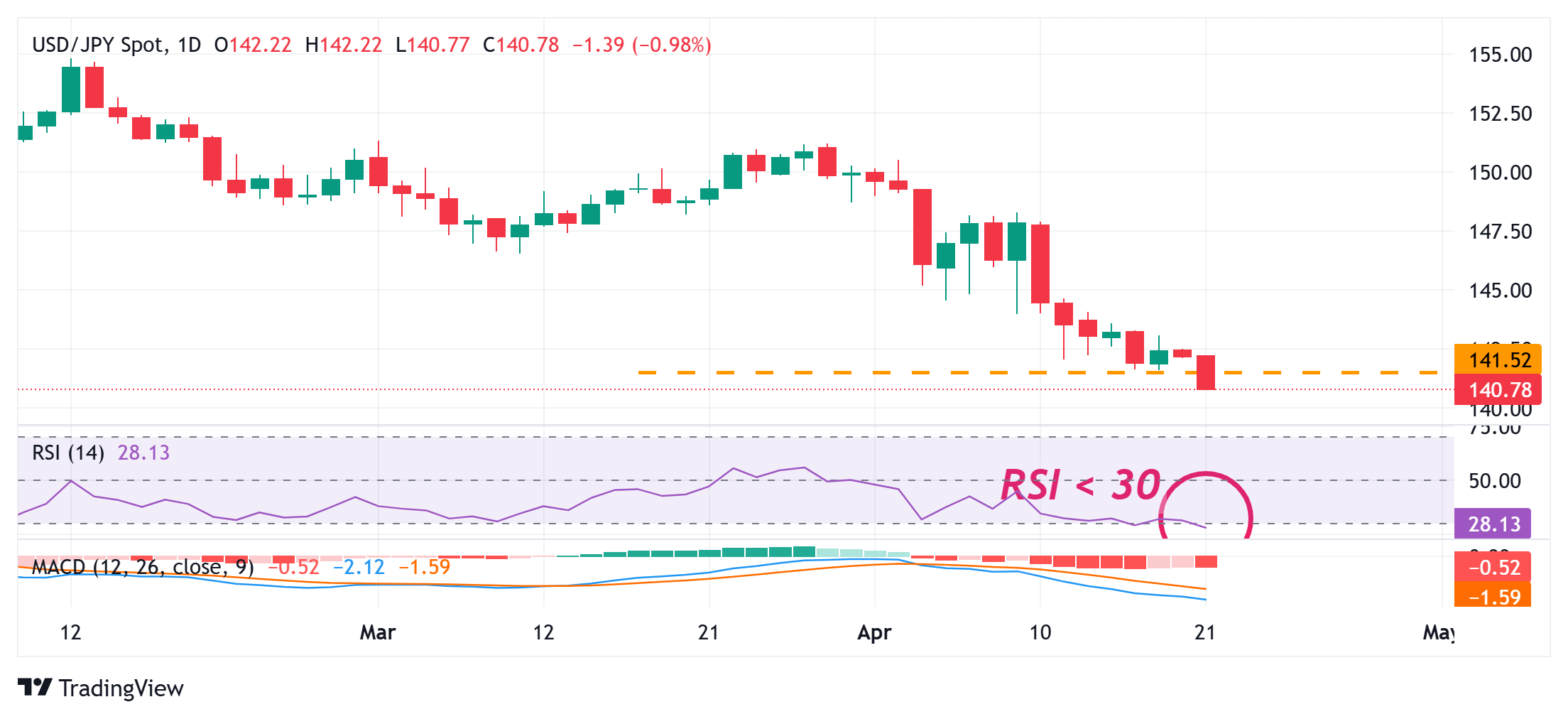
From a technical perspective, the daily Relative Strength Index (RSI) is already flashing slightly oversold conditions and warrants some caution for bearish traders. Hence, it will be prudent to wait for some near-term consolidation or a modest bounce before positioning for an extension of the USD/JPY pair's well-established downtrend witnessed over the past three months or so.
In the meantime, attempted recovery might now confront some resistance near the 141.60-141.65 region. This is followed by the 142.00 round figure and the 142.40-142.45 hurdle, above which a fresh bout of a short-covering move could lift the USD/JPY pair to the 143.00 mark en route to the 143.25-143.30 zone. Any further move up, however, might still be seen as a selling opportunity.
On the flip side, a sustained break and acceptance below the 141.00 mark could be seen as a fresh trigger for bearish traders and makes the USD/JPY pair vulnerable. The subsequent downfall below the 140.45-140.40 intermediate support might expose the 140.00 psychological mark. The downward trajectory could extend to the 2024 yearly swing low, around the 139.60-139.55 region.
Bank of Japan FAQs
The Bank of Japan (BoJ) is the Japanese central bank, which sets monetary policy in the country. Its mandate is to issue banknotes and carry out currency and monetary control to ensure price stability, which means an inflation target of around 2%.
The Bank of Japan embarked in an ultra-loose monetary policy in 2013 in order to stimulate the economy and fuel inflation amid a low-inflationary environment. The bank’s policy is based on Quantitative and Qualitative Easing (QQE), or printing notes to buy assets such as government or corporate bonds to provide liquidity. In 2016, the bank doubled down on its strategy and further loosened policy by first introducing negative interest rates and then directly controlling the yield of its 10-year government bonds. In March 2024, the BoJ lifted interest rates, effectively retreating from the ultra-loose monetary policy stance.
The Bank’s massive stimulus caused the Yen to depreciate against its main currency peers. This process exacerbated in 2022 and 2023 due to an increasing policy divergence between the Bank of Japan and other main central banks, which opted to increase interest rates sharply to fight decades-high levels of inflation. The BoJ’s policy led to a widening differential with other currencies, dragging down the value of the Yen. This trend partly reversed in 2024, when the BoJ decided to abandon its ultra-loose policy stance.
A weaker Yen and the spike in global energy prices led to an increase in Japanese inflation, which exceeded the BoJ’s 2% target. The prospect of rising salaries in the country – a key element fuelling inflation – also contributed to the move.
Author

Haresh Menghani
FXStreet
Haresh Menghani is a detail-oriented professional with 10+ years of extensive experience in analysing the global financial markets.